
Sternwheelers on the Skeena River
by Charles LeRoss
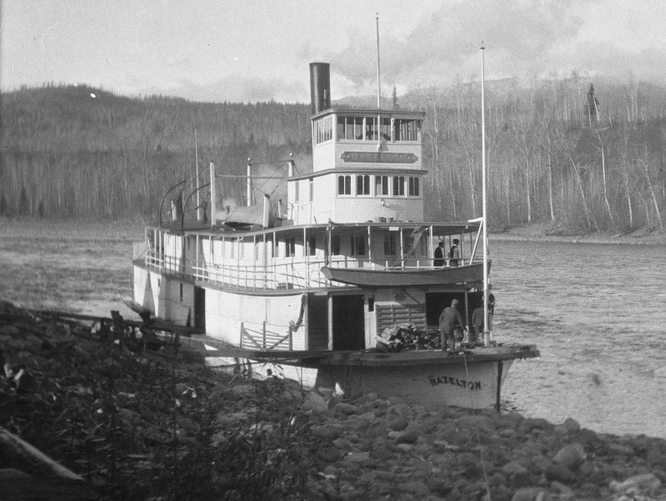
The first sternwheeler up the Skeena River, called the Union was in 1864 when Captain Coffin was engaged by the Collins Overland Telegraph Company to determine if supplies for the new telegraph line to Siberia could be moved by sternwheeler rather than canoe. The Union was not suited to the swift water of the Skeena River and could only make it up as far as the Little Canyon (Terrace). Captain Coffin recommended the construction of a more suitable boat for the Skeena and sent his specifications to the company in New York. His recommendations were ignored and a ship called the Mumford was constructed which again proved inadequate for the Skeena. In 1866 when construction of the line began, the Mumford, he was only able to move supplies as far as the Little Canyon and from there had to be moved by canoe up to Hazelton where the line was being built.
In 1890, the Hudson’s Bay Company who had a trading post at Hazelton, was trying to deal with the increasing amount of freight and traffic traveling up the Skeena and realized the accepted mode of transport by canoe was no longer feasible. They built a sternwheeler called the Caledonia with the intention of using her to move merchandise up the river and to bring furs down the river to market. Knowing about the difficulties with the Mumford, the Company wanted to ensure the engines were powerful enough for the Skeena. The Caledonia and its successor the Caledonia II went on to work the river until August 1901 when it was replaced by the Hazelton.
CHARACTERISTICS OF A STERNWHEELER
What are the characteristics of a sternwheeler that make it suitable for river travel?
First off, the shallow draft (flat bottom) of the ship allows it to travel in as little as a foot of water. The sternwheel gives it powerfull propulsion.
Second, with the use of a technique called grasshoppering, the ship can lower a spar into the water and by use of the capstan lift the bow of the ship and free it from a sand bar or other obstruction, allowing water to flow under the bow.
Third, the sternwheel was easy to repair being built of wood; it could be easily balanced, it was behind the boat out of the way of snags and floating logs.
Fourth, it could travel forward or backward with little difficulty, it made the boat easy to control as the rudders were in the water flow, and with the addition of monkey rudders, the boat had that much more maneuverability.
Fifth, if grounded on a sandbar, it could sometimes free itself by reversing the paddlewheel to churn water beneath the hull, loosening the sand and helping the boat back off.
In northern areas where heavy ice was formed, the sternwheeler would be taken out of the water and placed on ways during the winter months. In the spring the boat would be caulked before being placed back in the water.
All of the vessels on the Skeena River were sternwheelers, as opposed to sidewheelers (that had there propulsion wheels on the sides of the vessel).
STERNWHEELER LAYOUT
Following is a layout showing the basic parts of a Skeena sternwheeler, courtesy Cliff Armstrong, author of the book Sternwheelers on the Skeena published by the Skeena River Heritage Trust Society.
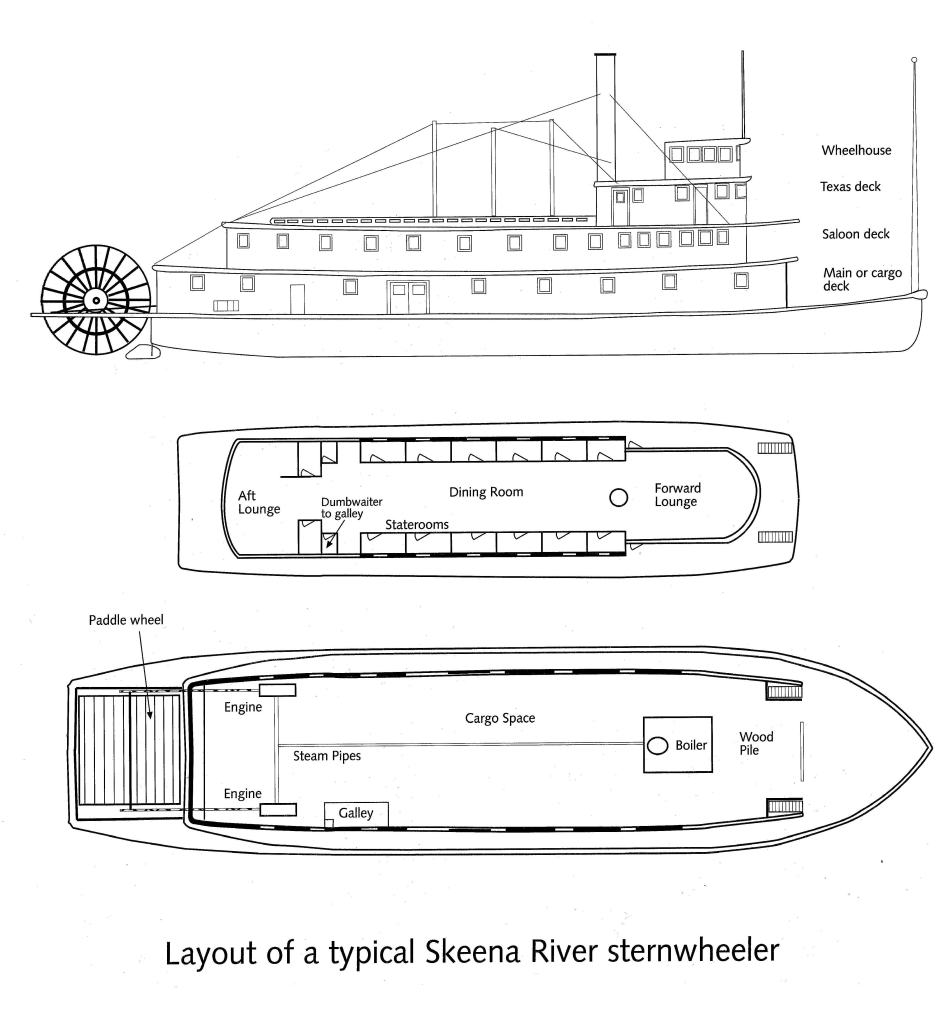
Image courtesy Cliff Armstrong, author of Sternwheelers on the Skeena
Sources:
Armstrong, Clifford Sternwheelers on the Skeena, 2001, Skeena River Heritage Trust BC Archives
MacDonald, Joseph F., MacDonalds Steamboats & Steamships of the Pacific Northwest
O’Neill, Wiggs Steamboat Days on the Skeena River, 1960 Northern Sentinel Press Limited
Wright, E. W. , Lewis & Drydens Marine History of the Pacific Northwest
◀
