
The Iron Butcher
by Charles LeRoss
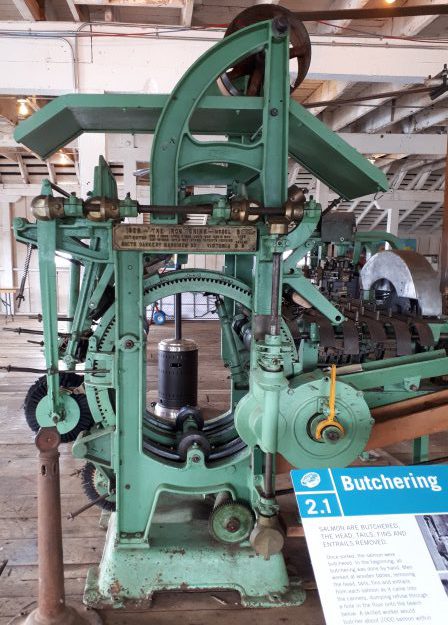
In 2019, I visited the North Pacific Cannery National Historic site in Port Edward, BC. I had visited the Cannery before when I saw for the first time the fish butchering machine with a bold information plate proclaiming it to be the Iron Chink. As I studied the machine and read about it on the display board, I realized it was in good shape, compared to the other equipment in the Cannery that was rusted, dirty and very tired out. I got the impression you could apply power to the machine and start butchering fish.
The machine looked like it was ready to work, in spite of being 93 years old.
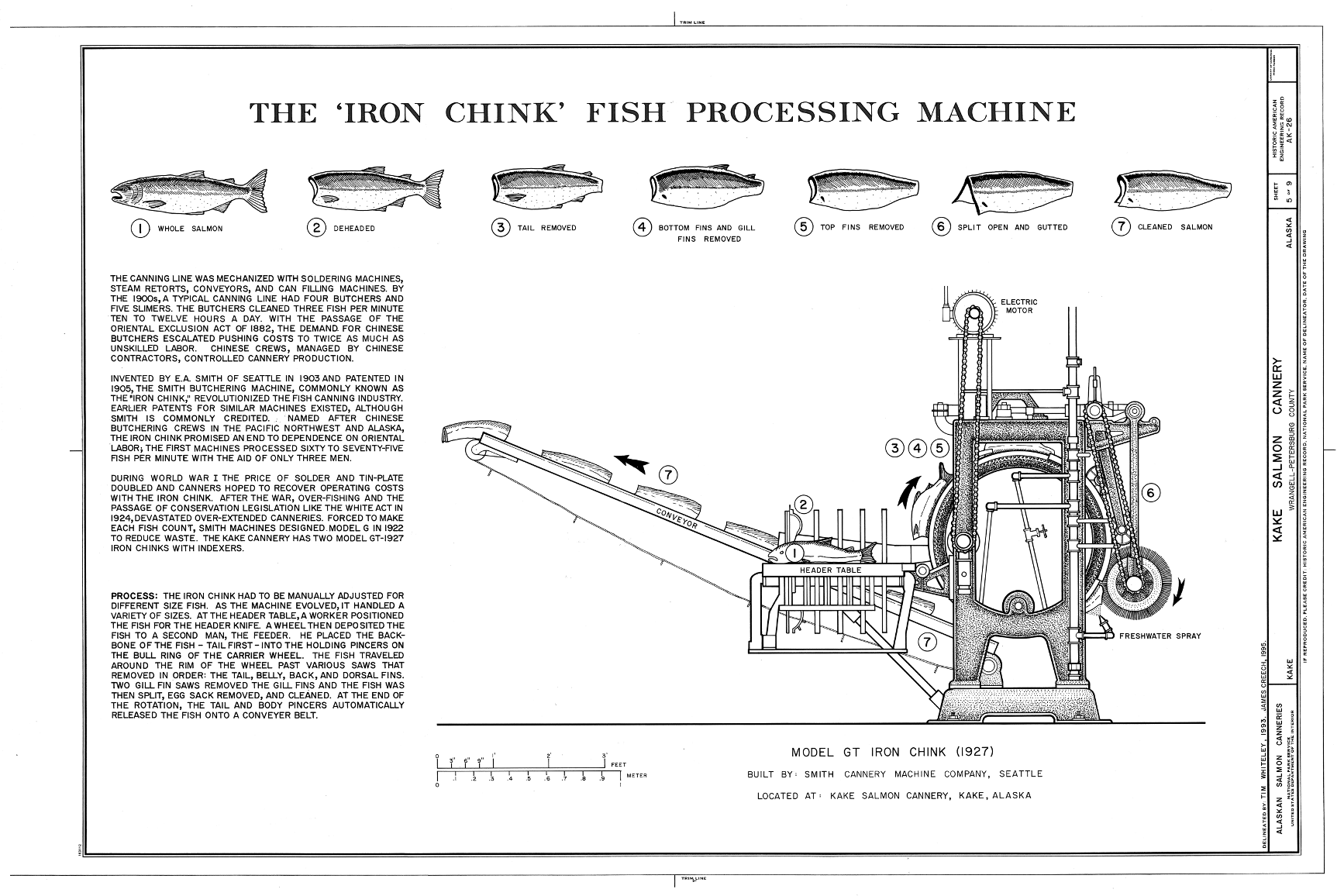
This machine was truly a revolutionary improvement in the operation of a cannery. The iron butcher cleaned the fish by cutting off the head, cutting off the fins and tail, sawing open the belly and cleaning out the guts of the fish at a rate of 50 fish a minute. That’s 3,000 fish in an hour. A Chinese butcher, who was very good at his job, took 10 hours to clean the same number of fish. The iron butcher was eventually introduced to all the canneries on the Skeena, replacing all the Chinese butchers, except for three who were required to operate and feed the machine.
In 1910, the Province newspaper published a lengthy article about the salmon fishing season and got quite poetic about the butchering machine: “Near by squats the Iron Chink like a bony goblin on his bent steel legs, with teeth of gears and universal joints and shafts and clutches and wire for elbows and arms and hands and tendons. This steel troglodyte achieves the labour of twenty flesh and blood “Chinks”. A real rice-eating Chinaman feeds the Iron Chink with fish. The giant seizes the fish, guillotines it, slices off the fins, and eviscerates it, spraying it with water jets as he whirls it in his iron fingers.”
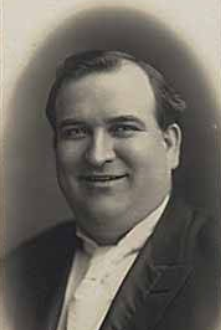
The machine was invented by Edmund Smith, who was born in 1878 in London, Ontario and was a large, intelligent and inventive man. His parents were farmers and moved to British Columbia when Smith was young. He started working life as a teen age cook, at one time running a cookhouse in Cascade, BC. After moving around and looking for work he settled in Washington State. He found investing in a fish cannery in Alaska was disappointing and a poor return on his investment. He realized the bottle neck and main reason the cannery was not profitable was that the butcher crews could not clean fish fast enough to earn a profit. This seems to have been the spark that set him to developing the butcher machine. In Seattle, he opened a workshop under the name Smith Manufacturing where he set to designing and building a butchering machine. In 1908, after much trial and error and several versions of the iron butcher, he had a machine that cleaned the whole fish.
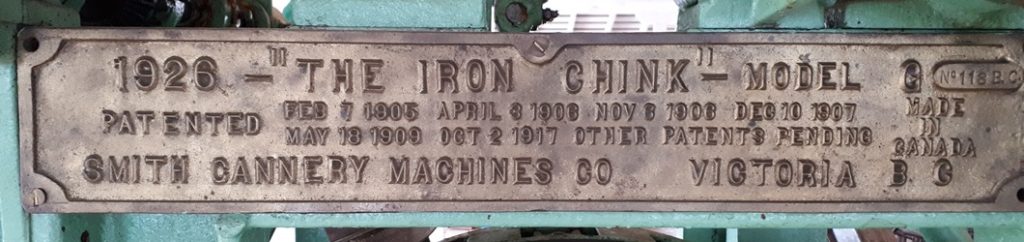
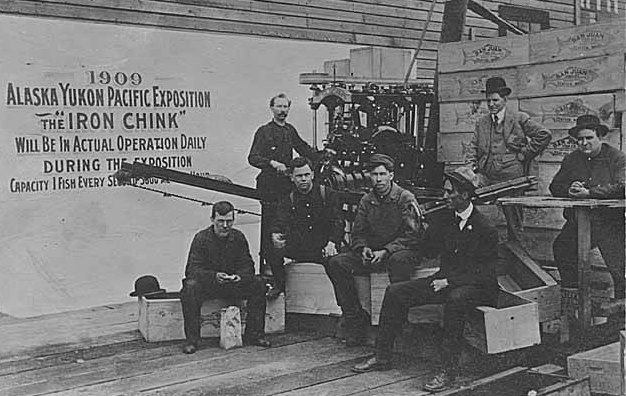
The butchering machine was introduced to canneries in BC in 1906, having been in operation in the U.S. for three years.
On June 8, 1909 Edmund Smith died in Seattle WA, as a result of burns received in a car accident when his car burst into flames from a ruptured gas tank and exploded. At the time of the accident, he was on his way to the fair grounds, where the 1909 Alaska Yukon Pacific Exposition was being held; he wanted to make a final inspection of his revolutionary fish cleaning machine, which was on display and performing each day.
In 1913, the Victoria Machinery Depot commenced making the butchering machine in Victoria, in order to avoid the duties imposed on the machines from the U.S.
If you would like a more detailed explanation of how the machine works, click on this image to enlarge it:
Sources:
Blyth, Gladys Y. Salmon Canneries: British Columbia North Coast. Trafford Publishing Company, Bloomington, Indiana 2007
Scott-B, Jo British Columbia History; Vancouver Vol. 38, No. 2, (2005): 21-24
The Vancouver Province
The Daily Colonist
◀
