
Bridging Zanardi Rapids
by Charles LeRoss
In April 1908, the first construction contract for the western end of the Grand Trunk Pacific was let at Prince Rupert. The contract was for the first mile of the road and involved heavy rock work that was expected to take a year.
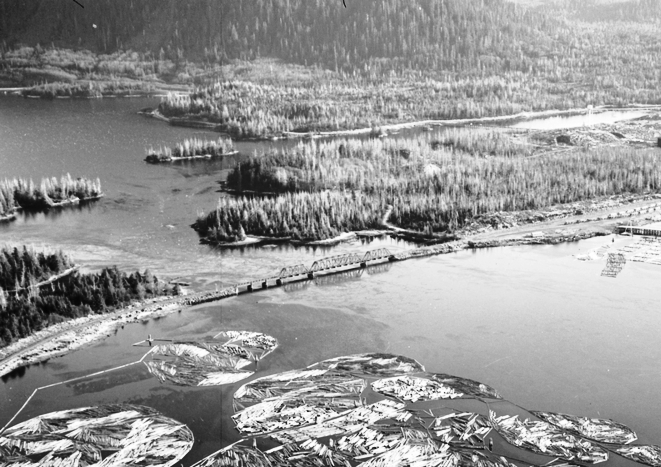
A contract was also let around this time for the building of a bridge across Zanardi Rapids. “It was on the Pacific Coast that the Grand Trunk Pacific Railway was brought face to face with its greatest obstacle in connection with bridge-work, and this was before the line had passed 10 miles from Prince Rupert. This port stands on Kaien Island, separated from the mainland at the point where the railway crosses by the Zanardi1 Rapids. This is a constricted channel through which the water rushes at a furious pace with the movements of the tides, this velocity varying from 12 to 14 miles an hour, the alternating rise and fall of the ocean at this point during the highest tides being about 26 feet.”
“Though the channel is not very wide, it has called for the erection of a bridge nearly 1000 feet in length, including two spans of 55 feet each, two of 150 feet and two of 250 feet. The last-named are the main or central spans, and it was the preparation of the piers for these that troubled the engineers.
In January, 1910, while the approaches to the bridge were being prepared, Alexander McIntosh was killed while involved with blasting of rock. McIntosh was trying to warn others to get away from the blasting operation. The inquest jury found that “If the warning signal had been left entirely in the hands of the men who had been dispatched to give the warning to the men on the scow and pier, the accident would not have happened.”
“The racing of the waters was found to be so furious at the highest spring tides that divers could not descend, and consequently work had to be carried out in short periods between the ebb and flow when the water was at its lowest and quietest. This represented a total available working-time of three hours out of the twenty-four hours, and even then work was very difficult and perilous. Of course, during the neap tides the duration of working was proportionately longer. Cribs, or box-like structures, were built around the foundation-sites to provide a working space within, but it was found impossible at times to render them capable of withstanding the force of the water. The engineers thereupon steadied the cribs in position by a pair of massive cables stretching from two corners of the temporary work to either bank. This was partially successful, but one day their complacency with this maneuver was disturbed very sadly by the wire hawsers snapping like pack-thread under the strain imposed by the pressure of the tides. As may be imagined, such capricious behaviour on the part of the sea was regarded by the workmen somewhat with alarm, and they kept a watchful eye and ear open ready to make their escape at the first signs of danger. Many thrilling moments were experienced, but owing to the unremitting vigilance and skill of the engineers no fatalities were incurred.”2 Except of course there were fatalities.
“On July 10, 1910, William E. Gilroy, a carpenter and member of the International Brotherhood of Maintenance of Ways Employees, drowned when he fell from the bridge while under construction. Gilroy, who had worked on the bridge for the last three months, was in the act of releasing a rail with a peavy. The rail was being hoisted out from between the false work on one of the piers on the bridge and got caught on a bolt and he gave it a sudden wrench with the peavy and lost his balance and fell into the swift running water. He was seen to come up near the derrick scow and the engineer threw a rope right over him as he was in the water, but he appeared to take no notice of it being apparently in a dazed condition. He disappeared and again came up near the anchor cribbing. Three men put out from the scow with a boat and stayed around where he disappeared the second time but he never came to the top again. Mr. James McGregor then ordered out three boats at slack water, equipped with grapples, in a hope of getting the body, but on account of the speed of the water and the rocks was unable to do so. As nothing more could be done, they abandoned the search.”
Work on the piers continued, and the challenge of the tidal waters remained. “When it was found that two leashes were insufficient to hold the crib in check, two additional hawsers were pressed into service, a pair stretching to either bank both above and below the bridge site respectively. This served to hold the crib in position from each corner, and though the hawsers, sung and groaned ominously they held out until one day the whole four gave way under the strain, and the crib went rushing down-stream, the sport of the angry tidal water.”
On May 7, 1910 it was reported that the last two piers of the bridge were in place and that the concrete work was to start immediately.
While the construction of the bridge over Zanardi Rapids3 went on, construction of the railway beyond the rapids continued. After a ferry slip was put in place on the east side of the Rapids, a scow was used to move rails and other material to the east side of the Rapids to supply the construction work further up the Skeena.
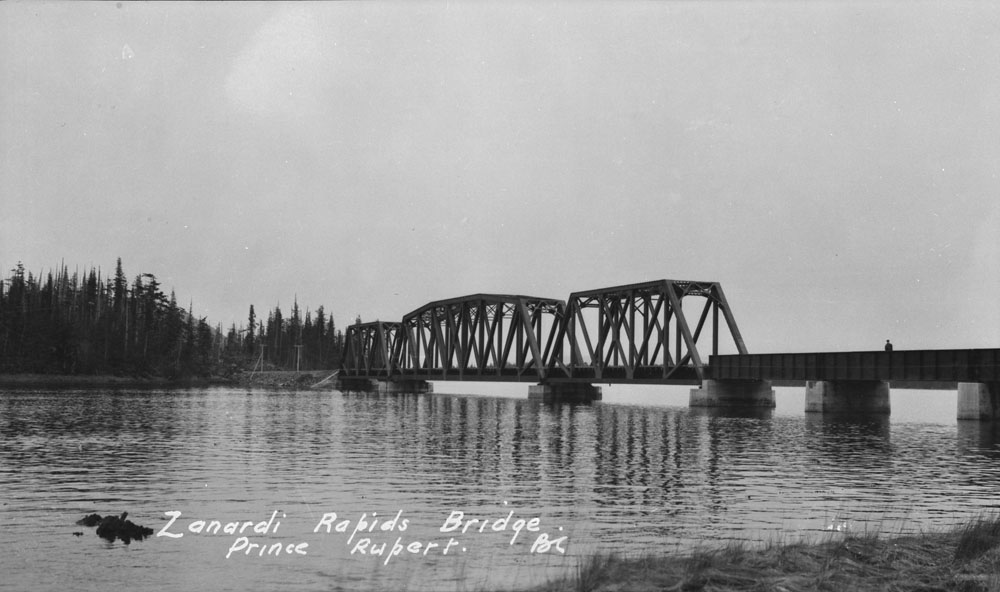
In June, the Prince Rupert Optimist newspaper reported that the piers for the bridge would be completed within days. Mr. Young of the Canada Bridge Co. would soon take charge of the construction of the superstructure which could begin immediately.
In early July the steel work for the bridge was on site and the contractor reported he would have no problem getting all the hands he wants for the work; saying he does not hire labourers but only skilled workmen drawing down 50c an hour. By the end of July, the steel work was completed to the point construction trains could cross the bridge.
On July 31, 1910, after laying down track across the bridge, the first construction train was able to pass over the Zanardi Rapids bridge, opening the first forty three miles of the Grand Trunk Pacific Railway.
“It was a continuous uphill struggle against heavy odds, but science at last prevailed, and now a handsome, solidly built bridge carries the line across the Zanardi Rapids.”
Sources:
The Vancouver Province, 1910
The Prince Rupert Optimist/Daily News 1910
The Prince Rupert Journal, 1910
Talbot, F. A. The Making of a Great Canadian Railway, Seeley, Service & Co. London, 1912
References:
- The rapids are named after Charles Zenardi, who was an inspector of the wharf at Prince Rupert. ↩︎
- Talbot, F. A. The Making of a Great Canadian Railway, page 311 ↩︎
- In July 1910 Alderman Barrows of Prince Rupert applied for rights to develop tidal power at Zanardi Rapids. The Prince Rupert Optimist reported: “The tidal power plan is today is in an experimental state. It has been proven that it will work, but nothing is yet known about the efficiency or the figures.” Riiight. Needless to say, tidal power was never developed at Zanardi Rapids. ↩︎
◀
