
Jean Jacques Caux aka “Cataline”
by Charles LeRoss

Courtesy B.C. Provincial Archives
Jean Jacques Caux, (pronounced ko) better known as ‘Cataline’ ran pack trains of horses and mules between the BC interior and the Hazelton area for 50 years. In 1910, at Quesnel, he was observed with a pack train of sixty horses and sixty mules, carrying goods to Hazelton. Originally, he ran pack trains into the Cariboo, but when freight wagons took over, he moved north to the Hazelton area.
“He came west from the kingdom of Bearn in the Pyrenees mountains near the Spanish border. He quickly built a reputation of honesty and reliability. He was a broad shouldered man with a barrel chest and slim waist. His hips were narrow and while he possessed tremendous strength he was also very agile. He always wore a stiff shirt but only on special occasions would he attach the collar. A silk kerchief around his neck, woollen pants, a wide, bright coloured sash around his waste and riding boots completed his outfit. A distinguishing feature was his hair, which reached to his shoulders. His favorite drink was cognac, and with each drink he would rub a little on his hair. He considered this a preventative for baldness and as he massaged the liquor into his scalp would say “a little inside and a little outside.” “He was a friend of all Indians and never once in half a century of packing did he have trouble with them. Another reputation of which he was proud was that he never failed to fulfill a packing contract. On two occasions his mule teams were virtually wiped out, but his freight was delivered – on the backs of Indian women he had hired for the occasion.”
“He was a strange mixture of origin. He claimed to be of Mexican, Native, French, and Spanish birth, and he was unique both in appearance and character. He seemed to have no family, or at least never spoke of one; his friends were few, and his acquaintances many, which was the way he wanted it. His fiery temper and most peculiar habits did not endear him to many people, but his horses, or his “ponees” as he called them, didn’t seem to mind at all. They were his family, and his life had been spent with his “ponees” up to the time he had retired. Cataline with his fierce black eyes, the luxuriant black hair, and his extremely vivid personality made him seem formidable.”

Courtesy B.C. Provincial Archives
Eva McLean, in her book The Far Land, describes an encounter her husband, Dan, a minister/veterinarian in Hazelton had with Cataline: “Dan remembered well the day when, accompanied by the police chief, he went to the corral where the pack train was being loaded for a trip to the mountains. Dan had noticed that some of the horses had running sores, or fistulas, on their shoulders. These sores were caused by careless packing. When the saddles were loosely tied, they would slip backwards on the upgrades and forward on the downhill trails. The constant friction broke the skin, and dirt and dust gathered to complete the wound. He had spoken about it to the chief, who decided to ask Cataline to take these affected horses out of the train for a few days so their wounds might heal. When the chief told Cataline the horses must be unpacked and left behind, the angered man tore his hair, cursed in his native languages as well as in English, and finally brandished a long knife which he carried for scaring ‘purposes only’. It seems unlikely he would have used it under ordinary circumstances, but he usually didn’t need to as its sight and the sound of the old man’s shouts were more than enough to frighten most people. When Dan promised to cure his ponies as quickly as possible, the matter was amicably settled.”

The pack trains traveled 10 to 15 miles a day, so from Quesnel to Hazelton would sometimes take a month to do the trip. Each animal could carry 150 to 200 lbs of freight. In August 1888, Cataline brought 14,000 pounds of supplies into Omineca from Ashcroft to a gold mining camp.
Alice Earley a school teacher and later a telegraph operator at Quesnel remembers her encounters with Cataline: “He was a jolly fellow, his real name was Jean Caux–at least that was what he had me sign to his messages. It was quite a sight to watch the pack mules cross the Fraser River. Billy Bouchie would ferry their ‘aparajos’ (pronounced “a-pa-ray-hos”) or pack-harnesses across in the canoe and arrange them among the road on the other side. Then Cataline would ride over and hold the bellmore’s halter so she swam behind and he’d jingle her bell all the way. Those mules would jump in and swim after her. When they got across every mule would go to his own pack and stand ready for it to be put on his back.”
In an article about Cataline, published in the Vancouver Province in 1947, C. B. (Bill) Bailey recalls a conversation he had with Cataline when he was a boy: “Once I watched Cataline and his crew camped on one side of the Cariboo road and noticed the number of Chinese packers, prevalent and asked Cataline why this was so. He looked down at me for a second, grunted once and went on with his work. I stood first on one foot and then on the other, watching him, curious to learn whether that grunt signified that there would be no answer to my question. When he had finished his task, he turned and asked, ‘You Billy Bailey’s boy?’ I nodded assent. I also gathered that if I hadn’t been W. B’s son, I’d have probably been told that it was not my business–which it wasn’t of course.
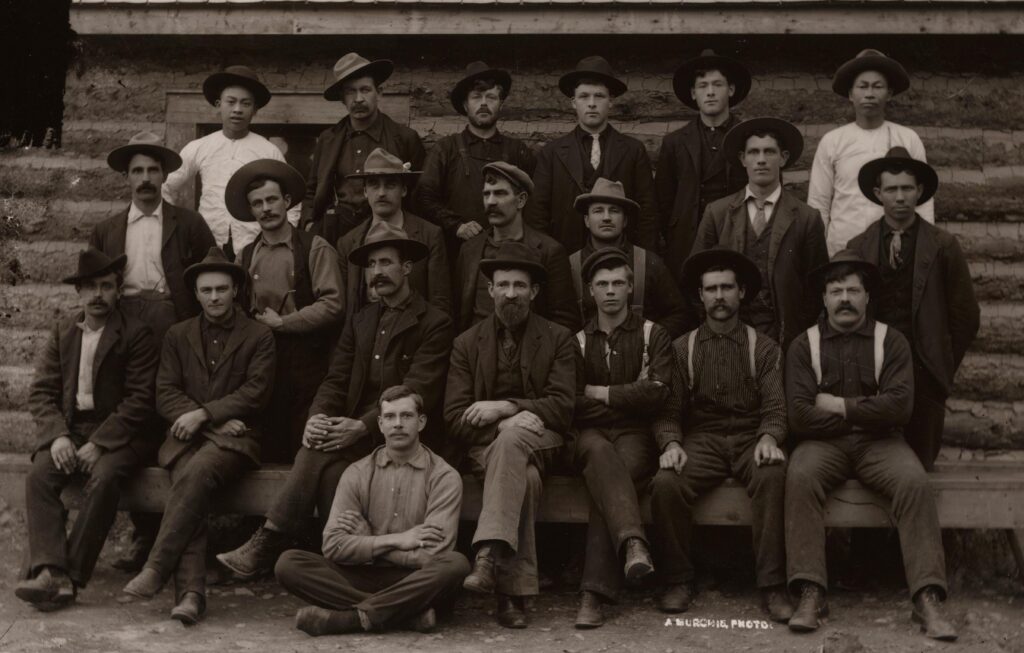
However, Cataline assured me that the Chinese were d— good packers. He also, insisted that the whites and Indians were good packers too. Then he went on to explain why he preferred the Chinese. “Lots of Indians were lazy, he said. Besides, when a stampede was on, they all wanted to quit and attend it. As for the whites, when they arrived in town, after a long trip, many of them got drunk. Often, he had to wait two or three days, while they sobered up before he could hit the trail again. But he could always rely on John Chinaman to be on the job.”

Courtesy Quesnel and District Museum and Archives
In 1902 the Hudson’s Bay Company awarded a contract to Cataline to transport their freight in from the Cariboo to Hazelton. And in 1910, Cataline purchased a pack train from Charles Barrett and took over his government contract to supply the telegraph cabins between Quesnel and Ninth Cabin (north of Hazelton) with supplies, making it the “largest single contract in the district and an important factor in making Hazelton the centre of the largest packing business on the continent.”
Cataline had a phenomenal memory. He couldn’t read or write, never kept records but he could pack a thousand articles on a trip, know on which animal each one was packed, where it was from, to whom it was going and the cost of freighting it. Traveling was done during the early morning hours and until the heat of mid-afternoon. Then the loads were taken from the weary mules. Fifteen miles a day was good speed and the trains traveled only in spring and summer. They would have been bogged down in fall and winter rains.
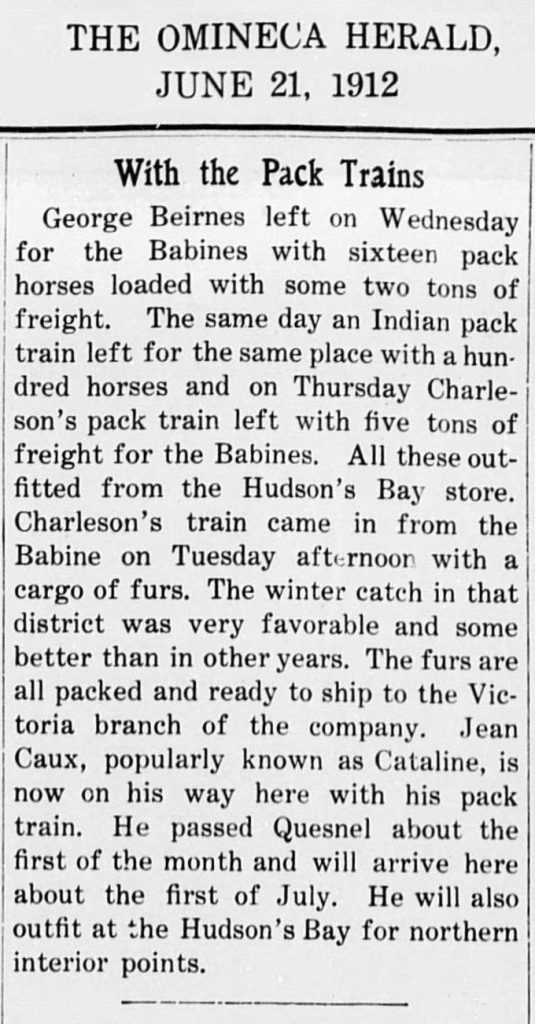
He would pack anything; glass windows, doors, stoves, food, whisky kegs, mining equipment. “Each load was carefully lashed and secured with the famous diamond hitch to a leather pack saddle stuffed with hay and called an aparajo. The aparajo was breast-strapped and cruppered in place upon the backs of the slow-pacing animals. The pack train crew consisted of a cook, a cargadore or manager and one man for each eight animals.
He made his last trip in 1913, ending his packing career. After his pack train was no longer needed, and his ponies had been turned out to pasture, Cataline’s health started failing. His work was gone and he retired to a cabin at Kispiox. In 1922 he became so ill he had to be taken to the hospital in Hazelton. There he died not long afterwards at the age of 93. “He didn’t seem to want to live without his “ponees” and made little effort to do so. Shortly before his death, Cataline said to the nurse who was bending over his bed, “Well, nurse, Ole Cataline, he’s goin’ to die, eh?”
“Now Cataline, you mustn’t talk like that!” she answered. “We’re taking good care of you, and we’ll have you on your feet again before long.”
“No, thees time I leave my poor ponees for keeps. They’ll miss ole Cataline.”
Tears filled his eyes, which had lost all their fierce gleam, and the nurse found tears were not far from her own eyes as she thought pityingly of the poor old man dying all alone, with no one of his own near him. She said gently, “Now you must sleep. Let me fix your pillow.” As she bent over the bed, Cataline looked up at her and said, “Nurse, when I get up dere to Heaven, you think maybe the good padre, maybe he let me have wan leetle ponee? What you say?”
Courtesy B.C. Provincial Archives and Neil J Sterritt, Mapping My Way Home
The nurse put her hand gently on his shoulder and answered, “Sure he will, Cataline. I know he will!”. Satisfied, the old king of the packers went quietly to sleep. He died the next day without speaking again. The nurse cried when she told the others the story, but she was glad she had given him enough hope to make his last hours a little happier.”
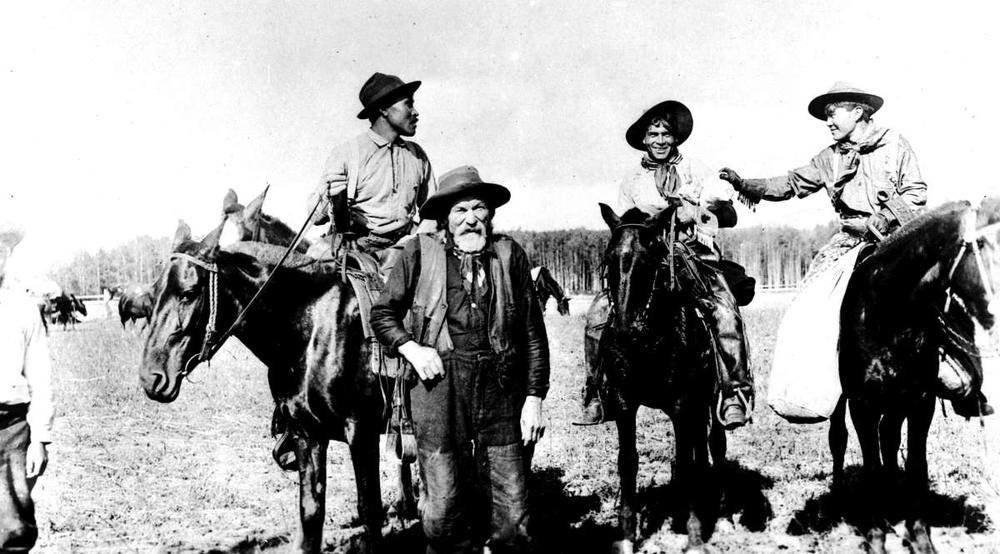
He is buried in the Hazelton Cemetary, and until recently his grave had been lost to memory. According to Neil J. Sterritt in “Mapping My Way Home”, it has been found, and he is buried next to two other pioneers of the area, James May and Ezra Evans. A stone cairn put up in his honour reads JEAN CAUX/THE PACKER/1832-1922, and is about 14 metres east of his grave.
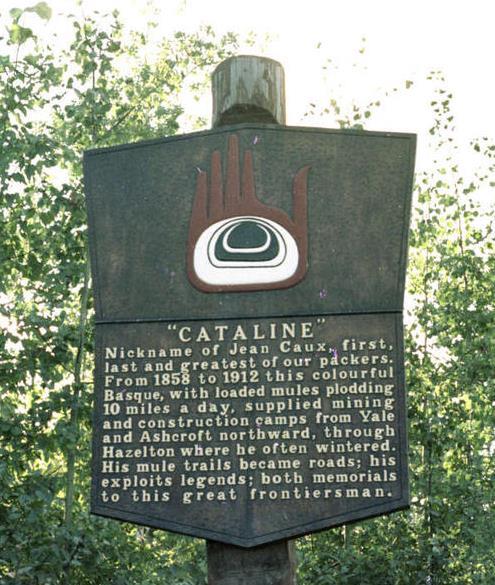
Image Courtesy B.C. Provincial Archives
The image below is a pack train, unrelated to Cataline, that has just loaded up 3400 feet of 1 1/8 inch steel cable weighting 7600 lbs on to 31 horses. Now that’s packing…

You can view a documentary written and directed by Sylvie Peltier, on Cataline’s life here: https://youtu.be/758bMarJ3Rk
Susan Smith-Josephy with Irene Bjerky have written a book about Cataline entitled “Cataline–The Life of BC’s Legendary Packer.” Irene is a member of the Yale First Nation and her great-great-grandmother was Amelia York, C’eyskn, mother to two of Cataline’s children.
Sources:
BC Historical News, Summer 1992, Vol 25, No 3
Bowman, P. Road, Rail and River, Prince Rupert, 1983
Downs, A. Wagon Road North, 1960
Jasper, W. Twelve Thousand Head North, Terrace Omineca Herald
MacLean, E. The Far Land, 1993
Omineca Herald, Hazelton, BC, 1910
Sterritt, N. J. Mapping My Way Home, 2016
Vancouver Province, interview of Alice Earley by Florence Lindsay, 1956
Vancouver Sun, 1949, 1958
◀
