
Kwinitsa
by Charles LeRoss
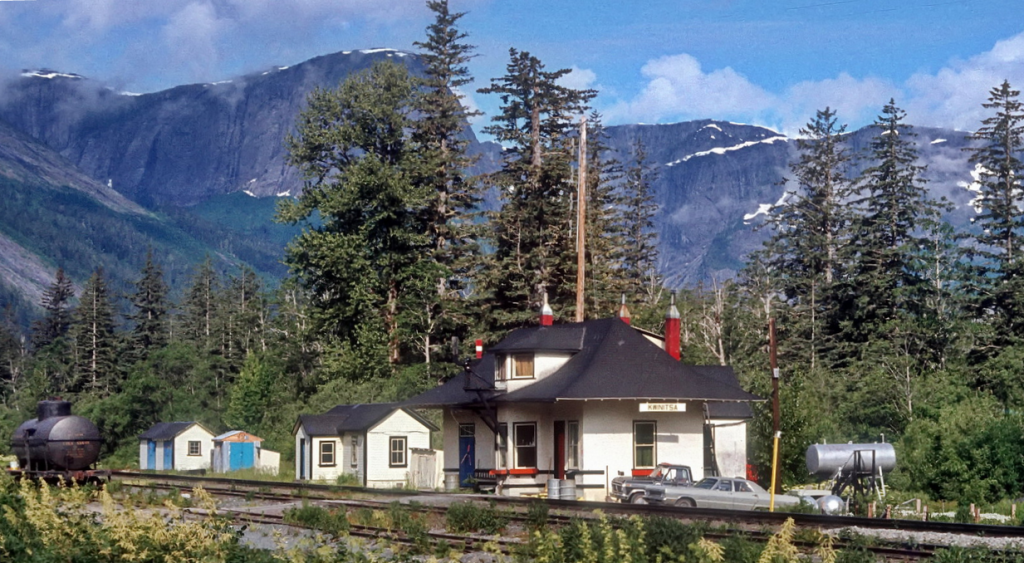
Kwinitsa, (originally “Quinitsa”, Tsimshian for “place of the beaver”) was the busiest train station located midpoint between Terrace and Prince Rupert on the GTP/CNR. It is still listed on the schedule for Via Rail passenger service as a stop, where you can flag down the train.*
In the Hendersons City Directory of 1916, Kwinitsa, spelled Kwinitza was described as follows:
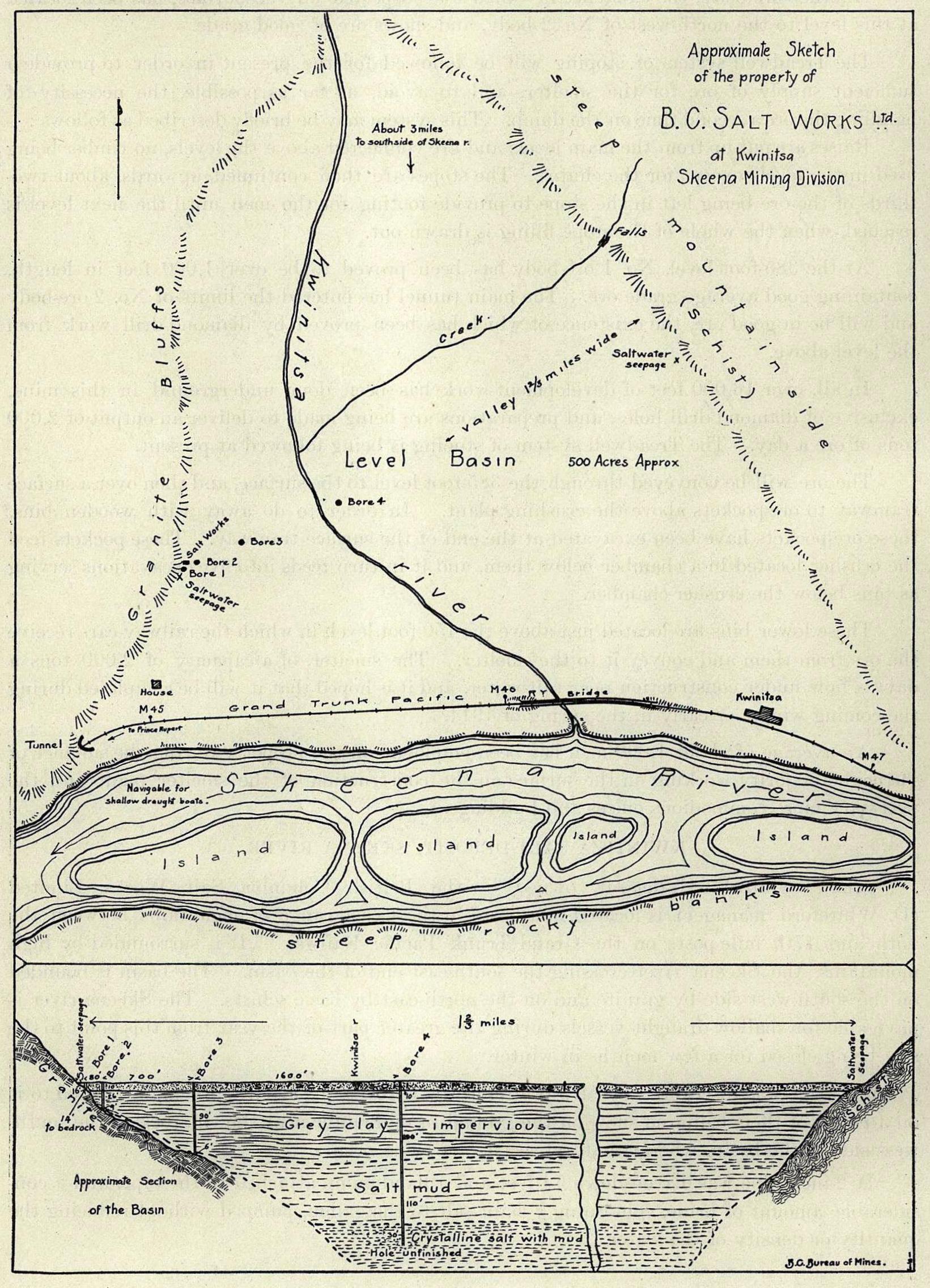
“On G. T. P. Ry., 46 miles east of Prince Rupert. Fare $1.90. Has salt deposits owned by the B. C. Salt Works Ltd., D. Whitford, Manager. Has also a farming settlement up the Kwinitza Valley. This valley, though restricted in area, is very productive. Market, Prince Rupert is close, and good prices are obtained for eggs, poulty, etc. No pre-emption land available. Address D. C. Whitford for further information.”
“The salt deposit was discovered in 1910-11 by D. C. Whitford, his attention being attracted to it on account of there being no snow on the ground in midwinter near the rim-rock on the south west side of the basin, where a natural seepage of brine occurs. After putting down a 2 inch pipe 14 feet long, a considerable amount of brine, containing ¾ lb of salt to a gallon of brine was obtained. Several holes were drilled and a small evaporating plant, consisting of open galvanized-iron pans with a fire underneath was erected and a few tons of salt were produced to demonstrate the possibilities of the deposit.” A sample from the temporary plant gave the following analysis:
Sodium chloride
Calcium sulphate
Magnesium sulphate
Insoluble matter
Iron and alumina
Magnesium chloride
98.15 per cent
1.82
Trace
Nil
Nil
Nil
The salt deposit was never developed.
The track past Kwinitsa was layed around 1910 and the station was built shortly thereafter.
In 1910 when the GTP was built passed Kwinitsa, a tunnel almost 1,600 feet long was built to deal with the numerous snow slides they expected would block the tracks. The tunnel referred to as McDougals tunnel is now unused.
In 1913, a brick making company opened business in Prince Rupert, and the owner of the brick company obtained a sample of clay near Kwinitsa that was sent away for testing. No clay mining was ever done at Kwinitsa.
Kwinitsa was always a place of refuge for passengers and cars stuck between snow and mud/rock slides that occurred east and west of the station.
In 1915, a freight train was headed east from Prince Rupert. Shortly afterwards a fish special ( I assume a train carrying frozen fish which was given priority) was scheduled to pass the freight train at Kwinitsa. Through a mechanical problem the freight was unable to pull off the mainline, tried to warn the coming fish special they were still on the mainline but were unable to warn the fish special in time, resulting in a collision with the freight that resulted in the death of the train agent, D. Tippens and the engineer J. Hastiz.
In October 1917, the main line of the Grand Trunk Pacific near Kwinitsa, 54 miles from Prince Rupert was buried for a distance of 300 feet by a slide of huge trees, rocks and snow to a depth of about 30 feet.
During the flood of 1936 the Skeena River was so high at Kwinitsa that Jim Donaldson who operated a gas powered fishing boat, was able to run his boat (Bilmor) through a snow shed located at Mile 54, once he took down the mast. Once the river level dropped, Kwinitsa was the furthest east a train could travel, because of the track washouts, and became a supply point for small boats travelling on the Skeena to Terrace with emergency supplies.
In 1943 during the construction of the highway near Kwinitsa, two men were killed and eleven others injured when a snow slide 300 feet wide and 5 to 6 feet deep, wiped out part of a construction camp near Kwinitsa. A special train with doctors and nurses was sent from Prince Rupert to assist with the injured.
Gordon Little , second son of George and Clara Little of Terrace, operated a sawmill at Kwinitsa during the war years.
In 1945, a passenger train with 140 U.S. soldiers on board, was trapped between two rock slides near Kwinitsa for two days, while crews tried to clear the slides.
In 1947, two snow slides blocked the railway near Kwinitsa. The slide on the west side was about 200 feet long and 20 feet deep and the other to the east was 300 feet long.

In 1948 during the spring, the Skeena River washed out thirty miles of track between Shames Station and Kwinitsa Station. Water was from 1 to 8 feet over the tracks.
In March 1949, a mammoth snow slide near Kwinitsa covered the tracks and nearly took a man’s life when he was briefly buried in the slide and suffered only bruises.
In 1951 13 persons, including women and children were marooned for several days at Kwinitsa by mud slides. Eventually they were brought out to Terrace by train. Crews spent 3 days clearing rocks and mud slides from the highway and filling washouts. The highway was only open as far as Terrace because of high water that resulted in the highway being littered with logs and debris after a violent rain storm
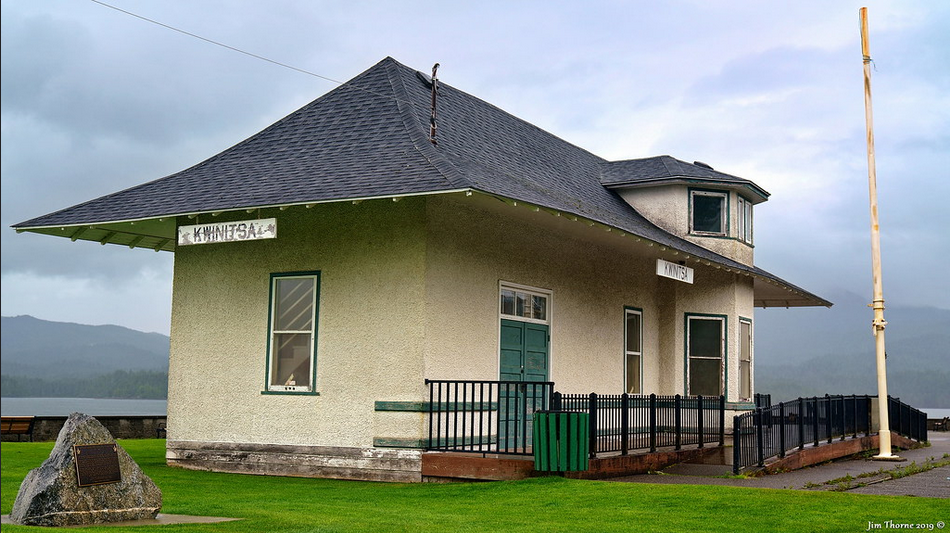
In 1985, the Kwinitsa train station was moved by barge, down the Skeena River to Prince Rupert and now serves as a small railway museum.
Floyd Frank in his book, My Valley Yesteryears writes:
“Just west of Kwinitsa was another tunnel, which is surrounded by a bit of controversy regarding when and why it was built. We understood that the railway originally ran around the steep cliffs in that area, along the bank of the river, but that there was so much trouble during the winter from avalanches that it was decided to build a tunnel. A heavy snow shed had been built, using twelve-inch-square fir timbers, but an avalanche had come roaring down the mountain and swept the entire snow shed halfway across the river. So it was decided that a tunnel should be built to avoid the worst slide area. The track was laid in this area in August of 1910, so the first problem with avalanches would have been that coming winter. But about 1980, I was given an article taken from copies of the Engineering Digest, in which appeared a history of the experiences of John Strickland Leitch, as the resident engineer on a nine-mile stretch of construction between Telegraph Point and the Kwinitsa River.
As a young engineer, in April of 1908, he was transferred to the Lower Skeena River. Raised in the east, he had never seen or worked on steep, bare mountain slopes which soared up right from the river’s edge. This was a new experience and tested all of his knowledge as a construction engineer. By the spring of 1910, he had completed all his survey work on the tunnel and turned over to the Railway Construction contractors the last surveys to guide them in their work. But he was not slated to be there to keep watch over the last of the tunnel work. At the end of March 1910, he received notice to turn his work over to his assistant engineer and proceed to a new posting as engineer in charge of construction of a branch line of the railway in Saskatchewan. He never did get back to B.C. to see the completed line. The article I refer to was composed of extracts taken from letters he sent to his girlfriend in Ontario, who later became his wife. After he passed away, she got out all his old letters and wrote a very interesting story of his problems, his triumphs and his happy memories in this new country just opening up to the outside world. There were tales of his trip up into the mountains on a goat hunt and of the many times he and his crew crossed the Skeena and enjoyed weekends up in the Khtada River and Lake area fishing and hunting.”
“So where does this leave the stories told by the old-timers about the avalanche problems at that point, leading to the blasting out of the tunnel? In retrospect, I expect the probable answer is that when the track-laying crew arrived at the area where the tunnel was being slowly carved out of the solid granite rock, the tunnel work was far from being completed. Beyond the unfinished tunnel, the railway grade was finished as far east as the Kitselas tunnels, and to get the track laid on that grade before winter set in, they decided that they had to keep moving. So the decision was made to close down work on the tunnel and skirt along the base of the mountain, along the bank of the river. It meant a few sharp curves in the track, but it would allow the track-laying crew, with the minimum of delay, to continue on upriver. Then, after several winters of continuous snow problems, the tunnel was completed. Somewhere, filed away and forgotten, there must be detailed accounts of what actually took place.
When it was decided during the Second World War to rush through the construction of a road to Terrace, there didn’t appear to be any difficulty finding room to go around the mountain at the tunnel near Kwinitsa. Then in the mid-fifties the pulp mill in Prince Rupert began logging in the Kitsumkalum and Zimacord areas and shipped the logs to Port Edward piled on flatcars, whole trainloads of them. The bumping and settling of the logs as they were moved out of the loading yards onto the main track caused them to shift, resulting in a few of them sticking up in the air or out from the sides of the cars. It seems that going through the tunnel these logs would hit the ceiling or walls, causing a lot of trouble. So it was decided to stop using the tunnel and put the railway around the mountain beside the highway, and again there appeared to be no apparent difficulty in finding room for both the highway and the railway.
* Editor: Although last year when I traveled the route, I was told by the train staff that the train will stop anywhere, if you can get the attention of the train crew.
SOURCES:
Prince Rupert Daily News, 1948
Nelson Daily News 1951
Cumberland Islander, 1924
Asante, Nadine The History of Terrace, 1972 Terrace Public Library Association
Large, Dr R G The Skeena River of Destiny, 1962 Mitchell Press Limited Vancouver BC
Bowman, Phylis Klondike of the Skeena 1987
The Vancouver Province, 1913-1970
◀
