
Misty Skeena River: The Stories of a Japanese Canadian Before the Second World War
by Tom Sando
The histories go back more than one hundred years since Japanese had immigrated to Canadian soil. The Japanese Canadians settled on the B.C. coast before the First World War had gone through extreme hardship, as the discrimination toward the oriental had been highest in the country. This is the untold story of a young Japanese Canadian nisei (Canadian born second generation) and his father who worked as a fisherman in the [sic] northern British Columbia before the war.
To the Native Place
On the sunny morning of May 2nd, 1938, a 22,000-ton ocean-liner S.S. ASIA sailed into beautiful Vancouver harbour. From its sundeck, a slim 16-year-old Tamio Kuwabara watched the superb scenery of the harbour tirelessly. The cobalt sky and the snow-capped mountains behind, the picturesque Vancouver city-line appeared in front of his eyes, as the liner approached Burrard Inlet. Eleven days had passed since Tamio and his five companions left turbid and crowded Yokohama harbour in Japan, and the long voyage crossing the rough Pacific Ocean finally came to an end. He was about to step on a foreign land, his native soil, and his father’s beloved country, Canada! His young heart pounced wildly with excitement, as the liner approached the Canadian Pacific dock in the harbour. He glanced at his companions from Japan. They were all excited too.
Vancouver was a very familiar place for their party leader, 53-year- old, Tatsu Kuwabara, as he had lived in Canada for almost 27 years. But for the rest of the five young boys, including Tamio, Canada was a very strange and foreign country. Although they were all born in Canada, the boys had been brought up in Japan with their relatives since they had been very small. Therefore, they hardly remembered anything at all about Canada.
The youngest of the five boys was 14 year old Tamio’s brother, Shig. Twin brothers, Yoshi and Kazu Tani, were 15 years old. Tamotsu Mayeda was 18 years old. Tamio’s mother had died in a fishing village in northern British Columbia when he was four years old and his younger brother was two years old. Soon after their mother’s death, their father Tatsu had taken the two boys to Japan and had left them with their grandparents’ in north central Japan, Niigata Prefecture. Tamio neither remembered anything about Canada or even his parent’s face, except for a faint memory of his red tricycle, which he was riding on the pier. The Tani brothers also had similar kind of circumstance as Kuwabara brothers. They lost their mother when they were small, and had been brought up by their grandparents in south-central Japan, Wakayama Prefecture. Their father, Shuichi Tani, was a good friend of Tamio’s father, Tatsu, and Tani had been fishing together on the Skeena River in northern B.C. for a very long time.
Tamotsu Mayeda’s circumstances were different than that of the Kuwabara brothers. He had been sent to Japan for his education when he was a small boy. It was a custom among the Japanese immigrants living in North America to send their children to Japan for their education in those days. Tamotsu’s father, Seiichi Mayeda, had sent all of his children to Japan to educate them. Those nisei who were brought up in Japan and came back to Canada were called ‘kika-nisei ‘(returned nisei) among the Japanese settlers to distinguish them from nisei who had been brought up in Canada. The kika-nisei who had been brought up in the militarism Japan [sic] were hard workers, but their lack of English was their greatest disadvantage. In comparison, the nisei who were brought up in Canada had more advantage over the kika-nisei because they were more proficient in English. However, there were many young nisei who were fluent in both Japanese and English, for many good Japanese-language schools existed in Vancouver, Steveston and the other large Japanese settlements.
After their ship had docked at the Canadian Pacific wharf, all the passengers were escorted to the Immigration building about two blocks away for their custom formalities. Almost two hours of standing and waiting in the Immigration building, Tamio and his companions finally finished their custom procedure.
It was almost four o’clock in the afternoon when they checked into Sakuma boarding house on Powell Street. The two stories high Sakuma boarding house was located on the south side of Powell Street, and about a half block from Main Street. Landlady Mrs. Sakuma, in her fifties, must’ve came from western Japan, as she spoke with a smooth kansai accent. After she showed them their rooms, she took the newcomers to a bathroom and explained to the boys how to use toilet, bathtub and shower, as it was very new to these boys from Japan. Mrs. Sakuma must have been used to the new arrivals from Japan as she has been operating the rooming house in this port city for a long time. Indeed she knew how to handle those newcomers from Japan.
A grocery store was located downstairs of the boarding house on the main floor, facing the sidewalk. The store handled Japanese and western foods. Also the store sold soft drinks and ice cream. As soon as the boys had settled down in their room, they took turns buying ice cream downstairs. When Tamio made two or three trips to buy ice cream cones and soft drinks at the store, he was greatly impressed by how a young girl storekeeper handled her customers. She was very polite and pleasant to all customers. If she saw elderly Japanese customers come in, she would greet them in cheerful Japanese, “Konnichiwa, Irasshaimase, Arigato gozaimashita.” If she saw younger customers, she would greet them in fluent English, “Hello, How are you, Thank you very much.” Japanese merchandise were sold along with western goods and Japanese language was spoken with English. On the first day in Canada, Tamio already felt keenly that he was in a Japanese settlement on foreign soil, far away from his homeland Japan!
At supper time, Mrs. Sakuma showed the boys how to use forks, knifes and the other table manners such as the teaspoon should always be placed back on the saucer after stirring coffee or tea, and to not make any sipping noise while drinking from the cup. In Japan, the sipping noises mean you are enjoying the meal, but in the western world, it would be bad manners.
After supper, Tamio’s father, Tatsu, took the five boys out to guide them around the Japanese town. Powell Street was called ‘Little Tokyo’. The evening-shadowed sidewalk was fairly busy with all kinds of nationalities, Japanese, Chinese, Whites and Natives. Located next to the Sakuma’s were a Japanese-owned restaurant, fish market, grocery store and bookshop. A noodle shop, barbershop and secondhand store were at the opposite side of the street. Farther down to the east from Powell Ground, at Dunlevy and Jackson Avenue, there were more Japanese- owned rooming houses.
A man sitting quietly on the bench by the Powell Grounds, hardly recognizable as Japanese or Native with his dark sunburned face, asked one of the boys, “Which ship are you from?” He must have mistaken the boys for seamen or cabin boys, because all the boys except Tamio were wearing brass-buttoned school uniforms from Japan. After Tatsu showed the boys most of the Japanese town, they returned to their rooming house by 9 p.m. Before they went up to their room, they each bought ice cream cones at the store downstairs. Unlike the melted chunks of ice-like cream sold in Japan, the Canadian-made ice cream was very tasty and creamy! Not only Tamio, but the other boys must have felt the same, because they all took turns going downstairs to buy ice-cream cones four or five times.
The following day, Tamio and the other boys followed George Nishimura, who was born and raised in Vancouver and was staying at the same house, to a Chinese-owned snack bar on Main Street not too far from Sakuma’s. George was their leader because nobody else could speak English. The small snack bar was packed with people of all nationalities. A dark-haired, half breed Native girl took their order of hot dogs. The hot dogs were ready in no time. Boys then followed George’s suit to put some ketchup, radishes and mustard on their hot dogs. Tamio thought the mustard was a little sour but the ketchup was tasty. Anyway, the boys enjoyed their first day out, and their first feast of a famous North American fast food.
On the next day, Tamio’s father, Tatsu, took the boys to the same snack bar to try out some cheeseburgers. The beef burger was very tasty but the cheese was slimy and stinky. Nobody ate the cheese except for Tamio and Tatsu. More Chinese-owned restaurants and stores were seen alongside Main Street towards Chinatown. A broad Hastings Street was two blocks away from there. The street was wide and not crowded, unlike the streets in Tokyo or Yokohama. Walking along the Main Street and Hastings Street, Tamio already noticed the different atmosphere from Japan. The people in Canada walked leisurely as if they had more time. Streetcars had a lot more room to move.
On the third day in Vancouver, they were invited over to visit Tatsu’s long-time friend, Ryuichi Yoshida. Yoshida was a well known person among the Japanese communities, and was associated with a Japanese language newspaper ‘MINSHU’ in Vancouver. His modest stucco home was located in the Kitsilano district, on the south side of the city, across from a big schoolyard. Modernly dressed Mrs. Yoshida and her daughter were very friendly. They showed the guests their well-kept, two bedroom home from the main floor, all the way to the basement. Their small, fenced back yard contained a nicely kept green lawn, two cherry trees, and a small vegetable garden bordered by flowering tulips. After supper, Yoshida showed Tamio how to push a lawn mower to cut the grass on his front yard.
One week seemed to go by very rapidly in Vancouver. Tamio and the other boys made a couple of trips to Stanley Park. They went many times to the waterfront to watch the big ships tied down on the wharves. Soaked in a warm sun, wrapped by the soft breeze from the ocean, Tamio wished they could settle down in Vancouver. But unfortunately, his bright hope was allayed when Tatsu announced, “We’ll be boarding on a ferry ship tomorrow morning, leaving for northern British Columbia.”
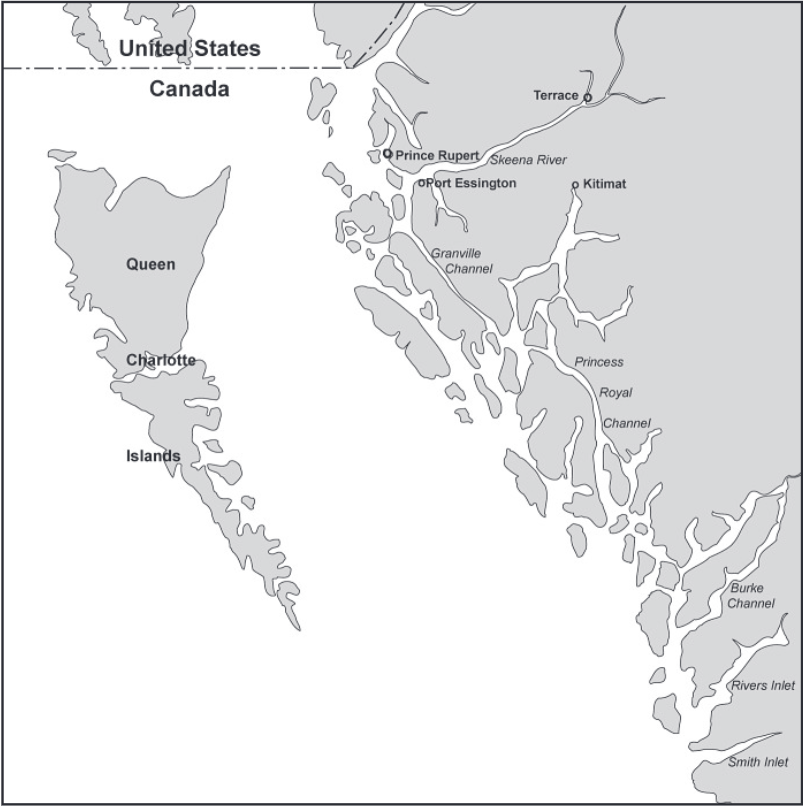
Three days had past since Tamio and his companions left Vancouver harbor on board the 3,000-ton ferry- ship S.S. CADEEMA The slow moving northbound ferry coasted around the many small islands and across the deep channels of the British Columbia coast. The ferry took plenty of time stopping at the towns of Powell River, Bella Bella, Ocean Falls and the other half dozen fishing villages around the coast to drop off some of their supplies, people and mail. After the ship had passed through the rough open waters of Queen Charlotte Sound, they finally entered the calm waters of the narrow Grenville Channel. The receding glaciers created many of those deep channels on the British Columbia coast many thousands years ago. Many of them were deep and narrow with shorelines that were steep and rugged.
The ferry’s deserted gray upper deck was cold and wet under the overcast sky. As Tamio was leaning against the rail, watching the foaming water break away from the ship’s side, he heard his father’s voice from the behind. “Tami, we’ll be entering the mouth of Skeena River pretty soon! You’ll notice the water color will change as we go up.” Then he excitedly added, “We’ll be arriving at Claxton around 6:00 p.m.!” Claxton Cannery at the mouth of Skeena River was their final destination.
Skeena River and Kuwabara
In 1884, as an only son to a tenant rice farmer, Tatsu Kuwabara, was born in Niigata Prefecture, Japan. He had four sisters. Somehow, he had managed to attend six years of elementary school, walking everyday a distance of four kilometers from his home. It was very rare for a poor farm boy to have some schooling in those times. Tatsu had enlisted in the army during the Russo-Japanese War of 1904-1905. The two years military service had changed his life completely. He was discharged from the army and was no longer a small farm boy. He had been witness to the vast territory outside Japan during the Manchuria campaign against Russia. While he was coming home after the war, he had a chance to observe the bustling seaport cities of Kobe and Yokohama. He saw an endless wide world unveiled before his eyes and realized how small the futureless farm back home really was. He felt it was ludicrous to go back home and carry on with a simple farm life. It would be a certainty should he return that he would be taking over the farm if he returned home, being the only son.
So once he was discharged from his military service, he remained in Yokohama and worked in a shipbuilding yard, never sending a word back home. Meanwhile, back home, a disappointed old father grumbled, “I should have never allowed an education to a farm boy. Now he hates farming and has surely deserted from home?”
Yokohama was the busiest seaport in Japan. Its harbour was crowded with ships from all over the world. Downtown taverns were constantly packed full of mariners. Whites, blacks, Chinese and all other sorts of nationalities roamed the busy streets. Surely, Yokohama was already a prominent international city.
While Tatsu worked in the shipbuilding industry, he made a few friends. Most of them ex-sailors. From them he gathered stories of the riches of America, well on the other side of the vast Pacific Ocean.
The adventurous Tatsu made up his mind to cross the Pacific Ocean into America rather than to remain working in Japan. His first attempt to cross the Pacific Ocean was in early March 1909. He had just turned 24 years old. As a fireman’s helper in the ship’s boiler room, he had boarded a 4,500-ton cargo ship, HIRAGA MARU, bound for San Francisco via Hawaii. His main purpose was to debark in Hawaii or San Francisco the very first chance he got. But his plans failed on account of strict immigration policies in U.S.A. To Tatsu’s untimely misadventure, prior to this time, U.S.A. and Japan had signed a Gentleman’s Treaty to restrict immigration from Japan. Thus was his first attempt to land in America thwarted. But a disappointed Tatsu never gave up.
After he returned to Yokohama, Tatsu discovered that it was much easier to enter Canada than U.S.A. Once within Canada, there would be an easy access to U.S.A. (In those early days, most of the people in Japan thought Canada was a part of the United States). Tatsu set out to find a person living in Canada that would offer him a sponsorship.
Not too long later, he found a person in Vancouver, Canada that offered him his sponsorship. His name was Hirota, owner of a restaurant in Vancouver. Hirota had emigrated to Canada seven years earlier from Yamaguchi Prefecture, Japan. Tatsu got to know him through Hirota’s nephew, Yamata, while they were crossing the Pacific Ocean in the same ship three months earlier.
After five months of anxious waiting, Tatsu was finally granted permission to emigrate into Canada. It was in late March 1910, young Tatsu found himself on a busy wharf in Vancouver with big hopes of a bright future and prosperity. But after only a few days in Vancouver, his bright hope were cut off when he discovered that there would be no easy access into U.S.A. On top of that, there were hardly any good jobs to be found in and around Vancouver as the discrimination against Orientals was overwhelming. The only available jobs that could be found were as low paying farmhands and sawmill workers.
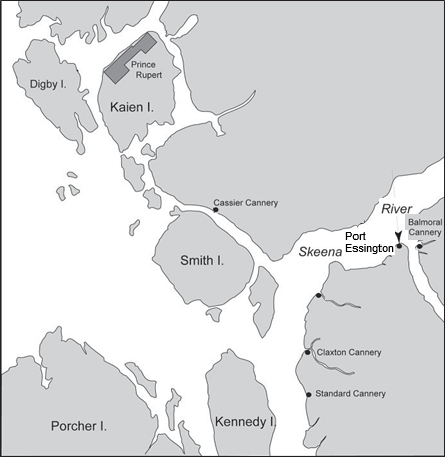
In early June of the same year, Tatsu gave up looking for a job in Vancouver, and headed for northern British Columbia. He finally settled down in the small fishing village, Balmoral Cannery, at the mouth of the Skeena River. As well as the Fraser River in southern British Columbia, the Skeena River was famous for its salmon fishing. The nearest town was Prince Rupert about 40 km. away. There were no roads that crossed the land, and the only available transportation was by boat. It would take roughly four hours to travel to Prince Rupert from the Balmoral Cannery.
Many canneries and fishing villages were scathed [scattered] around the mouth of the Skeena River. The B.C. Packer Co., Nelson Brothers Fisheries Co. and other canning companies owned these canneries. There were about 300 Japanese-Canadian fishermen residing with their families in company-built housing. Their rents and utilities were free as long as they signed a contract with the company to sell their catch exclusively to the company. In fact, they did not need any cash to buy any groceries or household necessities from the company-owned store. They could get credit on their accounts and clear it at the end of the salmon season. If the salmon season was bad, then, their credit could be carried over until the following salmon season without no interest. In addition, there was plenty of firewood around for cooking and warmth during the snowing winter months.
Actually, the salmon season only lasted three months of the year. For the rest of the year, the inhabitants of Skeena River could go fishing, hunting and cut firewood for their own use. So life was made easy for the Japanese fishermen in Skeena River.
Many single men sought wives from Japan by exchanging their photographs through advertising agencies, friends and relatives in Japan for many did not have enough money to go back to Japan to look for suitable wives.
Eventually, adventurous women from Japan answered their ads and came to Canada, persuaded by the notion that Canada was a new land of riches. Most of these women believed that their future husbands were wealthy, and possessed a good business or job and a big house with many maids. But the so-called brave ‘picture brides’ were soon dismayed beyond their imaginable hopes the minute they set foot in Skeena River. Some of them found that her new husband was much older than his picture and living poorly in remote fishing villages among many Natives. Some women were thrown into such consternation that they immediately returned to Japan. However, most women remained in Canada, doing their very best to raise decent families and livelihoods.
Many Japanese Canadian fishermen living within the Skeena River area were from Wakayama Prefecture, Japan. Some of the villages in that prefecture were named ‘decasegi mura’ (being at work in another country) as most of the villagers were out to work in North America.
The water source of Skeena River began in the Skeena Mountain ice field in northern British Columbia. Thereafter it joined up with many tributaries, and cut through about 600 kilometers of the coastal mountains, it finally dumped its icy yellow-water into the Pacific Ocean.
Every year from July to September, millions of sockeye salmon swam up into Skeena River to lay their eggs in the shallow streams. After the eggs hatched, the small parrs swam down the river and then into the ocean. These small salmon stayed in the ocean for five years. Once they matured, they would swim up the same river and lay their eggs in the same shallow streams where they were born. They would turn a red tone and perish, as did the other species of salmon: coho, spring, chum and pink. Sockeye and pink salmon weighed no more than about twelve pounds but some of the spring and coho salmon could weigh over 30 pounds!
The region at the mouth of the Skeena River was renown for its high tides. The tides rose and fell twice a day: 10 to 20 m [sic] every day. When the tide began to rise, the river reversed its current and flowed back upstream. On the high spring tide, sometimes the river would back flow almost 140 [sic] kilometers upstream towards Terrace B.C. When the tide began to ebb, the river changed its direction, and flowed down at dangerous speed. Consequently, most of the big ships and small boats checked the timetable for the tides before ever entering the river. Most of the big cargo ships and ferries entered the river when the tide was rising to avoid running the ship aground on shoals.
The Skeena River region was the wettest part of the B.C. coast. Some clearing breaks in the sky appeared in May and September, but the rest of the year, the region was usually covered with thick clouds, heavy fog and rain. When it started to rain it did not stop for three or four days. Sometimes the misty rain covered Skeena River for well over a week.
The name ‘Skeena’ was originated from the aboriginal language meaning ‘water from cloud’. The natives called the Skeena River, ‘Misty River’. In fact, there was a saying among the local fishermen, “Don’t ever forget your rain suits even if you should forget your lunch!” The weather was cool and damp all year around. Even in the middle of August, most of the fishermen wore heavy sweaters and woolen pants underneath their rain suits to keep warm and dry. There were no warm sunny days in summer for sunbathing.
After a few years fishing in Skeena River, Tamio’s father, Tatsu, saved some money. He was thirty- five years old when he thought about getting a wife. Finally after twelve years of absence, he wrote a letter to his relatives in Japan and let them know that he would be returning home to look for a wife.
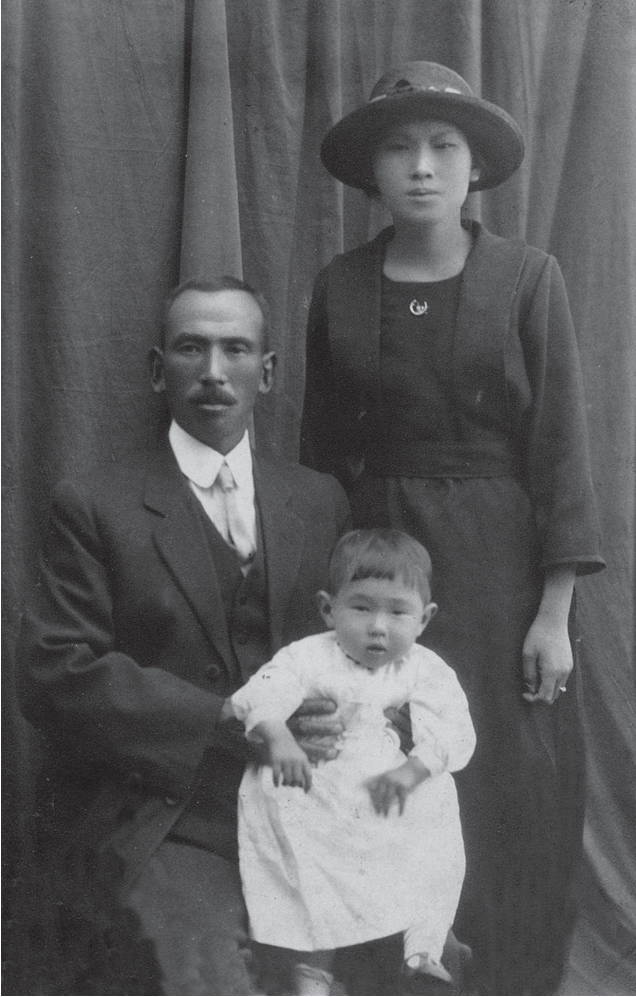
Back home in Japan, Tatsu’s letter surprised his parents as they thought he was dead. They had even made his grave!
In the early October 1920, Tatsu finally returned home to Japan. He stayed at home over the winter months, and married a twenty two year old Mitsu from a neighbouring village.
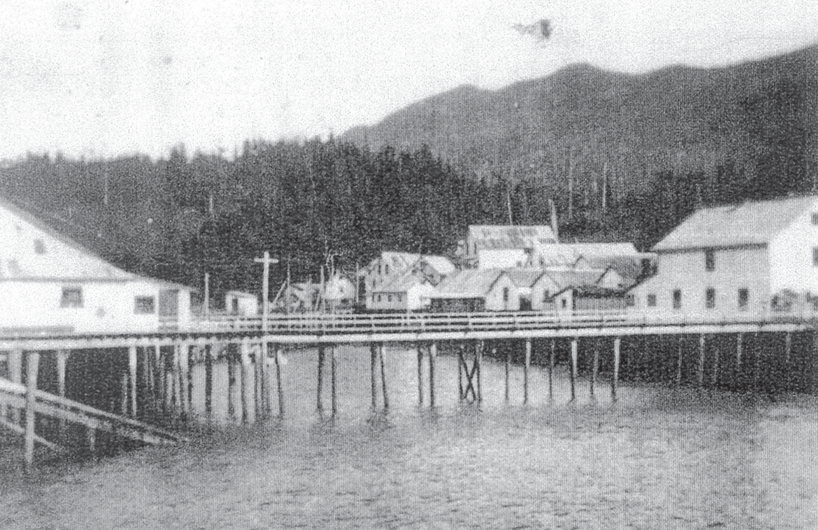
Early next spring, soon after Mitsu’s immigration was granted, Tatsu returned to Canada with his new wife. The newlywed couple settled down in the Balmoral Cannery on the north shore of Skeena River, [east shore of Ecstall River] just in time for the salmon season. The B.C. Packer Co. owned this fishing village that was built on the steep riverbank. The company’s factory, warehouses and housings were mostly built on the muddy riverbank supported by hundreds of heavy wooden posts, all driven firmly into the mud. On the high tides, the water would reach up to only three meters below the buildings. On the low tides, the muddy river bottom would appear a good distance below.
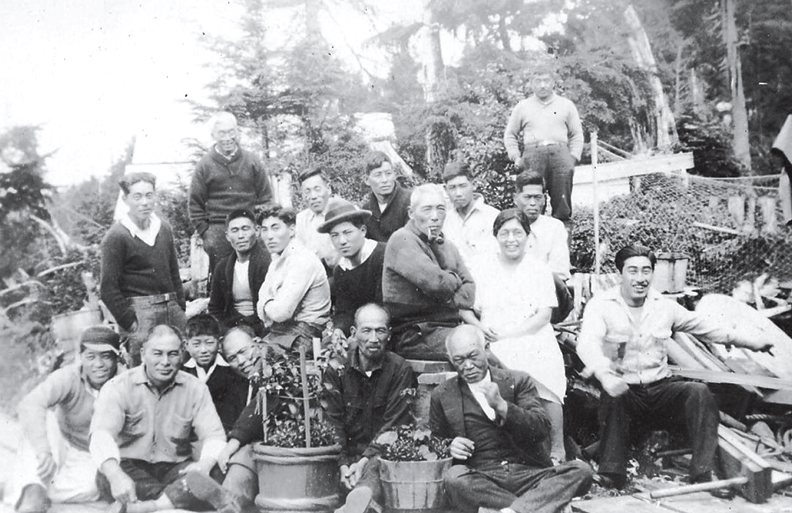
There were about 35 Japanese people living in the small fishing village all year around. Most of them were single men. Many Japanese fishermen from southern British Columbia came up during the salmon season in the summer to fish. They roomed in the boarding house, which was operated by Mr. and Mrs. Mayeda and Hamano.
The company had offered a tenement house with 2½ rooms to Tatsu and Mitsu, who were very happy with their new living room, bedrooms and small kitchen. There was power and water supplied in the house but no sewerage as the house was built above the water line.
A neighbouring little town, Port Essington, was about three kilometers away on the opposite bank of Skeena River.[Ecstall River] This town was founded in 1870 as a Native trading post. The town was located in the confluent point between the Skeena and Ecstall Rivers. About a dozen Japanese lived there among the Whites and Natives. A Japanese cemetery was located on the hill, at the eastside [west side] of the town.
The good fishing season continued after Tatsu and Mitsu settled down at the Balmoral Cannery. Their life seemed very pleasant and stable after their two sons, Tamio and Shig, were born. But their happy life didn’t last very long when Mitsu suddenly took ill with acute appendicitis. Her sickness had gone too far and by the time Tatsu took her to a hospital in Prince Rupert she was beyond help. There had been no doctors or nurses to help her in Balmoral. Mitsu died in the hospital shortly after she arrived, at the age of twenty-six.
After his wife’s death, Tatsu was compelled to make another trip to Japan, for he was uncertain where to turn with his two young boys. On October 1926, Tatsu took four-year-old Tamio and his two-year-old brother Shig to Japan and left them in the care of their grandparents and Aunt. Tatsu remained in Japan over the winter and then returned to Canada. He continued fishing salmon in the Skeena River and sent money home for the care of his two sons.
Tamio and Shig were raised with their three cousins in their grandfather’s farm in north central Japan. Aunt Setsu was a kind and very gentle person. She treated Tamio and Shig fairly, as equal as her own children. But her husband, Seizo, was not so fair and often mistreated Tamio and Shig.
Compared to an obedient Tamio, his younger brother, Shig, was an unyielding child, short and tough. He often got into arguments or fights with his older cousin Yoshi. Usually uncle Seizo took his own son, Yoshi’s side regardless, and Shig would be punished for fighting. From time to time, their grandmother would come to aid Shig. She often got angry and scolded her son-in-law, “Don’t forget, these kids have no parents, you should feel compassion for them, and treat them more gently!” Their grandmother was always there to give Tamio and Shig some warmth and support when they needed it. Sometimes she hid some candies from the other children to give to Tamio and Shig.
Tamio grew up as a shy boy. His schoolmates called him ‘America-jin’ instead of ‘Canada-jin’. The villagers knew Tamio and Shig came from the other side of the Pacific Ocean (America). Accordingly, the school kids and his friends treated him with an altogether different attitude. Some of the teachers gave him special attention. Sometimes Tamio felt like a foreigner, not at all Nippon-jin!
Tamio made a lot of girlfriends while he was babysitting for a neighbour after school and on summer holidays. He learned how to skip rope, make paper dolls and pretty necklaces with flowers, and all other sorts of girl stuff.
Tamio often wondered about the unknown country of Canada where he was born. He wondered where his mother had been buried and where his father was still fishing. He had no memories of Canada, nor hardly any knowledge of that country. The only things that he knew about Canada was from his father’s letters, which arrived once in a while.
After Tamio completed his two-year advanced course at the elementary school in the spring of 1936, he began staying at home and helping to farm with his older cousin Tatsuji. Tamio and Tatsuji had gotten along very well and worked hard to get the farm going for their grandfather had died three years ago, and Tatsuji’s father, Seizo was not at all capable as a farmhand.
The year 1937 had been a hard year for the Japanese people, especially for the farmers. The war in China was escalating, and all able young men were joining the army. Only the elderly men, women and children remained in Japan to farm. As Tamio turned fifteen, he was compelled to attend some military training sessions in the schoolyard twice a week.
In that crucial summer, Tamio had received a most important letter from his father. The letter changed his life completely. “It is up to you boys whether to remain in Japan or return to Canada. If you boys want to return to Canada, let me know soon. I will come to Japan as soon as possible and we can return to Canada to live together.”
Tamio wrote a letter to his father right away to let him know that he and his brother had decided to return to Canada. This was sure to be the biggest decision that he had ever made in his entire life! Although Tatsu was not all too anxious to take back and look after his young boys, having been a bachelor for so long, he must have been very concerned with the escalating situation in Japan. He had not persuaded his sons to remain in Japan.
On September 1937, after another 12 year absence, Tatsu returned to Japan once more, this time to claim his two sons. Together they would be returning to their homeland Canada. Tatsu remained in Japan over the winter and took a second wife saying, “I need a woman to look after my sons, as they are too small to look after themselves.”
In the early spring of 1938, the time had come for Tamio to leave his dear place of upbringing. It had been an exciting and emotional moment when they said good-by to the villagers who came all the way to the train station to see them off. Standing on the platform, in front of the cheering people, Tamio could not help hide his mixed emotions; a sadness of parting from his place of upbringing, and excitement of travelling to an unfamiliar far away place.
Most of the cherry blossoms had disappeared around Tokyo and Yokohama when Tamio and his companions sailed away from the Yokohama harbour. They left their new stepmother behind, as she needed more time for her immigration papers.
Standard, A Quiet Fishing Village
The S.S. CADEEMA traveled smoothly across the narrow Grenville Channel. The view from the ferry’s deck widened into a beautiful merging of waters. Some broken seaweed and wooden debris swirled atop the rising blue seawaters of the Kitkatra [Kitkatla] Channel as it merged into the yellowish waters of Skeena River. Tamio watched as the warm seawater cascaded over the cold river water, forming a white misty froth.
Far to the west, and to the left side of the ferry, Mccarley [McCauley] Island and Banks Island lay floating hazily into the horizon. To the right, the snow-capped Coastal Mountains towered high into the blue sky. Its foot base sloped down steeply into the jutting shorelines. Dense cedar trees covered the rocky slopes, their heavy branches barely touching down into the cascading water.
Leaning against the ship’s railing, Tamio marveled at the spectacular untouched scenery for a tireless moment. Tamio’s father, standing beside him, spoke in a happy voice. “Tami, we are just passing Gunkan-jima (a small battleship-shaped island). This is a boundary line for the salmon fishing. I often come this far to fish.” Tatsu’s excited voice and flushed face recounted the complete joy of his return to Skeena River.
Eventually, the ferry left the blue seawater behind and entered the river current, gaining speed as it swiftly pushed aside the rising tide waters. The ferry made a wide turn following the river-bend, cutting through rope-like seaweed that floated atop the water. A white- washed cannery building appeared on the right.
A little after 6:00 p.m., the ferry docked on the Claxton Cannery’s wharf. The wharf was crowded with Japanese and natives. It was almost impossible to distinguish the Japanese from the natives from their dark faces.
As soon as Tamio and his companions disembarked from the ferry, the relatives of Tamotsu, Yoshi and Kazu immediately welcomed them. Tamotsu’s father, Seiichi Mayeda was in his fifties with lush gray hair and a gentle countenance. Yoshi and Kazu’s father Shuichi Tani was a big man, and bald as Tamio’s father. They were reunited after eleven years of separation.
The other people were Tamotsu’s older brother, Masaru, and Uncle Yamamoto.
Soon Tani and his sons left the crowded wharf after Tani thanked Tatsu for bringing his two sons home. Tani was remarried five years ago and they lived in the company owned housing within the fishing village. Tamio, Shig and their father were arranged to stay with Mayeda’s family in the small fishing village of Standard, about five kilometers downstream of the river until the time that their stepmother arrived from Japan.
Tamio and his companions followed Masaru Mayeda to the south end of the long pier, then down the stairs leading to the floating dock where Masaru’s white fishing boat was tied. A long stairway was connected to the floating dock, its slope varied according to the height of the tide.
Now the tide was high, the stairway was in a gentle slope. Tamio was suddenly struck by a strong smell of seaweed as he stepped onto the floating dock. The dock rocked slightly up and down with his shifting weight. The delightful cries of seagull’s and the sound of water spattering underside of the dock seemed to bring back a distant memory from twelve years ago! He murmured pensively with a deep emotion, “At last I’ve returned to my native place! Now my new life on the water has begun!”
Tamio followed Masaru onto his newly painted fishing boat. As soon as Masaru saw that everybody was on board, he started the engine, and the boat cleared the dock with a pleasant murmuring sound coming from the exhaust pipe at the side of the boat. The skipper coasted the boat close to the shoreline where thick cedar branches and spruce drooped down gently to the waterline.
This was Tamio’s first experience riding on a small boat. When Tamio asked Masaru why he was coasting his boat alongside the shoreline instead of going straight up the middle, Masaru replied in a convincing voice, “It is much better for a small boat to go near the shore where the river currant is slight. The river current is much faster and more dangerous as you travel towards its center.”
When Masaru was making a wide turn around the river bend where some rope-like seaweed floated, Masaru warned his younger brother, Tamotsu, “You should be careful whenever you see floating kai-rope (rope-shaped seaweed). It’s a sure sign of hidden reefs or shoals underneath”
At around 7:00 p.m., after a pleasant 20 minute ride from Claxton, they arrived at Standard’s desolated wharf. They climbed up from the high ladder to the top of the wharf; and were welcomed by Mrs. Mayeda, Mrs. Yamamoto and the Tamotsu’s brother, Yoshio. Tamio recognized Mrs. Mayeda right way from the spectacles that she wore, as he had seen her in a picture in Japan. As soon as Mrs. Mayeda saw Tamio come up on the wharf, she rushed towards him with her arms wide open and saying, “Tami-chan! You sure have grown!” She gave him a big hug. Tamio felt her wet cheeks against his own flushed face. It was his first experience of anyone ever giving him a warm motherly embrace since his mother had died. For the first time in his life, he was entranced into a heartwarming moment, and wished to remain in her embrace forever!
After Mrs. Mayeda finished her emotional embrace, she looked at Tamio and Shig heartily, then held her hand 2½ feet from the ground, saying, “You two were such small boys when you left for Japan twelve years ago!” Tamio’s father standing beside them responded proudly “Yah! The kids sure grew up in a hurry! Consequently we parents are getting older every day!” He stroked his bald head and tapped his old friend, Seiichi Mayeda’s shoulder.
Standard used to be a fair sized fishing village belonging to the B.C. Packer Canning Co. but when the new cannery was built in Claxton ten years ago, most of the families from Standard had moved to Claxton. The Mayeda family remained as caretakers with Mr. and Mrs. Yamamoto and Ryoichi Yamamoto. Tatsu moved to Standard ten years ago once the Balmoral cannery closed down. Since then he lived with Mayedas as a boarder.
Four or five old buildings stood silently by a little creek. The Mayeda family occupied the largest building in Standard, where Tatsu, Shig and Tamio would be boarding until their stepmother arrived. The Yamamotos occupied a little house on the north side of the creek. A flat building on the pier closest to the shore was Masaru’s blacksmith shop. Masaru worked there in the off-season.
After they walked across the long pier and a narrow bridge over the creek, they reached Mayedas’ house. The house was built just above the rocky shore at the front of a dense cedar forest.
Standing by the porch, Tamio marveled at the wild scenery. The high tide filled the quiet cove, covering most of the sandy beaches and rocky shores. Yoshio’s white fishing boat, UCLUELET BABY, was anchored in the mid-section of the cove, and cast a flickering white shadow on the calm waters. The sun started to descend beyond the top of Kennedy Island to the opposite side of Skeena River, all the while casting a dark golden light upon the river. A flock of seagulls, flying back to the offshore islands, fluttered their white wings to the setting sun. The whole land appeared to melt into the water, with the green forest dissolving into the distant sky. Its natural beauty gave Tamio a peaceful impression of Standard.
Mayedas’ house was scantly furnished. The living and dining rooms were outfitted with old-style leather furniture. A kitchen was located at the rear of the house. A large room upstairs with many beds provided for the boarders. A good size patio extended to the shore, overlooking the mouth of the river.
As soon as everybody settled down in the house, Mrs. Mayeda and Mrs. Yamamoto served supper. The table was filled with delicious Japanese foods; miso-soup, tsukudani (shellfish cooked with soy sauce), sashimi (raw fish), rice, kazu-noko (herring roe), and takuan (pickles).
Tamio ate and ate until his stomach couldn’t take any more. The supper was exceptionally delicious after three days of yoshoku (western food) he had ate on the ferry. After supper, Tamio’s father recounted his voyage to Japan.
Tamio went out for a walk with Mayeda’s housedog, Bochi, towards the wharf. It was a quiet evening, with only the murmur of the water ripples lapping onto the nearby shore and the sound of his footsteps gently tapping the wooden bridge. A full moonlight cast a shadow of a boy and a dog on the deserted wharf, and threw silvery ripples upon the quiet cove. Kennedy Island rested peacefully beyond the horizon.
It was already midnight by the time Tamio, Shig and their father went upstairs to bed. For a little while, Tamio heard his dad’s loud snoring but he soon fell asleep. He must have been very tired after such a long and exciting day.
Tamio woke up around nine o’clock the next morning. The sun was already high above the cedar trees. The pleasant cries of seagulls and the smell of the ocean drifted in from the open windows. As though Mrs. Mayeda had been quietly waiting for everyone to finally awaken, she announced that breakfast was ready. A lovely smell of toasted bread from the kitchen made Tamio’s empty stomach churn as he quickly went downstairs. Tamotsu who stayed with Yamamotos next door came in and joined them at the table.
The bacon and eggs were delicious and the toasted bread with butter and strawberry jam was exceptional! Tamio, Shig and Tamotsu, the newcomers from Japan, ate toast after toast after toast with insatiable pleasure. Mrs. Mayeda, standing by the hot wood-burning stove, with a gentle smile, toasted the bread after bread on a wire-mesh, and fed the three hungry, insatiable boys, continuously.
Tamio and his father descended to the beach after breakfast. The tide had receded leaving many pretty smooth rocks, with seaweed and shells clinging to the bare shore. A red crab trapped in a puddle between some rocks crawled quickly to find a place to hide. The dark brown seaweed abandoned on the beach made a cracking noise as Tamio walked over it. The cracking noise echoed sharply in the wood, and suddenly the still air was broken by the flapping sounds of a grouse flying out from the nearby bush.
Tamio walked into the bush with his father where the grouse had flown. They followed the narrow trail alongside the shore that was just wide enough for one person to walk. Tatsu told Tamio, “This trail was made by deer.” Sure enough, there was some marble size dung alongside the path. Tatsu said that he used this trail when the tide was high. Therefore, both deer and Tatsu had made this trail. The trail was covered with thick bushes and undergrowth. The mixtures of the smells from the new leaves and the rotten woods filled the path as they continued on their walk.
After walking down the trail for about 1½ kilometers, they reached a small cove with a little creek. The creek’s blue water was clear and cold, as it originated from the base of Steckle [Steckel] Mountain. Tatsu had named this creek ‘Kuwabara River’ after himself.
Tamio saw a raft with a log cabin floating in the mouth of the creek and tied down to the shore by a rope, and asked, “Who does that raft belong to?” Tatsu replied proudly, “That is my raft. I built it myself This is my pleasure raft! I pull this raft behind my boat to all the different little islands, and use it for some fishing and hunting during the off-season.”
The cabin was about 3-meters by 5-meters; and contained a bed, stove, table and chair, just enough for himself. Tatsu recounted that sometimes he went as far as Banks Island, about 40 kilometers away. Alone in his floating raft, he would spend the whole month fishing and hunting. He knew these offshore islands better than the local natives. (More than a half of these islands in the region were uncharted. People who were not familiar with these territories could get lost very easily.) Tatsu possessed an inborn power of observation along with a remarkable memory. He could memorize every detail of the water ways, the shape of islands, the shallow points of caps and shoals once he had past through. He was one of the pre-eminent hunters in the territory. Deer hunting was his pride and joy. If anyone wanted some deer meat, they would say, “Better ask Kuwabara.”
A little farther down from the mouth of the creek, Tamio saw a gray boat aground on the sandy beach, exposing its red belly in the May sun. Tatsu owned two boats. He had been using HOKUI No. 1 for fishing halibut and other miscellaneous errands. HOKUI No. 2 was his other boat that he used exclusively for salmon fishing. Tatsu said that HOKUI No. 1 was set aground every spring for painting, repairing and engine overhauling, to be made ready for the next fishing season.
Tatsu rubbed the belly of his boat gently. Then with a gentle smile and a skipper-like gesture, he ordered Tamio and Shig, “Starting tomorrow, you boys have a job painting HOKUI No.1 and overhauling her engine!”
The tide began to rise. A line appeared in the middle of the river where the rising seawater met the river. Gradually the bare shores started to submerge under the rising water. It was almost high tide by the time they got back to their boarding house, just in time for lunch.
After lunch, Tamio and Shig borrowed Mayeda’s small boat to practice rowing as their father suggested, “You boys must learn how to row the boat if you want to be good fisherman.”
Tamio gripped the oars as Shig held onto the side of the boat and they fearfully took off from the pier. They seemed uncertain in the small skiff by themselves, rowing across the big waves. This was their first experience ever rowing a boat. The tiny boat rocked from side to side on the waves, making it very difficult to row. When they were away from the shore, Tamio stopped the boat and dipped a finger into the cold water. He wanted to know what the water tasted like from the place that he was born. He thought that the water tasted a bit muddy and salty.
Masaru and Tamotsu came out to meet the boys. They manoeuvred their small boat alongside, and Masaru demonstrated to Tamio how to hold the oars and row the boat. Tamio marveled at Masaru’s skill, how he could row the boat with such ease and agility. After only 30 minutes of attentive practice, Tamio and Shig were more confident with rowing the boat.
Visiting Mother’s Grave
Within a week, Tatsu, Shig and Tamio were hard at work together on HOKUI No. 1. It was fun and exciting for father and sons to work together, scraping the old paint off, putting on new paint and overhauling the engine upon the sun-filled beach. Tamio also verily enjoyed his two km walk to the boat from Mayeda’s house. Walking on the sandy beach or taking the forest trail seemed like a new adventure everyday. It was almost the end of May when they finally finished working on their boat. One day, they launched HOKUI No. 1 into the water.
On the following morning Tamio and Shig went to pick up some wild flowers to make a wreath for their mother’s grave. They had been planing to visit her for a long time, and today would be the day. They made a beautiful wreath with the help of Mrs. Mayeda. Mrs. Mayeda also made a pot-full of ‘aka gohan’ (rice boiled with red beans) for their lunch. She wrapped some rice balls in silver paper for an offering to their mother’s grave.

Tamio’s mother, Mitsu, had been a very close friend of Mrs. Mayeda while they had been living in Balmoral before she died. There were no doctors or nurses in the community when Tamio was born. Mrs. Mayeda delivered Tamio as she had some experience as a midwife. When Mitsu had been bedridden with an acute appendicitis, Mrs. Mayeda had nursed her like her own sister. After Mitsu had died, Mrs. Mayeda looked after Tamio and Shig as her own children until the time they left for Japan.
The Kuwabaras left from Standard’s pier aboard HOKUI No. 1 the moment that the tide began to rise. Tamio’s mother’s grave was located in the village of Port Essington about 14 km upstream from Standard on the Skeena River .
The blue sky disappeared into gray as the end of May approached. Most of the islands at the mouth of the river were already wrapped under low clouds brought from the Pacific Ocean. Heavy clouds covered the mountain ranges upstream of the river, leaving the impression that rain would fall steadily at anytime.
Tatsu positioned HOKUI No. 1 midstream. The rising current helped push their little boat upstream at a fairly good speed, and swiftly past the Claxton Cannery and Cassier Cannery. The current slowed down as they turned a high cliff, Veitch Point. Then Tamio noticed the river water turn to a more yellowish colour. His father explained, “We are getting close to Port Essington delta. The yellowish flood-water from the Ecstall River, takes a circuitous route around the Point. The name Ecstall comes from a native tribe, the word Tsimshian, meaning, `something from the side, a tributary’.” Then he added, “This is the boundary line of the fishery. Salmon fishing is prohibited upstream beyond this point.”
Closer to noon, they arrived at the desolated pier of Port Essington. The long pier built on the muddy delta lead to the base of Main Street. The town’s wooden sidewalk was almost empty except for a few natives strolling idly with their children.
The town had been developed as a trading post in 1870. Now only a few old buildings remained as vestiges to the old times. Even though there was no longer a trading post, there were three or four general stores that remained operational. The white shop owners bought leathers, fins and smoked fish from the natives that came from upstream of the river, interested in guns, clothing and other goods.
The natives that dwelled around the mouth of the river and the islands were more civilized as they had more contact with the white people. But those natives who lived upstream of the river were mostly uncivilized and tended to become rambunctious after indulging in whisky.
To sell any alcoholic beverages to natives was strictly prohibited, but thirsty natives could purchase any amount of liquor quite easily from any bootlegger (at a high price). Actually some Japanese settlers in the community made a substantial profit selling sake (Japanese rice wine) to the natives. These native people had no need for money once they returned to their villages as they had an abundance of food to eat. There were all kinds of animals on their land and plenty of fish in the river. Their only real necessity was clothing. At the end of the salmon season in August, the small town bustled with prodigal natives. They would spend their money as they pleased from all their earnings from salmon fishing. They would not return home until their very last penny was spent.
At the end of the salmon season, there were many fights and even murders in town as the younger natives got drunk and became aggressive. Most of the residents in town carried guns in their houses or boats as a precaution. There were no law officers in town, and it was far too remote a place to get any kind of police protection in a hurry.
Tamio noticed that the town’s Main Street was deserted today. The salmon season was over a month away. About halfway down Main Street, there was a hardware store with some fishing equipment, guns and furs displayed in the window. The sign on the store read, ‘Old Trading Post.’ There was no sign of any customers inside. On the next block stood an old town hall with a derelict upper balcony and a pointed rooftop.
A black bird flew up from the rooftop with a sad cry as father and sons continued walking uphill. On the top of the hill stood an old church, looking down upon the village. An old schoolhouse was adjoined to it. A public cemetery was located on the sandy hill behind the church. Tamio’s mother Mitsu’s grave was rested in the middle of the cemetery among several other Japanese graves.
Tamio and Shig offered a wreath and `akagohan’ before their mother’s tombstone. Tamio closed his eyes in a profound silence, and reported to his mother that he had finally returned to his native place. The toll of noontime bells rang from the church and shocked the still air upon the desolate hilltop almost as if to bless the reunion of Kuwabaras.
Once they had finished visiting Mitsu’s grave, Tatsu decided to pay a visit to his old time friend, Koji Ohashi. Ohashi was Tatsu’s close friend since he used to live in Balmoral across from the river. There was about twenty Japanese settlers in town, mostly fishermen. Ohashi had lived there more than twenty years, and was one of the oldest residents among the Japanese settlers. He operated a general store and sold Japanese food to the Japanese communities in Skeena River. Tamio had met his son Seiichi a few times before when he had come to Standard to deliver groceries. Mr. and Mrs. Ohashi were delighted to have the unexpected visitors. Kuwabara and Ohashi must have been very close friends before the Balmoral Cannery closed down eight years ago.
As soon as they had settled into the large living room, Mrs. Ohashi brought in sake and some Japanese rice crackers. She also offered Tamio and Shig a tall glass of seven-up. Sipping their favourite drink, hot sake, Kuwabara and Ohashi grew busy talking in high spirits about the good old times.
After awhile, Tamio asked his father if he would like to visit the old site of the Balmoral Cannery, where he was born, being that they were not too far away from there. Tatsu consented willingly to take him, saying, “The whole cannery was torn down and nothing remains to be seen but we’ll go there while the tide is still high.”
After a short while, they left Ohashi’s, and walked down to their boat on the pier. Then they had a lunch in the boat. The lunch that Mrs. Mayeda had made for them was very delicious. There was `akagohan’ (rice cooked with red beans), pickled eggplants, herring-roes, dried gourd and bog-rhubarb boiled in soy. Also Mrs. Ohashi made ‘omanju’ (bean- jam-bun). Very tasty. The high tide filled the riverbanks, and the river flow stopped completely for about half an hour before the river reversed its flow back towards the ocean. So many things would happen during this short period; salmon and the other small fish would come up near the surface of the water to get more oxygen and food. Most of the fish stayed at the bottom of the river when the river was flowing fast. The still waters would give the hawks and kingfisher a chance to spot the fish near the surface and dive down like dive-bombers from the transparent skies. A male black seal with long whiskers tagged out his family from the shore to midstream and had some fun chasing prey. Even the seagulls and small birds ventured out to circle above the river to catch some fish. Sometimes a good-sized halibut and gray sharks would come up from the ocean, surfacing like a small submarine while chasing after a school of smelt.
It took HOKUI No. 1 fifteen minutes to reach the opposite shores from Port Essington. There was hardly anything left of the Balmoral Cannery. Only a couple of half broken down buildings on the shore and some old wooden posts that had supported the piers still remained.
Tamio tied down their boat to the only remaining wooden post, and Tatsu spoke in a tone of deep emotion, “This is the place you boys were born and the place that your mother died.” His eyes blinked as he stared at the old cannery site. He must have reminisced of the time so long ago that he had spent with his loving wife. After a while, he said in a low voice, as if to divert himself; “Well, we better head for home while the tide is still high.” Then he told Tamio to untie the boat from the old post. As Tamio approached, a seagull flew away from the top of the post letting out a single lonely cry.
Moved to Claxton Cannery
In June 1938, Tatsu decided to move to Claxton when he received a letter from his second wife Kiyo in Japan that she would be coming to Canada. Tamio had only been living in Standard for a month with his father and brother. He was very excited when his father told him to pack their supplies in the boat.
Claxton Cannery was built on a steep bank of the river about 5 km upstream from Standard. The B.C. Packer Canning Co. owned the cannery, and about ¾ of the buildings supported on many wooden posts driven into the muddy bank. About 50 Nikkei (Japanese Canadians) lived there all year round. Their rents and utilities were free as long as they were employed by the company and agreed to sell their salmon catches exclusively to the company during the salmon season.
The house that Tamio and his family moved into was located at the north end of the village, high upon a hilltop. The snug cedar-siding house contained a living room, bedroom and kitchen. A handy Tatsu made a spare bedroom in the attic for the boys, and installed a Japanese style bathroom at the rear of the kitchen. A toilet shed was built under the roots of a big cedar tree near the cliff in their backyard. The location offered the finest viewpoint. The former owner of a logging company had built the house 17 years before the cannery had taken over. In fine days, the open waters of Chatham Sound and Stephens Island could be seen clearly, so that all the boats coming in from the mouth of the river could be observed distinctly.
There was no electricity or water supplied to the house as it was situated in the outskirts of the village. Therefore Tamio had to fetch some water by pail from a hydrant located at the bottom of the hill. Several coal oil lamps were used for lighting.
The most fortunate thing for Tamio and Shig was that the Tani family lived next door to them. Yoshi and Kazu Tani had come with Tamio and Shig from Japan and now lived with their own father, stepmother and stepbrother.
The Kuwabara brothers and the Tani brothers got along very well as both brothers had been brought up in similar circumstances. They lived with their loveless stepmother in Canada. The Tani brothers spoke with a Kishu brogue, and the Kuwabara brothers spoke with an echigo brogue, but there was no language barrier between them. They got along so well, as though they had known each other for all of their lives. Sometimes they walked down to the pier, and watched the boats come in. Other times they hiked up the mountain with rifles on their shoulders to shoot small game.
Tatsu Kuwabara and Shuichi Tani, were long-time friends. Shuichi often came into Tamio’s house to talk and drink sake. The two fathers mostly talked about the oncoming salmon season. Both Tatsu and Shuichi were bald, with little hair left at the back of their head. When Tamio asked Shuichi why they became bald so early in their age, he replied with a grin, “The ghosts of the dead deer come every night to lick our hairs off from our sleeping heads.” He purposely rubbed his bald head. Tatsu and Shuichi were proud of their renown as expert deer hunters. It was always a certainty that they would bring home a deer whenever they left for the mountains with a rifle.
The Nikkei that lived in Claxton had an easy life for their rents and utilities were free. There was plenty of firewood to be cut for their cooking and heating needs. They were able to buy anything they wanted from the company-owned store by credit, and they did not have to pay their bills until the very end of the salmon season.
There was a manager, storekeeper and school teacher that lived in Claxton all year-round. They were the only non-Japanese residents. The manager, Philip Olson was a long time friend to Tatsu. Tatsu used to bring him salmon and sake whenever he had the chance to drop by in Claxton. He often gave Philip a hand repairing his house as he enjoyed working with carpentry.
When Philip Olson learned that his friend, Tatsu had moved into Claxton with his family, he rejoiced and invited the Kuwabaras to his house for lunch. Olson’s house was located at the south end of the village. His stucco house with a flower bed in the front looked much more luxurious than Kuwabara’s own shabby, older house. The classic European style furnishing in his house was new to Tamio, for he had never been inside any non-Japanese home before.
Although Tamio felt uneasy to walk into the thickly carpeted living room with his shoes on, he followed everyone else’s suit, and walked in without taking his shoes off. As soon as they settled down on the soft sofa, Mrs. Olson brought in some coffee. Remembering the lesson that he had been given by Mrs. Sakuma in Vancouver, Tamio sipped the coffee noiselessly. He also made sure to put a teaspoon back into the saucer when he was done. Mrs. Olson’s homemade apple-pie was very delicious. Tamio never had tasted any kind of pie before and liked it very much.
With a big pipe in his mouth, Olson talked animatedly with Tatsu. Although Tamio did not understand much of their conversations, he guessed that they were talking about the oncoming salmon season. Philip Olson, as an operations manager to the company, would be a busy man when the salmon canning season began.
Most of the Japanese residents in Claxton only worked during the salmon season. The only people that worked all year round were boat builders, Juzo Tasaka and his helper, Kinji Sakamoto. Juzo was a young man in his thirties and a renowned boat builder. His new style boats were very popular among the coastal natives. They paid a high price for his craft, as these natives living on the coastal island were fairly well off. Juzo had a hard time to keep up with all his orders.
Finally Tamio’s stepmother, Kiyo, received her immigration permit to enter Canada. When she arrived in Vancouver, Ruichi Yoshida, a good friend of Tatsu, met her, and then Yoshida escorted Kiyo to Skeena River aboard the ferry, S.S. CADEEMA. Ruichi Yoshida used to come to Skeena River every summer to fish salmon besides working as a representative of the fishermen’s union.
It was on Friday, in early July 1938, when Kiyo arrived in Claxton with Yoshida. The cannery’s wharf was crowded with Japanese, Chinese and natives, all there to meet their friends and relatives from the ferry. Tamio recognized his stepmother among the passengers on deck when the ferry docked. He went halfway onto the walkway bridge from the ferry, and held her hand while helping her down to the pier. Tamio noticed her face was pale and her hand was trembling.
Last year, in October 1937, when Tatsu returned to Japan to pick up Tamio and Shig, he had mentioned to his relatives that he was looking for a wife. Within two months, he had received over a dozen proposals from women wanting to marry him. His resemblance to a Caucasian white man, dignified black mustache, and first class suits were enough to make people think he was a wealthy man. Nobody suspected that he was a poor man that had borrowed money from his friend for his last trip to Japan. Kiyo was one of those who believed that he was rich. Kiyo thought he must have a good job or good business of his own in Canada, and surely have a magnificent mansion with the help of maids.
As soon as Kiyo disembarked from the ferry, her eyes caught the whitewashed cannery building and shabby houses behind it. Her fearful eyes fell onto all the people on the wharf. The men on the wharf were hardly recognizable from being Japanese, native or Eskimos with their salt water burned dark faces. Some savage looking natives with heavy rubber boots rambled around the wharf. It was so much different than she had expected. Her new husband, Tatsu, never told her that she would be living in the remote fishing village among wild looking natives. Tamio felt awfully sorry for his stepmother as he recognized the look of disappointment on her frightened face.
Salmon Season
When July arrived in northern British Columbia, the countless salmon started running up Skeena River to spawn. The many fishing boats from southern British Columbia with Japanese, Norwegians and Swedes fishermen poured into the river. Suddenly, the fishing villages located around the river boomed with men intent on fishing. Accordingly, Claxton’s population increased more than four times with these fishermen and cannery workers. The cannery workers were mostly Chinese that came from southern British Columbia.
In the second week of July, the salmon fishing season was officially opened. In accordance with the provincial fishing regulations, the salmon fishing time was set from 6:00 p.m. on Sunday to 6:00 p.m. on Friday. Therefore most of the fishermen worked day and night without stopping during these five days. The canning company’s boats collected the salmon from the fishermen once or twice a day so that there was never a need to return to the cannery to unload their catch. Most fishermen could remain fishing the waters for five days straight.
Shig went out with his father in HOKUI No. 2 and Tamio teamed up with Juzo Tasaka in his boat for the salmon fishing. As well as being an excellent boat-builder, Juzo was the top fisherman in the territory. Tamio was sure glad that he had a chance to team up with an experienced fisherman. Juzo would be an excellent teacher. Most of the fishermen in the river worked in pairs for they worked day and night upon the treacherous river. As Juzo was the boat-owner and captain, and Tamio was a greenhorn fisherman, Tamio had to do most of the work. But it was worth working hard because their catch would be split evenly between the two.
The pale-green fishing net that they used for salmon fishing was about 70 m long and 12 m deep. The corks were attached on the top rope of the net to float, and the leads were fastened on the bottom of the net to give weight. A buoy with B.C. Packing Company’s green and white flag could see the end of the net. The other end of the net was fastened to the stern of the boat. Therefore the boat and net would go up and down the river according to the varying currents. They would leave their net in the water 15 to 20 minutes depending on the tide and the positioning of their net.
With the raising tide, the river flowed upstream at a moderate speed. But once the tide began to ebb, the river current reversed its direction and flowed downstream at dangerous speed. The fishermen had to be on guard so that their boats and nets did not get too close to shore. If their nets got ever too close, they had to haul the net into the boat in a hurry, otherwise they might lose everything. Tamio found the water logged net very heavy. He braced himself firmly on the boat deck and pulled with all his strength, allowing the net to come through the rollers located at the rear of the boat.
Tamio had just turned sixteen years old in March but he was as strong as an adult, credit to the hard farm work he had done back in Japan. Also his unyielding spirit must have helped, as he had been brought up without parents. Tamio’s partner, Juzo, helped remove the salmon from the net and remarked pleasingly, “Tami, you are a young man but you are much stronger than I thought, and you learn quick!” Even though Juzo had hired Tamio as his helper at Tatsu’s request, he must not have expected much from him, thinking him too young and inexperienced. Juzo had to teach Tamio right from the beginning; how to throw the net and how to remove the fish from the net. The net had to be disentangled before it was thrown, so that it would not become tangled in the water. Juzo also taught Tamio how to remove any tangled fish from the net quickly and without damaging the fish or net. The fish had to be taken out head first from the mesh of the net. That way the fish could be squeezed out smoothly without going against the fish’s gills and scales.
Though Juzo was a man of few words, he was a methodical man. He explained to Tamio about the work in a very clear and brisk manner. He taught Tamio that the most important rules as a fisherman that worked on the dangerous waters were quickness, cleanliness, accuracy and safety.
In two, or three days of fishing with Juzo, Tamio felt like a qualified fisherman, but working day and night with little sleep or rest was a hard thing to master. After four days of fishing, Tamio felt some tiredness creeping up into his young body. Whenever the tide rose, Tamio and Juzo could nap for 15 or 20 minutes at a time, as the river currents were moderate. But one of them had to remain awake at all times to guard against aggressive seals, which came up to steal salmon from their net, and keep a keen eye on the native fishing boats. Every year, some fishermen had some of their nets and salmon stolen by natives. Most of fishermen kept a rifle handy to scare them away. It would need only two or three shots to chase the natives away, but the clever seals were smarter. They would duck their heads under the water as soon as they saw a rifle, and never gave a man a chance to shoot them.
Once the tide began to ebb, the river flowed at a tremendous speed. The currents were much faster in the center of the river. Salmon usually tried to swim up alongside the shoreline where the currents were more moderate. Accordingly, fishermen cast their nets in as close as possible to the shore to catch the salmon. But it required some skill, caution and nerve as their boat and net skimmed dangerously close to the rocky shore and hidden reefs. One miscalculation and they would be in big trouble. The river currents were very unpredictable when the tides were receding. Sometimes the rushing currents would drive the boat and net ashore in no time. Even an experienced fisherman like Juzo had many close calls fishing near the shore; just as Juzo and Tamio had hauled their net into their boat, they skimmed past the rocky shore within the swirling waters. Yet they caught more salmon than all of the other fishermen who chose to rest during the fast moving tide.
The most important thing to the fishermen was the tide table. At the peak of high tide, the river flow would stop completely for almost 30 minutes before it changed its direction, and stop about 20 minutes at low tide. The salmon would come up near the surface of the river when the river flow stopped. The salmon usually swam at the bottom of the river where the currents were much slower, and too deep down to reach by nets. Therefore this was the best time to catch the salmon in the river.
The countless fishing boats would go up and down on the river to their favorite spots and wait for the tide to stop. Then they would cast their nets in a hurry as soon as the river flow stopped.
Juzo’s favourite spot was at the mouth of Moscow Creek, about 5 km downstream of Standard. There was an abundance of sockeye salmon and pink salmon within Moscow Creek but it was designated as a non-fishery zone. Some fishermen sneaked into the creek at night to poach salmon, but if the patrol boat ever caught them, their fishing boat would be seized and they might even end up in jail. Juzo would cast his net in as close to the shore as possible, and covering the mouth of the creek to catch the salmon entering the creek. They caught over 50 sockeye salmon and nearly 100 pink salmon in a very short time.
Once the tide began to roll in from the open waters again, the river current reversed its direction upstream. While their boat and net drifted upstream at a moderate speed, Tamio would have a chance to have a nap – maybe 20 minutes – or a few minutes more, leaning against the outside cabin, wearing a full rain suit and rubber boots in the nasty drizzle. He remembered his father’s letter, which he had received earlier in Japan. The letter had mentioned, “You must be prepared to work hard if you come to Canada.” Although Tamio was ready to work hard when he came to Canada, he never thought he would have to work non-stop day and night!
At the beginning of the week, Monday, Tuesday and Wednesday, Tamio felt strong and energetic but after the continuous sleepless nights, around Thursday, he began feeling the tiredness creep into his body. It was a long tiresome and sleepless five days on the surging waters. He could hardly wait for Friday to come.
Finally Friday 6:00 p.m. arrived, and the fishery regulation proclaimed the time to stop the salmon fishing until Sunday 6:00 p.m. During the two-day resting period, the fisherman were given a chance to catch up on their lost sleep and any necessary repairs to their nets.
Tamio and Juzo had caught 425 sockeye salmon and 695 pink salmon in their five-day fishing trip. They were on the top list by the catch they had made among the fishermen belonging to the company. The B.C. Packer Canning Co. paid 50 cents per sockeye salmon and 3 cents per pink salmon. This company was one of the largest canning companies in the Skeena River area. The Claxton cannery alone produced approximately 1,000 to 1,200 cases (one case held 48 fish cans) a day. Most of the cannery workers were Chinese, and Japanese women were employed to wash and cut salmon. The cannery workers received an average of 50 cents an hour. For most of the permanent residents in Skeena River, the short salmon season was the only real chance to earn money. Only a few Nikkei fishermen like Tatsu ever went out for halibut fishing in the off-season. Most of the Nikkei residents stayed idle for the rest of the year.
After two days rest, Tamio was fully recovered and ready to go fishing again. Once again the Claxton cannery’s waterfront was reactivated with Japanese, Norwegian, Swede and Native boats, as the second week of salmon fishing approached on Sunday evening.
Tamio and Juzo bought about 50 dollars worth of food rations from the company owned general store for their boat. Most of the groceries were canned foods as these could be eaten in a hurry without cooking. Then they purchased 100 gallons of gasoline from the gas stand pier, at 17 cents a gallon.
By 5:00 p.m., they were ready for another five-day fishing trip. Before Tamio and Juzo took off from the floating dock, Juzo’s wife, Michi, came with their baby to see her husband off. Tamio took the time to go see his father and brother as they were readying to depart on the HOKUI No. 2. Tamio heard Shig’s voice as their boat took off from the dock, “Let’s try our best again Tami!” Tamio glanced at his brother’s salt-water-burned, dark face, and noticed how fast he had grown up in the short time he had spent fishing!
Tamio and Juzo were soon departed from the crowded Claxton dock, aboard Juzo’s fishing boat, HONSHU, and heading towards the mid-stream of Skeena River. Tamio was for another five sleepless days of battling against the torrential waters. Under a clouded sky, the mighty river poured out its yellowish water as if to challenge him.
The Native Village
Tatsu made a few friends with the native people while he was visiting the offshore islands on his floating log-house. One of his friends used the English name Joe, a Haida native, who lived in a native village on the northern edge of Porcher Island. Tatsu used to visit him many times on his way to halibut fishing. He taught Joe how to salt salmon, herring roe and vegetables; can deer meat; and harvest herring roe, dry seaweed, and eat sashimi (raw-fish). In September 1938, once the salmon season had ended, Tatsu decided to visit his friend Joe again, as he had promised to bring him some jars for pickling. Tamio had begged his father many times and finally, Tatsu promised he would take him along on his trip. Tamio was very excited for he had never visited a native village before. Hunt Inlet was about 20 km from Claxton and it took 2 1/2 hours to get there on HOKUI No. 1. The Native village was located on the north shore of Hunt Inlet, almost 2 km into the inlet from Hunt Point.
Joe’s house was built on sandy ground in the middle of the village. His three-room house was made from rough lumber, and painted a pale-blue. A small work-shed and smoke-house stood behind his house.
Joe lived with his wife, his father and four children – one daughter and three sons. Their family life pattern had a similar way to that of a Japanese family. The man was the head of the family. The children were always very obedient, each having their chores to do every day. The fourteen-year-old boy had a job to bring water into the house. The ten and eight-year-old boys had to fetch in some firewood, and the sixteen year-old girl helped her mother with the cleaning and cooking.
When Tamio asked Joe’s old father how old he was, he pointed his finger towards a well-branched cedar tree upon the hill, “My father planted that very tree the day I was born. I guess I should be eighty-one years old now according to the size of that tree.” He replied in a carefree tune, puffing his long pipe. Joe and his father kept up their trap-lines all year, trapping beavers, muskrats and martens. Those furs brought extra money to the household. Joe told Tamio that his ancestor, the Haida Native tribes of Queen Charlotte island, had settled down in the Hunt Inlet about 200 hundred years ago. They had traveled across 80 km of treacherous water in small canoes carved out of tree trunks.
The Haida Native tribe’s history was as old as the other native tribes, Bella Bella and Bella Coola on the mainland coast. Compared to the rest of the natives that dwelled inland or in the prairie regions, the coastal natives were much richer and more developed. They were blessed with mild climate and surrounded by all of the ocean’s wealth. The surrounding seashores yielded an abundant supply of fish, shellfish and sea-mammals. On land, there was deer, wolves, elks, bears, mountain goats, beavers and muskrats that inhabited the thickly forested mountains and shorelines. The animal furs were very useful for clothing. Pacific salmon returned generation after generation to their native rivers. The mild climate and moisture produced many giant cedar trees. Some of them were well over two meters in diameter, and were used to make canoes measuring up to 22 meters in length. With these canoes they hunted whales, or traded with neighboring tribes. The soft cedar wood was easy to cut and split to be used as useful material for buildings. Their ancestors carved stylized animal forms on the red cedar, then brightly painted the hand- smoothed totem poles. These unique monuments became the West Coast Natives’ characteristic carvings.
Their language contained many impelling tunes, such as, shitsu, kitsu and mitsu. Like the Japanese, there were not many accents in their language. Even though they never had any forms of writing, they liked telling stories. Folklore had been handed down from generation to generation, and told over and over with guarded enthusiasm. All the villagers, young and old gathered around the fireplace, surrounding storytellers, and listening carefully to the familiar stories. These scenes were primitive but brought Tamio a compelling feeling. Even in their general conversations, they used some humorous words, and bust [burst] into hearty laughter; showing their naive and simple nature.
On the hill top where Tamio stood, at the south edge of the Hunt Inlet native village, was erected three beautiful totem poles that had been brought over by their ancestors many years ago. Wings spread wide, claws exposed sharply; a dignified looking eagle was carved atop one of the poles to symbolize the king of the sky. A distinguished wolf with high shoulders was carved at the bottom of the pole to symbolize the king of the forest. It was apparent to Tamio how much the native ancestors had respected the birds and animals.
Halibut Fishing
At last, the sleet and cold winter of 1939 had passed, bringing mild spring weather to the Skeena River. As the temperatures gradually warmed in April, the ice upstream of the river broke lose, and started running down with the familiar yellow water. The crushing noise of ice grinding on the shore, cracking as it struck the ice-apron posts, resounded throughout the nights. The ice flow on the river lasted for almost two weeks.
In the beginning of May, the clouds began to move away, and some clearing appeared in the sky above. Then, the buds on the birch, tamarack and poplar trees began to open as the fine spring weather bloomed in the Skeena River valley.
With a pleasant cry, flocks of seagulls began to fly into the river from the offshore islands. At the same time, sharks and grampus swam up into the river from the open sea. Tatsu saw these changes in the river, and reminded him that the halibut-fishing season was approaching.
Every year from the middle of May to July, before the salmon season, Tatsu went halibut fishing. He used his bigger boat, HOKUI No. 1 for halibut fishing, as it required more equipment, and the capacity to go out into the rough open seawaters near Queen Charlotte Island. He used his smaller boat, HOKUI No. 2 exclusively for salmon fishing. HOKUI No. 1 was over ten years old but was a solid and seaworthy boat. She was equipped with a sturdy 12 horsepower Standard model engine, and cruised at roughly six knots. Her length was 8 m and 2 1/2 m wide. HOKUI No. 1 was a small boat for halibut-fishing, but was equipped with as much fishing gear as a 50-ton fishing boat, and able to compete with larger fishing boats offshore of the Queen Charlotte and Banks Islands.
Even though Tatsu’s boat was equipped with only an old-style compass and without a radio, Tatsu often ventured as far as Dundas Island near the Alaskan border for his halibut fishing trip. He had navigated these open seas while relying only on his compass, charts and long years of experience at sea. The boat repairs and engine overhaul were completed in the spring, so father and sons were ready to go fishing. In the middle of May 1939, they departed from Claxton onboard the HOKUI No. 1, fully equipped with their halibut- fishing gear. It was a bright and sunny morning. The receding river current and tide helped push the HOKUI No. 1 out of Skeena River at a fair speed, and in no time they turned into rocky Georgy Point near Kennedy Island. Soon after their boat had passed the southern edge of Smith Island, the view widened. A morning haze lightly covered the surface of the ocean, and the far away islands seemed to float above. The pale-green ocean stretched as far as Tamio could see. HOKUI No. 1 rode peacefully on a gentle swell towards Porcher Island.
After a two-hour ride from Claxton, they arrived at the Hunt Point herring fishing ground on the northern edge of Porcher Island. Several fair-sized fishing boats were there, scooping up herrings with giant seine nets. Tatsu approached one of the boats and purchased a half-ton of herrings for six dollars and fifty cents. The fresh herring was used as bait when halibut fishing. Just as they were ready to leave Hunt Point, Tamio asked his father if they were going to Hunt Inlet. “There is no time, we’ll visit Joe later,” Tatsu replied. Then he turned their boat and headed for Prince Rupert, another 20 km to the north.
With the rising tide, they entered Prince Rupert harbour at noon. Prince Rupert was the most important seaport (after Vancouver) and the western terminal belonging to the Canadian National railway. The huge grain elevators at the railhead stored wheat for overseas shipment. This port was considered the halibut capital of the world. From the deep, ice-free harbour, many fishing boats, large and small, sailed out everyday to fish halibut, salmon, herring, lingcod and sole. The fishery wholesaler’s warehouses, canneries and cold storage facilities stood in a row at the harbour front.
Tatsu tied down HOKUI No. 1 upon the crowded floating dock near the cold storage, and suggested to the boys to have lunch at a restaurant on the wharf. The restaurant was crowded with all kinds of nationalities, Whites, Orientals and Natives. The meal price was astonishingly low; the full-course-meal of lunch, including soup, main meal, coffee and dessert was only twenty-five cents.
After Tatsu paid seventy-five cents to restaurant’s cashier, he remarked, “The meal was delicious, and not too expensive. We’ll come back here again to eat on our next trip unloading our catch of halibut. It would be ten days or two weeks from now, depending on our fishing.”
They paused at the stairs leading to the floating dock, and Tatsu said, “You boys wait in the boat while I go to the liquor store.” Then he left, walking briskly towards the front street, almost as if he had forgot something.
Tatsu had been partial to drink all of his life. Prince Rupert was the closest town with a liquor store, and he looked forward to the visit. Tatsu never went short of alcohol at home for he was an expert at making, homemade sake. In order to guard against the RCMP that occasionally visited Claxton, he made a dugout cellar under his bedroom floor to hide his homebrew. In the event that the Mounties were ever nearby, he put a bed over the trapdoor, and let his wife lie on it. The Mounties usually came by on a grayish speedboat about once a month on a routine patrol.
As soon as Tatsu had returned to the boat, they left the floating dock to buy some crushed ice from the ice-factory next to the cannery. A half-ton of ice into the hatch gave good ballast to their boat. Then they bought 200 gallons of gasoline from the Imperial Oil gas-stand at the far end of the long wharf.
Finally all their preparations were made for the fishing trip. It was early in the afternoon when they left the Prince Rupert harbour. The scenery widened once their boat had past through the narrow channel between Kaien and Digby Islands. The swells grew higher as HOKUI No. 1 headed into open water. The ocean was a very quiet place. Only the splashing sounds of the water hitting the bow and the rhythm of the engine puffing could be heard.
They had passed Kinahan Island, and Tatsu told Tamio to take over the helm once he had aimed their boat towards Stephens Island, 14 km to the west. “You can head straight to that island. You don’t have to worry about any reefs. Just watch out for any floating logs.” He pointed to the dark island ahead of the boat.
Afterward he went inside the cabin and brought out a little bottle of whisky. Then standing in front of the cabin beside Tamio, he drew a good sip from the bottle straight without mixing anything. Tamio was worried that his father might get drunk. Especially as it was dangerous on the small boat. But amazingly he never showed any signs of drunkenness. He must have been used to drinking heavy most of his life.
About three-quarter of the way to Stephens Island, he finished the bottle and tossed it overboard. Then with a steady hand he took over the helm from Tamio, saying, “I’ll take the wheel from now on, as we are close to the island.”
About two hours from Prince Rupert HOKUI No. 1 reached the east shore of Stephens Island. Tatsu maneuvered the boat into a narrow passage between Stephens and Prescott Island. Some parts of this waterway were only 15 meters wide, but he managed to steer the boat skillfully between reefs and rocks, until they emerged west of the island.
The waters grew rapidly turbulent. Large three to four meter-high waves smashed against HOKUI No. 1’s bow. The Queen Charlotte Islands appeared on the horizon to the west. Tamio observed the tall mountains covered with small fluffy clouds. The crossing to the Queen Charlotte Islands was about 80 km from Stephens Island. There were no other islands in the Hecate Straight to screen any boats from strong westerly winds.
As soon as they had cleared Stephens Island, Tatsu steered HOKUI No. 1 southward, coasting alongside Porcher Island. A wall of white water exploded on the shores of the island, sending a spray of water to the rocky surface. HOKUI No. 1 bounced and rocked dangerously upon the high waves, but kept a slow and steady pace southward. For the first time in his life, Tamio saw a group of sea lions clinging onto bear rocks, almost washed away by the angry seawaters. He noticed that the seagulls in this part were much larger than the ones in the river. Tatsu said, “those seagull eggs are good to eat. They are twice the size of chicken eggs. They lay their eggs on the rocks away from the shore. They’re not at all easy to get.”
Their boat passed near the bare rocks, where seagulls were nesting, and Tamio felt like asking his father, “Let’s go and get some eggs.” But he quickly changed his mind when he saw the giant waves crashing violently against the sharp rocks.
Suddenly from no where, a school of grayish fish appeared in the dark waters, and swam playfully back and forth around the boat. Tatsu told the boys, “They’re dolphins. They’ll keep us company for awhile, as they like to play near our boat.”
The strong waves had been pounding the starboard of HOKUI No. 1 until they reached the south edge of Porcher Island. The sea suddenly calmed once their boat made a left turn between Goschen Island. Their boat passed a couple more small islands, and Tatsu maneuvered HOKUI No. 1 into a sheltered cove shaded by the islands. Tamio was awfully relieved when his father ordered him to drop the anchor within the shallow waters.
Dense cedar trees, spotted by low-lying pine trees surrounded the cove. To the west, a narrow opening between the island lead to the open sea, but no waves entered the cove, as it was sheltered by the L-shaped island.
There were three other boats anchored within the cove. Tatsu said, “Many small boats anchor in this cove for an overnight stay before crossing the Hecate Strait to the Queen Charlotte Islands. This is the best place for the small fishing boats to anchor over-night while they are fishing near the island.” Tamio realized that his father was familiar with these offshore islands, and he knew the best place to anchor the boat, at a safe distance away from the rough sea.
The tranquil beach surrounding the cove was very appealing. Tamio felt like asking his father if he could go to shore and lay down on the sand for a while. But his wish was altered when he heard Tatsu’s voice, “We’ll get ready for tomorrow’s fishing before we have supper, as we’ll be leaving for Banks early in the morning.”
The main fishing line used for the halibut fishing was a 1,500 meters long, one-centimeter manila rope. Thin one-meter long branch lines with hooks and bait were fastened to the main line every two meters apart. Heavy anchors were attached to both ends of the main line so that the whole line could sink down to the bottom of the ocean floor. Halibut lived mostly on the ocean floor. While preparing for supper, Tatsu instructed Tamio and Shig how to attach the herring bait to the hooks and coil the lines onto the canvas-coverings. He was very patient in his instruction, as his sons had no experience in halibut fishing.
At around 6:00 p.m., they finally finished their job and supper was made ready. Father and sons ate their meal on the boat-deck where the setting sun cast its rays of golden light. The reflections of the sailboats next to HOKUI No. 1 shimmered upon the mirror-like waters where the evening sunlight softened the cove. In the evening sky, a flock of seagulls was flying back to their nest, as if to promise that tomorrow would be another fine day.
It was shortly after 9:00 p.m. by the time they crawled into their beds, in the cabin at the head of the boat. It was the first time Tamio slept together with his father and brother in the boat.
Tamio and Shig were awoken by their father at 3:00 a.m. Tatsu had said last night that they would be up early, but Tamio never thought he meant this early in the morning. Tamio felt a cool northwest breeze, and saw a few stars in the sky as he went out on the deck to wash his face. He noticed that the other fishing boats in the cove were pulling up their anchors and preparing to depart.
The cove was still dark and misty when HOKUI No. 1 slipped out from the narrow exit. The waves grew higher again as they made for the wide-open sea. HOKUI No. 1 left the dawning eastern sky behind. When the boat had cleared far enough from the rocky shore, Tatsu gave the helm to Tamio and went inside the cabin to make some breakfast. Before he went into the cabin, he instructed Tamio to watch the compass and set a course due west.
They enjoyed warm porridge, boiled eggs, toast and hot coffee for breakfast. Porridge was their habitual breakfast at home. Tatsu steamed his bread instead of toasting it. He liked his bread soft. Tamio still liked his toast with plenty of butter and strawberry jam.
About 20 km away from Goschen Island, the day finally broke, and the dark figure of Queen Charlotte Islands appeared more prominently to the west. Tatsu told Tamio to stop the boat, and then he measured the depth of the water with a weighted-line. It measured 40 meters. Even though the old compass was the only navigational instrument onboard, well experienced Tatsu knew that he had reached the halibut fishing bank.
After he had finished measuring the depth and observing the land marks on the east shorelines, he ordered Tamio and Shig to set the fishing lines. The lines shot out from the chute located to the stern and the boat moved ahead slowly. It took about twenty-five minutes before the whole 1,500m. fishing lines sank completely to the ocean floor.
After nearly forty-five minutes of rest, they began pulling up their fishing lines with the help of their winch. Up and down upon the swell of the high seas, in the endless dark-blue ocean, father and sons silently tugged at their heavy laden fishing lines, meter after meter from the deep-water below.
The lines were loaded with fish! Some of the halibut weighed more than 200 pounds. It took all three of them to haul the big fish onto the deck. Some middle-sized, 30-40 pounds halibut were very active, they had to be whacked with a wooden hammer in order to settle them down. There were other kinds of fish on the hooks: shark, cod and catfish. Sometimes a two-meter long octopus would cling itself around the bait.
At around 2:00 p.m., a westerly wind started blowing hard and the sea suddenly got rougher. Tatsu decided to take in the second batch of lines and head for shore before the waves got any higher. They were in the middle of the ocean and had to make it back to shore before the sea got stormy. Other nearby boats were already heading back to shore. Only the larger 50-ton boats remained.
On the way to shore, Tamio and Shig were busy icing the halibut into the hatch, and recoiling the lines to ready for tomorrow’s fishing. The tail wind and waves helped HOKUI No. 1 ride on the high waves smoothly. With Tatsu at the wheel, smiling in his salt-water-burned face, the small boat headed for shore. Tatsu commented pleasingly, “Although it has been a short day, we did very well. We caught about a half ton of halibut!”
After two more days of fishing near the Porcher Island, Tatsu decided to move towards the less crowded Banks Island, 25 km to the south. The steep banks near the Banks Island made it a very dangerous place to fish; the currents were faster and the bottom of the ocean floors was lined with uneven rocks. Only an experienced fisherman like Tatsu could fish there. Even he had lost a portion of his fishing line on this fishing ground. But the size of the halibut were much larger, mostly 40 to 150 pounds.
The good weather and good fishing continued. There was no other fishing boat around the island. They were able to work long hours for they had not far to go out to fish. In three days of fishing, HOKUI No. 1 was loaded full of halibut. Finally Tatsu decided to head for Prince Rupert. This time he decided to take his boat a longer but much calmer route, through the MacCauley Channel and Arthur Passage, instead of going through the rough open sea. The boys used up the last bit of ice and threw out all the leftover bait to feed the hungry seagulls. They secured a canvas covering over the boat-hatch to make a watertight deck.
After they had refueled in Kitkatla a native settlement on the eastside of Dolphin Island, they waited until the tide to change. The tide began to rise and Tatsu maneuvered the boat smoothly through the narrow passage between the islands. The receding ice had made the channel many thousand of years ago at the end of the ice-age period. Some parts of the channel were over 100 m deep. The steep rocky shores dropped right into the deep channel on both sides.
After an eight-day fishing trip, the slow-moving, heavy-laden HOKUI No. 1 arrived at the port of Prince Rupert. The harbour was crowded with fishing boats as usual. The price of fish varied day to day according to supply and demand. Tatsu received 20 cents a pound for the halibut and 50 cents per pound for halibut liver.
While they were waiting for their turn to be unloaded, they had lunch at the same restaurant they had lunched at eight days ago. They sold their halibut, then walked downtown and did some shopping. In the evening, Tamio and Shig went to the movie theatre, while their father visited his friends, Henry Shimizu and Shutaro Abe. The Shimizus operated a hotel and restaurant, and the Abes owned a photo studio in town.
Early the next morning, father and sons left Prince Rupert and headed home. They had a ten-day resting period before making their second fishing trip, in accordance with the fishing regulations.
Deer Hunting
Finally the busy salmon season of 1939 was over and Skeena River returned to a quieter place. Piers and floating docks displayed its emptiness, and most of the nets and fishing boats disappeared. Soon after the cannery closed down, the seasonal workers departed to southern B.C. Left behind was 50 or so permanent Japanese residents, isolated within the remote fishing village until next July. Idle months lay ahead for those people, except for the cutting of firewood and mending of nets, they would be left with much time to themselves.
This time was a golden opportunity for the Kuwabaras and Tanis, as they would enjoy plenty of hiking and hunting. There were hardly any hunters around in the region except for the natives. They did not have to go too far in the mountains to shoot deer and mountain grouse. Near the riverbanks, they were able to approach close enough to shoot ducks and large white swans. Sometimes they had encounters with black bears in the creek, fishing salmon and feeding their cubs on the shore.
According to the natives, there was plenty of other wild animals in the mountains. Wolves and foxes lived deep in the mountain where no human hardly ever set foot. These animals were seldom seen near the Skeena River. One day, near the end of October, after Tamio’s repeated entreaties, Tatsu finally agreed to take Tamio on his next deer hunting expedition. Tatsu never took any companion when hunting. He was especially wary of taking an inexperienced hunter like his son, as he would only give his father trouble in the dense bush.
Tatsu gave Tamio a couple of reminders that he should abide to while in the bush. Tamio should follow his father closely so that he could not get lost, but he should not follow any closer than one meter to avoid getting hit by tree branches. Also, he had to walk very quietly, and especially to avoid stepping on dry twigs.
On a sunny October morning, Tamio and Tatsu departed together from Claxton aboard HOKUI No. 1. It was a beautiful day, not a cloud in the sky. It was unusual to have a clear day at this time of the year, as not often did the blue sky appear behind the usual clouds. They arrived at Standard. A little over one year had past since they had left Standard, but nothing had changed. No one could be seen, only Mayeda’s dog Bochi stood on the pier. He must have heard HOKUI No. 1’s engine. Bochi ran to Tamio and whimpered joyfully, his tail wagging rapidly, as Tamio came up the ladder. Then he barked aloud to let the Mayedas know that guests had arrived. His barks echoed sharply upon the quiet cedar forest behind Mayeda’s house. On hearing Bochi’s barking, every Mayeda came running out from the front door to greet their unexpected guests. Mrs. Mayeda was the last one to come out, wiping her hands on her apron. When she saw Tamio step onto her porch, she screamed excitedly with her arms wide open, “Tami-chan! It’s so nice to see you again!” Then she hugged Tamio warmly, as though she was welcoming her own son that was returned from a long journey. Tamio felt a wonderful motherly-warmth from her, the same sensations he had felt over a year ago when they had first met.
Tamio and Tatsu stayed at Mayeda’s house for about half-an hour. Mrs. Mayeda offered them some delicious manju (bean-jam- bun). Then she wrapped some in a bag that she gave to Tamio.
The October sun was warm and pleasant when Tamio and Tatsu departed. It was a beautiful day for hunting. Bochi barked pleasently, he wanted to follow Tamio but Masaru stopped him. From the back of the house, they stepped into the dense cedar and birch bushes. Tamio followed one meter behind his father as he had been instructed. It was very quiet in the forest, only the crunching sounds of dead leaves could be heard underneath their feet.
In about half an hour, they reached the base of a mountain slope, and entered a hemlock forest. The hemlock trees grew more than 40 meters in height, one of the tallest trees on the North America Pacific coast. From between the towering hemlock trees, Tamio could see the lightly snow-covered Steckle Mountain peak very distinctly in the cobalt-blue sky.
As they emerged from the hemlock forest, the view widened, and the whole Steckle Mountain expanded before Tamio’s eyes. Tamio felt a cool inspiration coming down from the mountain as the magnificent scene captivated him. Tatsu raised his canvas hat higher off his forehead, looked up at the mountain, and spoke, “This mountain’s named Steckle, originating from the native language `spirit of the mountain’.” Steckle Mountain seemed a very spiritual place to the native people because of the appearance of the clouds that always covered the mountain. It was unusual to see the entire mountain unveiled in its beauty and clarity. This territory was Tatsu’s favourite hunting ground, and had been for many years. Tamio stood by his father, glancing at his shining eyes, and would never forget his artless happiness, as though he had arrived in a place that was truly and always would be his home.
About 2 km from Mayeda’s house, they arrived upon a flat basin with thick undergrowth and many cedar trees. The ground was damp and cool. Tamio noticed marble-sized deer dung and hoof marks on the moss. Suddenly Tatsu stopped, looked around, and quietly sat down on a fallen cedar tree. Then slowly he pulled out a deer-caller from his shirt pocket. He blew it two or three times. The low-pitched deer-caller penetrated deep into the forest. He waited for fifteen minutes, and blew another two more times. In a short while, Tamio watched his father raise his rifle to his hip. Tamio heard Tatsu’s low voice, “I see two or three deer around us!” But for Tamio it was not easy to spot the deer, camouflaged so well behind the many branches and leaves. Then Tatsu pointed his finger at the bottom of an undergrowth to his left where a small brown deer foot was showing. A moment latter, Tamio heard a faint sound of dead-leaves cracking. This time the deer moved forward slightly and showed part of its antlers and head between the branches. Suddenly, bang! A sharp rifle sound echoed deep into the mountains. At the same time the wounded deer disappeared swiftly into the woods.
Tamio instantly started to run after the deer, but he was stopped by his calm father, “Don’t be in a rush! He won’t be gone too far. I am sure that I have mortally wounded him. We’ll take our time to find him.” Tatsu handed his rifle to Tamio, and went down on his hands and knees to find the deer’s bloodstains on the moss and falling leaves. He circled around the bush like a bloodhound. The dark bloodstains on the brown dead-leaves were not easy to spot without trained eyes.
Tatsu explained, “Most of the deer don’t die on the spot where they have been shot. They run and run until they suddenly drop dead. Sometimes it takes me over an hour to find the deer. Some experienced hunters often miss their dead prey in the dense wood. Come on, we’ll find it together.”
Patiently, Tatsu followed the bloodstains, taking his time. After about fifteen minutes, they found the deer at the base of a big cedar tree, almost 50 meters from where he had been shot. The deer’s big eyes were still wide open even after he was dead. Tamio timidly approached the deer, thinking that it was still alive.
Tatsu scolded Tamio, “Don’t be afraid! Deer is dead! Now I need your help.” He tied the deer’s hind legs with a rope and hung it on a cedar tree branch with Tamio’s help. Then he instantly cut deer’s head off to let blood run down on the ground. Next he expertly cut deer’s stomach open. Tamio turned his head away when he saw the steaming guts pore out from the opening.
While Tatsu was busy taking all the plucks out of the deer’s stomach, he asked Tamio to cut some cedar leaves. After he took the deer down from the branch, he stuffed the leaves into the deer’s cavity. Next, he crisscrossed the deer’s front legs and hind legs together to make a harness-shaped strap. He lifted the deer and put it on Tamio’s back. When Tamio put his arms through the leg straps, the deer’s body fit like a packsack on his back. Tamio instantly felt the deer’s weight. It must have weighed over 60 pounds. Then Tatsu pulled out a bright orange coloured cloth from his backpack and placed it on the deer to guard against being shot mistakenly by other hunters.
Shortly thereafter, father and son descended from the mountain, taking the same route they had come. Tamio did not mind the 60 pounds on his back. He felt proud thinking himself an expert hunter. Tatsu followed a few feet behind Tamio to make sure that he was all right.
Tamio turned around and asked, “Dad, where did you learn how to blow that deer-call?” “I learned from a native friend, some ten years ago in Port Essington. It took me four or five years to learn how to blow it effectively. I think I must be the only Japanese settler that owns a deer-caller.” Tatsu proudly pulled out his deer-caller whistle from his shirt pocket then handed it over for Tamio to examine. Tamio blew the whistle a couple times but quickly gave up. The whistle sound never came close to that of deer-cry. It was more like that of a cat-cry. Tatsu burst out laughing and teased, “Your deer-call would be enough to scare all the deer away!”
In about 45 minutes, they were back at Mayeda’s house. Bochi ran out from the back of the house, and barked fiercely when he saw a deer on Tamio’s back. Bochi’s barking brought Mayeda’s entire family to come out and see what was going on in their backyard.
Everyone surrounded Tamio and the deer, and praised him like a champion once Tatsu told them that it was Tamio that shot the deer. No sooner had Tamio dropped the deer off on the back porch, when Mrs. Mayeda came out from the back door, and screamed, “Tami-chan! You shot a deer! You are a true hunter just as your father!” Then she hugged him proudly. Tatsu nodded in a dissembling gesture, saying “Yap,” with a grin on his face.
After Tatsu and Tamio ate a late lunch with the Maedas, they left Standard aboard HOKUI No.1
It was past 2 p.m. by the time they returned to Claxton. They left a half portion of deer meat with the Maedas for their hospitality.
Departure from Skeena River
Three years had past since the Kuwabaras settled down in Claxton, Skeena River. Since then they had saved some money from salmon fishing and from Tamio’s stepmother, Kiyo that had worked in the cannery.
In early spring of 1941, Kiyo suggested to Tatsu that they move to southern British Columbia where they could be closer to civilization. Surely, Kiyo despised this remote fishing village right from the very first day she had arrived. Three years had been long enough for her, cooped up within the confines of an uncivilized country. She had been anxiously waiting for the chance to depart from Skeena River. Her husband, Tatsu, had not been so anxious in moving. Skeena River had been his home for a long time, and he dearly loved this natural country.
After many a long debate, finally Kiyo got her wish. Tatsu agreed to move his family south after the salmon season had ended. Tamio was also delighted with his parents’ decision to move south. There was hardly anything else to do around Skeena River after the short fishing season. Even though he loved the country, there would be more work in the south, and he would be closer to his favorite city, Vancouver. He thought with some excitement of what the big city life would hold for him, all the people to meet and places to visit – it would be another adventure for young Tamio.
Tak Fujino, a long time friend of Tatsu brought some good news. He invited the Kuwabaras to go fishing together off the coast of Vancouver Island to catch shark during the fall and winter months. He mentioned that a fertilizer plant in Nanaimo was paying a fair price for shark. Shark produced good fertilizer and its liver was a good source of fine oil. Another good thing was that they could use the same fishing equipment that they had used for halibut fishing. Surely, HOKUI No. 1 would keep them securely upon the distant waters.
As soon as the salmon season was over in August 1941, Tatsu sent Kiyo and Shig to Vancouver by ferry, and Tamio and himself stayed behind and prepared HOKUI No. 1 for their long voyage south. They gave all their furniture to the neighbours, the Tanis, as there was not enough room in their small boat. They took some pots, pans, dishes and clothes with them, but their boat was mostly loaded with fishing gear. Yoshi Tani and his brother Kazu came to the floating dock to see Tamio off. The dock was almost deserted after the salmon season was over, only a few boats tied up sparsely here and there that belonged to the permanent residents of the village. Tatsu aimed their boat towards the center of the river. The yellowish water pushed HOKUI No. 1 downstream at a fair speed. In no time at all, the familiar scenery of the Claxton cannery disappeared into the misty Skeena River. ◄
