
The Astonishing Hike of Lillian Alling
by Francis Dickie
Re-published from Pioneer Days in British Columbia, Volume 2, edited by Art Downs.
She hiked 5,000 miles across North America to the Bering Sea. She slept under the stars, ate roots, leaves and berries and answered questions with four words “I go to Siberia.” Did she succeed?

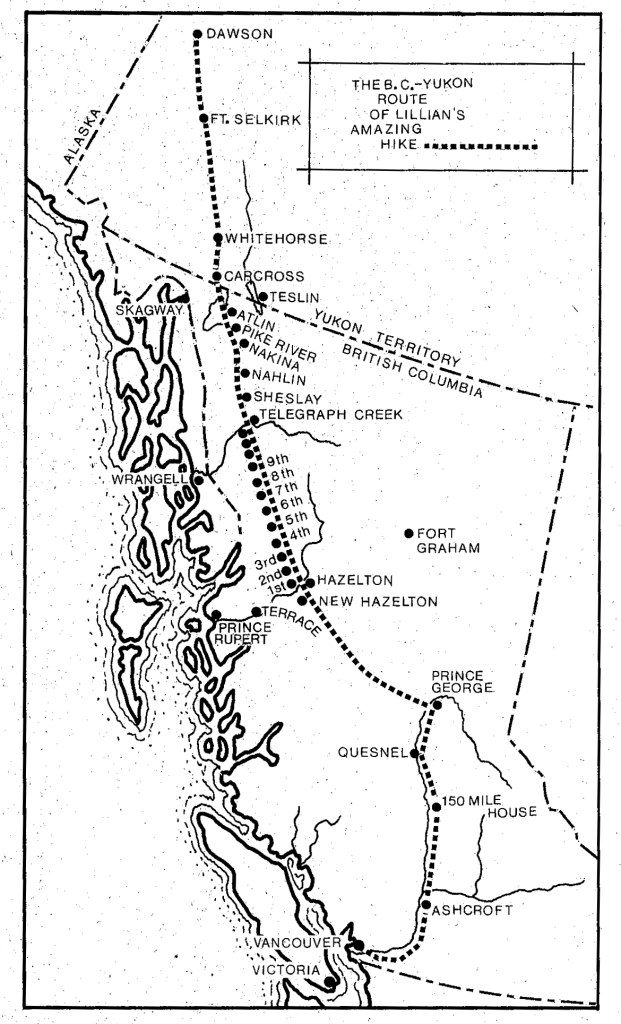
Recorded in police files, old newspapers, and the memories of old-timers in the north are fantastic accounts of endurance and determination. Possibly the greatest of these sagas, easily the most unusual, and certainly the most pathetic, was that of a Russian girl, Lillian Alling, who walked some 5,000 miles from New York City to the Bering Sea. Her incredible hike took her through Chicago, St. Paul, Winnipeg and Vancouver. Then she trudged up the Cariboo Wagon Road, through Prince George, then west to Hazelton. From here she walked northwestward for 1,000 miles across mountain passes via the Yukon Telegraph Trail to Dawson City, then down the Yukon River to the Bering Sea. “I go to Siberia” was the answer she gave to all questions about the reason for her trek. In all, she was four years on her solitary journey and whether she finally triumphed or perished in the mist-shrouded Bering Sea, or on the coast of Alaska or Siberia, no one knows.
Her past, and the strange compulsion which drove her to continue this venture of madness against every obstacle of man, plus nature at its worst, remains wrapped in mystery. Throughout all the days, months, and years of her walking, mystery surrounded her. People ranging from telegraph linemen to policemen, magistrate to prison warden tried to help her, or in her own best interest, hinder her from continuing her fantastic trek. She confided in none of them, and refused to listen to those who tried to convince her that the trek was foolish and very likely would be disastrous. “I go to Siberia,” she told them all, simply and with conviction.
At the very outset, among the hurrying millions, of New York City from where she started, only these sparse facts are known: She was twenty-five years old and came from Russia but why she came, how long she stayed, why she started for Siberia, we know nothing. We know she worked as a maid, spoke good English, and despite her occupation, apparently was well educated. She told the B.C. Provincial Police that, when after months of work she was still unable to save enough for steamer fare back to Russia, she decided to walk. She explained that she had studied books and maps in the New York Library and had drawn a rough outline of her journey, an outline which the Police thought a remarkable example of cartography on the part of one untrained. When the Police Officer at Hazelton told her of the impossibility of her plan, she replied: “There is only one big difficulty; the fifty miles of Bering Strait. I cannot walk that, but I will cross.”
Apparently she must have left New York early in the spring of 1927, because on September 10 she arrived at 2nd Cabin on the Yukon Telegraph Line which angled northeastward through mountain wilderness some 1,000 miles from Hazelton to Dawson City. On the first portion of her journey she had walked an average of thirty miles a day, a grueling pace that was repeated even in the rough going of woods and mountain. In fact, her stamina and determination continually amazed the experienced telegrapher linesmen, whose cabins every twenty to thirty miles guarded the wire. Her determination also amazed the Provincial Policeman who tried to bar her path.
During the earlier portion of her trek she was plainly and neatly dressed in brown skirt and shirt waist, plus stout walking boots. She also wore a scarf head-dress, common to Russian peasant women, and carried a small knapsack on her back. As she trudged across hundreds of miles of prairies and rolling rangelands, through the Rocky Mountains, over the Cariboo Plateau and into Northern B.C., her clothing became more and more trail worn. When she finally reached 2nd Cabin on the Telegraph Trail north of Hazelton, her skirt was in rags, shirt waist torn, and boots replaced with running shoes through which her bare feet showed.
With hospitality for which they were famous, the telegrapher at the cabin fed her from his own provisions, then asked her where she was going. “Siberia,” she replied without hesitation. The operator realized that she was in no condition, physical or clothing-wise, to continue her trek through nearly 1,000 miles of mountainous country to Dawson City and the end of the line. He sat down and wired Constable J. A. Wyman at Provincial Police headquarters in Hazelton and informed him of the woman’s condition. “And she says she’s going to Siberia!” was his incredulous comment.
Wyman was an officer experienced in the wilderness. He knew September marked the beginning of bad travelling weather on the mountain trails. Winter was fast approaching, north winds were waiting to swoop down from Alaska with death-bringing blizzards, and fog already hung low over the mountains beyond 9th Cabin, a region where even hardy linesmen could get lost. The constable instructed the telegrapher to keep the woman at 2nd Cabin until he arrived.
Wyman brought her back from 2nd Cabin, although she pleaded to be permitted to continue, then defiantly protested, but finally she yielded without the officer having to use force. At Hazelton headquarters, Wyman turned Lillian over to the District Officer, Sergeant W. J. Service. Again, in answer to a question about her destination, she promptly replied, “Siberia.”
Service gazed almost in awe at the woman. She was ragged, wraithlike from the effects of little food and her 3,000 mile hike. Her gaunt features and frame cried aloud of malnutrition. Kindly, Service strove to dissuade her. He pointed out the nearness of winter, and warned her that she endangered her life in going on. When she repeated her intention, he said, “In the clothes you are wearing you will freeze to death; and you are without food.”
Her reply was astounding. “I have three loaves of bread and some tea. I must go. Please do not stop me.” As she spoke, her eyes pleaded compellingly, suggesting to the seasoned frontiersman a motive akin to madness,
Sergeant Service was in a difficult position. Had he the legal right to prevent a peaceful citizen walking in a free country? Out of the kindness of his heart towards this strange foreign female, to prevent her from committing certain suicide, he hit upon a plan – he arrested her for vagrancy. In a cell the Police matron searched Lillian. She had two $10 bills, and under her skirt dangled a thin iron bar eighteen inches long. When, a few minutes later, the Sergeant remarked to Lillian the bar would be useless against wild animals, she answered curtly, “It’s protection against men.”
She little realized then how considerately and gallantly in the near future the telegrapher-linesmen on the lonely British Columbia-Yukon Telegraph Trail would treat her, and that the bar was the last equipment she needed. Brought before Justice of the Peace W. Grant in Hazelton Police Court on September 21, 1927, Lillian was charged with vagrancy. However, the very fact that she had $20, and was on a peaceful walk, made doubtful the strict legality of the charge. However, Magistrate Grant, moved by the same humane intention as the Provincial Police to prevent the woman’s folly at this time of year, overcame the legal technicality in her favor by one of his own. He fined her $25 and costs for carrying an offensive weapon!
As her bankroll was limited to $20, making it impossible for her to pay the fine, he gave her the alternative sentence of two months in Oakalla Prison at Vancouver.
Thus Lillian was saved her $20, and assured of free, reasonably decent food and lodging until even she would realize it was impossible to continue, at least for the time being, the hazardous trail leading across British Columbia and Yukon to Siberia. Also, in the mind of the magistrate, was the hope that in the months of confinement Lillian would have time for reflection and forego her folly. But such wasn’t the case.
When released from Oakalla Prison the second week in November she obtained kitchen work in a Vancouver restaurant. By the end of May she apparently had saved enough money since she again headed northward. By now the story of the girl’s hike had spread throughout the Provincial Police force and at the end of June 1928, Sergeant A. Fairbairn at Smithers received a wire that Lillian was heading his way. To his astonishment she reached Smithers on July 19. Fairbairn made a rough calculation and realized that she had averaged between thirty and forty miles a day. “Did people give you a ride in their cars,” he asked?
“I walked all the way,” she answered with proud dignity. “I go to Siberia,” she added, in an emphatic tone.
Fairbairn looked out of the window. There remained half of July, August, and early September that she, might expect good weather. By then, he reasoned, she would probably be over the worst of the mountain passes on the Telegraph Trail and into the Yukon. Since there was no ground on which he could prevent her, he let her continue, but asked her to report to each of the Cabins on the Yukon Telegraph.
“I will do that,” she said, with great fervor, and with thanks went on her way.
After she left, Fairbairn wired the personnel on the Telegraph Line, requesting that they keep a watch for her. Consequently, each operator reported her progress from Cabin to Cabin, carefully checking her pace and always amazed at her progress. The trail wound up and down valleys, across mountain sidehills, through mud and swamp and rough terrain in general, but the wiry girl maintained an average of twenty to thirty miles a day.
Cabins 1 to 7 reported her safe arrival and departure, and shortly after she reached 8th Cabin. Here two men, Jim Christie and Charlie Janze, were stationed as linesmen and telegrapher, and occupied a cabin, each. They were appalled at Lillian’s appearance. Her clothes were in shreds, shoes very worn. Her face was swollen from continuous bites of mosquitoes, bulldog, black and no-see-um flies, and badly burned by sun and wind. Yet it was the manner in which she dropped her nearly empty packsack and slumped into a chair which conveyed to the men how exhausted and hungry she was. But despite her worn out condition and beaten look, she shrugged off the men’s attempts to persuade her not to continue. Finally they realized that the only thing that could stop her was death itself, and they gave her every assistance they could. In the next three days while she rested in the cabin which Christie had turned over to her and ate enormous meals, the two men achieved a miracle of outfitting.
They remodelled a pair of Janze’s breeches which were of toughest cloth. Janze, the smaller of the two men, gave her two shirts, his best, and a new handkerchief for the head-dress she had always worn, and a felt hat over it to keep off the rain. He also gave her a pair of his stout boots, which with two pair of socks, Lillian could comfortably wear.
At this point, the popular accounts of Lillian Alling’s hike differ from what actually, happened. Many stories state that just before she left, Christie gave her his black and white dog, Bruno, as a companion. The same accounts state that she was deeply affected by the dog and remarked, “My first companion, he will always remain with me.” Later when she arrived at Atlin she carried on top of her knapsack the hide of the dog, lightly stuffed with grass. Supposedly, it had drowned while crossing a stream and she was keeping her promise to Christie that “he will always remain with me.”
One man who disagrees with this version is Cyril J. Tooley, who was relieving Bob Quinn at Echo Lake during the time of Lillian’s hike. Because of a tragedy which befell his partner, Scotty Ogilvie, who had set out to help Lillian, Mr. Tooley became deeply involved in the sad drama that was about to unfold and remembers it well.
“I have read several articles relating to the dog incident,” he wrote, “and in all cases they have errors in continuity and other things. For instance, Christie never had a dog called Bruno. His was called Coyote but he did not give it to Lillian; another lineman gave her one. But let’s go back to 8th Cabin and take things in sequence.”
“When Lillian left 8th Cabin, Christie accompanied her over the Naas Summit on past 9th Cabin to the cabin twenty-seven miles south of Echo Lake. Meanwhile, Scotty Ogilvie and I at Echo Lake were preparing to offer what assistance we could. Scotty loaded up his two dogs and went to meet her. I tidied up the cabin and was then required to go north on some line trouble.
“After clearing the trouble I called Echo Lake from a cabin which was about eight miles north of the Station but didn’t get an answer. I then contacted Jack Wrathall, the Wire Chief, at Telegraph Creek. He advised me that Scotty had not reported in since leaving Echo Lake in the early morning and I had better hit the trail as early as possible the next day.
“I became very concerned about my partner. Conditions were the worst possible since it had poured with rain, all week and the streams were in flood. Even with the greatest of care accidents could easily happen and, tragically, this proved to be the case.
“I headed out early next morning for the 7 Mile Refuge Cabin south of Echo Lake. On arrival I found Scotty’s two dogs huddled on the stoop, their packs still on but soaking wet and torn. I attended to the dogs but they would not accompany me so I proceeded up the Ningunsaw River to our usual crossing place. Scotty’s and the dogs’ tracks were easy to follow to where Scotty had tried to cross the river. Here the bank had caved in and it looked to me as if he and the dogs were catapulted into the river when the bank collapsed. I went back to 7-Mile, called Telegraph Creek and then Jim Christie. I eventually got Jim and told him I thought I could make it over the river, and for him to leave the girl at 27-Mile and I would meet him at what we called ‘Misery Cabin’ the next morning. We met as agreed and proceeded north to the Ningunsaw River. Because of the flooding there were several channels and we had to make bridges by falling trees and moving logs. “While looking for bridge-building material, I was shocked to see Scotty’s body wedged against a cottonwood tree in one of the channels. With heavy hearts, Jim Christie and I moved the body to a small island in mid-stream. Scotty had apparently struck his head when he fell in and had broken his neck. We wrapped him in a Hudson’s Bay blanket and canvas, made a stretcher and with difficulty carried him, to the bank. Here, with a prayer and great sadness, we committed his remains to the grave. “It was now quite late in the day and pouring with rain. We headed for 27-Mile Cabin and arrived late at night, looking like a couple of drowned rats. Luckily, Lillian had a good fire going and with a hot meal we felt better, although neither of us could get Scotty off our minds.
“The next morning at 27-Mile, Jim Christie and Lillian Alling said goodbye, Jim heading back for 8th Cabin, Lillian and I turning north for the river crossing and 7-Mile Refuge Cabin, where we arrived late in the afternoon. Early the next morning I left for Echo Lake since I was needed to instruct a Trail-and-Line crew where necessary repairs were required. One of the crew went to meet Lillian and bring her to Echo Lake Station where she rested overnight. Like us, she was deeply moved by the tragedy.
“The next morning she had much help and instruction from the men assembled there. It was at this time that Tommy Hankin loaned her his black and white husky lead dog, Bruno. Tommy gave explicit instructions on how to put the dog’s pack on properly, and also stressed that under no circumstances must she let him run free between 27-Mile north and the Iskut River. This was a trapping area and there were quite a number of poison sets out for wolverine. Bruno must have eluded her just south of the Iskut because he just made it to the Iskut River, took a drink and keeled over dead. This news was telegraphed to us at Echo Lake by Moose McKay who witnessed this additional tragedy from the north shore of the Iskut River.
“Lillian stayed at the Iskut Cabin for a day and then headed north but she didn’t have Bruno’s hide. It would have taken a skilled person several days to prepare a hide since it would have had to be tanned so that it could be carried during several weeks of hot weather.
“From Iskut she apparently made good progress once she reached the open country north of Telegraph Creek. We listened on the line and were able to follow her progress from Cabin to Cabin, and we all wished her the best of luck.
“I hope that this account will set the historical record straight,” Mr. Tooley concluded.
Lillian arrived in Atlin some time in August and then headed to Whitehorse. On August 31, 1928, the following news item appeared in The Whitehorse Star: “A woman giving the name of Lillian Alling walked into town Monday evening and registered at the Regina Hotel. Lillian was not given to much speaking but as near as can be gathered from information she gave at different places she had walked from Hazelton to Whitehorse, a distance of about 600 miles, following the government telegraph.
“However nothing is reported of her until she reached Atlin, where she tarried only long enough to buy a pair of shoes. At Tagish she was taken over the river by Ed Barrett. On Saturday last she arrived in Carcross and had a meal at the Caribou Hotel.
“She left Carcross the same afternoon, travelling in a northerly direction. On Sunday afternoon Mr. and Mrs. George Wilson overtook her between Carcross and Robinson and she rode in the car with them as far as Robinson, where she got out, saying that she was going to rest a while. Beyond saying that she was going a little north of Whitehorse she had very little to say. She did say, however, that for a part of her journey she had a pack dog but that he was drowned in crossing a stream. When warned that she would have streams to cross between here and Dawson she said that she would cross them on a log. She told Mr. Erickson that she did not have much money, and she seemed to be conserving her resources but paying her way. She had no means whatever of killing wild game and was carrying very little food If she knows her destination she is not telling but she started north from Whitehorse on the Dawson trail Tuesday forenoon.”
As she trudged toward Dawson, the newspaper carried reports of her progress, referring to her as “The Mystery Woman.”
“SEPTEMBER 7, 1928. The last report of the mystery woman was that she was seen by H. Chambers some distance east of Tahkinna several days after she left here. Mr. Chambers offered to give her a ride to the fork of the road but she declined.”
“SEPTEMBER 14, 1928, Word reached Whitehorse that the mystery woman passed through Carmacks but she maintained her silence. Some time later she arrived at Yukon Crossing where she allowed H.O. Lokken to put her over the river. She still had the Pelly and Stewart rivers to negotiate.”
“OCTOBER 19,1928. Mystery Woman Reaches Dawson. From the time of the first account of the Mystery Woman in the Whitehorse Star, the people of Dawson have been looking forward with an unusual degree of curiosity for her arrival there.
At Carmacks she made some meagre purchases and continued her journey; at Yukon Crossing H. O. Lokken put her over the river in a small boat; at Pelly Crossing A. Shafer performed a similar service for her; at Stewart T. A. Dickson’s survey party was camped and the boys cared for her for three days during a bad storm, and from this point she went down the river in a small boat to Dawson, arriving there in the morning of October 5th. She left Whitehorse on the morning of August 28 and as far as was known the only provisions she had was a loaf of bread, which she had cut in three pieces, as she said she was not carrying a knife.
“Thirty nine days were spent between here and Dawson and practically all that time she must have slept in the open. Upon reaching Dawson she had a different style of men’s shoe on each foot.”
How she survived the trek from Whitehorse to Dawson without adequate food, clothing or shelter is another mystery for in the Yukon October nights are short and the days cold. In Dawson she found employment as a waitress, living alone and confiding in no one. Somewhere she got a cheap, battered skiff and occupied herself repairing it and waiting impatiently for spring.
At break-up she loaded her flimsy craft with provisions and blanket roll. Then she launched it and bobbed down the mighty Yukon – a wraith-like wisp, of a woman embarked on a 1,600-mile journey to the Bering Sea.
She reached the mouth of the Yukon safely, then on the windswept coast of the Bering Sea she left her boat on the beach and trudged into the Arctic vastness. Months later an Eskimo reported meeting a woman beyond Teller, a coastal outpost near the point where Alaska and Siberia are closest. She was slowly tugging a small two-wheeled cart. After that encounter there was silence.
Did Lillian, by Eskimo or other boat, cross Bering Strait to at long last reach her Russian destination? Or somewhere on that bleak shoreline, or in the icy waters of an Arctic Strait, did she perish, writing finis to a saga unique in northern annals? No one can say.
Then, in 1972, I wrote an account of her hike for True West magazine. One of the persons who read it was Arthur F. Elmore of Lincoln, California, who wrote the following letter to the editors:
“After reading the article I decided to write because of a very peculiar incident that occurred back in 1965 when I was a visitor in Yakutsk, Eastern Siberia.
“I had been invited by a Russian ex-Army man, with whom I had become quite good friends in Mukden, Manchuria during the closing days of World War II, to come and visit if ever I got the chance. The opportunity finally came in April 1965 when the Cold War had thawed, so I went to San Francisco where I secured passage to Moscow. In Moscow I then flew to Yakutsk where I located my friend.
“It seems he, like I, enjoys mysteries, and one day while exploring around (as much as one was permitted to do) he suddenly asked what I considered a very strange question. ‘If I were in America, how would I be treated?’
“Somewhat taken aback, I replied, ‘In what way do you mean? What makes you ask that?’ Then he told me the following incident.
“As a very young boy – somewhere around fourteen or fifteen – he had lived in a very small community in the Soviet Far East named Provideniya, which is about 170 or 180 miles from the present town of Wales, Alaska across the Bering Strait. He stated that late one afternoon while on an errand for his mother he saw a crowd gathered on the waterfront and several official-looking men were present, questioning a woman and three Eskimo men. He said he recognized that the Eskimos were from the Diomede Islands in the Strait by their dress but the woman was differently dressed, like a European or American.
“He remembered the woman telling the officials she had come from America where she said she had been unable to make a living or make friends (Of necessity I’m condensing much of what I was told to save space). She said she had had to walk a terrible long way because no one would lift as much as a finger to help me in any way because they didn’t want to – or couldn’t understand – my feelings. I tried to make friends at first, but everybody wanted no part of me – as a foreigner – and that so deeply hurt me I couldn’t bear it and so I began to walk. I knew it was far and would be hard but I had to do it even if no one understood. And I did it!’.
“He told me he saw the girl and the Eskimos led away – he never saw them again – but the memory was to linger with him always. He also stated all this took place in the fall of 1930 – he was very positive of the date because he stated his parents and his family were moved two years later farther westward to a place named Ust Yansk where his father fished commercially.
“For several years all of this sort of haunted me – all mysteries do, in one way or another – but I never could figure out any answer. Then this past week I happened to pick up your magazine, and saw the article.”
“Now I’m really curious! Is it possible that that girl with the three Eskimos could have been Lillian Alling? The Eskimos were definitely dressed as the Eskimos of the Little and Pig Diomede Islands do. The only thing is – no black and white dog was visible or I’m very certain my friend would have said so. Anyway, knowing the people and the country as well as I do – I’ve spent nearly two-thirds of my life in Alaska – I’m very, very sure Lillian Alling made it! (Though, of course, I have no proof.)”
◀
