
Saving Life on the Skeena
by Jim Morris, Terrace Kitimat Daily Herald, August 10, 1978
On August 3, 1978 while taking a lunch break with his fellow CN work crew on the west bank of the Skeena River downstream from Usk, Donald RICHARD heard a high pitched scream. He first thought was one of his friends had caught a fish, and when he went to investigate, he saw an overturned canoe in the middle of the Skeena with a person clinging to the side of the canoe. While the rest of the work crew went to phone the RCMP, RICHARD realized he should do something right away.
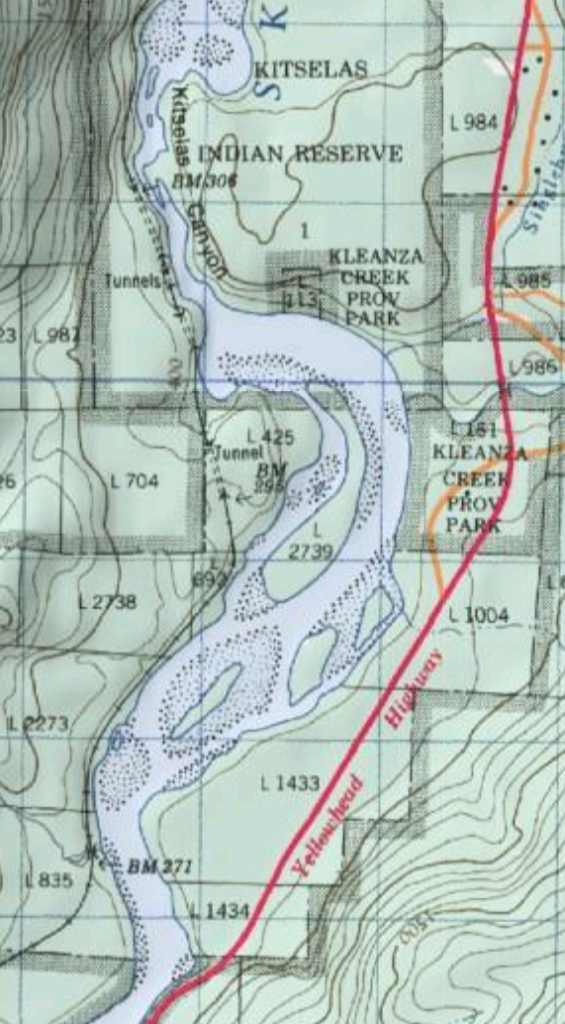
“I decided I’d better go in and get her, but by this time she was way down river and I was quite a ways behind her. I ran along the shore to try and keep up to her.” RICHARD said he wanted to go into the water to help the girl but she was on the far side of the river and he wasn’t sure he could reach her. He kept yelling to the girl he wouldn’t let her out of his sight and she kept screaming at him to help her. He says he was getting discouraged because he was still so far behind and was running out of both breath and energy. “Just as I was thinking I was wasting all my energy she hit these rapids and at that point I thought for sure I was going to lose her. That’s when I decided, even though she was that far ahead of me I should enter the water now because I was getting nowhere running.”
RICHARD says he took off his clothes and entered the water. He relates he was getting fairly close to the girl when he saw a truck on the opposite bank of the river. He yelled at its occupants he needed help and they waved, turned and headed toward Terrace.
“I had no idea what they were doing. I thought for sure they were going to come out of the truck to help us. I was getting really cold and tired and I could have used somebody at that point.”
The people in the truck had a CB radio and tried to contact police RICHARD later learned. Meanwhile, he was nearing the girl.
“As I was swimming to her she was pleading with me not to drown. The reason she was afraid for me, the first words she spoke to me when I got closer, was her father had just drowned. She told me she had seen her father drown and she did not want me to drown.”
RICHARD says the girl was hysterical and he hesitated going near her in case she grabbed him and they both drowned. He says he was surprised she was only a child because he hadn’t seen her until this point in the drama.
“Her canoe was three quarters under water and she never really was able to get on it because it kept rolling with the current. She kept grabbing to stay with it. I grabbed onto it and held it in a certain position so she could get on it, then explained to her everything was O.K. and we were going to do it on our own.”
RICHARD explained at this point he didn’t know where he was on the Skeena River. He felt the canyon where the river narrows between two walls and the current is stronger, was ahead of him. It wasn’t until he reached shore he found out the accident had occurred in the Canyon and by the time he reached the canoe they were well down stream from this point.
“After floating with her for quite a long ways and explaining to her I had thought the canyon was ahead of us and we were both going to drown if we didn’t get away from the boat, I told her if she didn’t relax she would drown me. So finally she said she would get on my back and we would go for shore.”
RICHARD says he had entered the river on the track side of the Skeena and now they were going to try to reach shore on the highway side. He says the current was going this way and he felt they could make it easier.
“Amazingly enough when she got on my back she was really helpful because she kicked her feet and everything. She was really calm and never strangled me.”
He adds because of the life jacket Ann was wearing, she was much lighter than she normally would have been.
“After a lot of stroking and stuff we weren’t getting too far. We tried for this one point that was sticking out and we missed it. We got pretty discouraged about that.”
RICHARD relates after fighting the current for what seemed a long time he finally got close enough to the shore he thought he could stand up, but this was not as easy as it seemed.
“When I finally did touch bottom I couldn’t stand up, the current would throw us back into the river. I was very tired and she knew it. We did a lot of kicking and stroking until finally I did stand up. When we finally got to stand up I couldn’t move. My body was so exhausted I just started shaking. She started crying she was so happy that she was not going to die.”
RICHARD says both he and Ann rested on the shore for a time. Because he wad taken off his clothes to swim, he couldn’t help warm her up. Also no one knew where they were. They had about half hour wait before the RCMP picked them up in a boat.
Once they were back in Terrace, Ann had to go through the ordeal of telling her mother, who had been waiting for them in Terrace, her father was dead. RICHARD says they were in a room when the mother came in.
“She asked Ann where Dad was. Ann told her he had drowned and she just went to pieces. It seemed to me she had no idea he had drowned.”
RICHARD says it was his belief in the Baha’i faith which gave him the strength to fight the current of the Skeena River to save the life of Ann Baxley. “It’s being a Baha’i. Its my belief that I should risk my life, or give my life for another person. Part of our belief is we should help anyone who is in distress. I think being a Baha’i gave me the strength and the decision right away to help this person with no hesitation whatsoever.”
“I shouldn’t be praised for what I did because what I did was something I had to do.”
Since the accident and rescue, RICHARD says he has seen the mother two or three times.
“They’re very beautiful people. They thanked me a heck of a lot. The brother flew in from Hawaii. He wanted to thank me for what happened.”
At last report Ann had been released from Mills Memorial Hospital. The police had given up the search for the body of Ann’s father and the family has returned home to the United States.
—
On September 26, 1978, Commander Robert A. Duin of the Seventeenth Coast Guard District in Juneau, Alaska wrote to the Commandant of the United States Coast Guard with the following recommendation:
Subj: Recommendation for Gold Lifesaving Medal
Ref: (a) Medals and Awards Manual (CG-207-2)
1. It is with distinct gratitude that I submit this letter highly recommending Mr. Donald A. Richard of Usk, British Columbia, Canada for the Gold Lifesaving Medal in accordance with Section 417 of reference(a). This recommendation is made because of Mr. RICHARD’s direct personal and singular efforts in the rescue of Anne Marie BAXLEY from the waters of the Skeena River, east of Terrace, British Columbia on 3 August 1978.
2. To briefly recount the events leading up to the rescue: Commander Baxley and his daughter, Anne Marie were boating down the Skeena River from Usk to Terrace, British Columbia in the late morning on 3 August 1978. At some point while travelling through the Kitselas Canyon, their craft capsized, spilling them into the water. Both occupants were able to hang onto the boat at first, but at an undetermined time after the capsizing, CDR BAXLEY became separated from the boat and disappeared beneath the surface of the river. CDR BAXLEY’s drowning was witnessed by his daughter, Anne Marie. At some point after the boat capsized, she climbed on top of the boat and managed to hang on until her cries for help were heard and she was rescued. This occurred approximately 8 kilometers down the Skeena River from the Kitselas Canyon.
3. The circumstances of the rescue are as follows: Mr. RICHARD was a member of a Canadian National Railways crew working on tracks adjacent to the Skeena River. The crew was on their lunch break when they heard Anne Marie BAXLEY’s cries for help. While the rest of the crew went to get help, Mr. RICHARD decided that some action had to be taken immediately. Without hesitation, he responded by running along the river bank for approximately 800 meters trying to keep up with the boat. He finally decided to enter the water in an effort to aid Anne Marie and, at that point, disrobed, got into the water, and began swimming. With complete disregard for his safety, he swam through the frigid waters for more than 130 meters and finally reached the girl and the boat. He then tried to persuade Anne Marie to return to shore with him, finally convincing her to climb on his back and swim with him to the opposite shore. Once on shore, and although totally exhausted from the ordeal, he ministered to her until additional help arrived.
4. The Skeena River in the vicinity of Terrace, British Columbia is a swift moving, turbulent, silt laden, and cold. Its width and depth varies considerably with the terrain, being approximately 275 meters wide where this rescue occurred. The water temperature was between six and seven degrees celsius and the air temperature was approximately 23 degrees celsius.
5. Enclosure (1) is the RCMP report (editor: not available here) and Enclosure (2) portion of topographic map (editor: not available here). Enclosure (3) is a newspaper account of the rescue (editor: reproduced above)
6. In summary, Mr. RICHARD’s act of heroism in rescuing Anne Marie BAXLEY from the frigid and turbulent waters of the Skeena River is truly outstanding and worthy of recognition. Enclosure (4) is a proposed citation for the Gold Lifesaving Medal.
Robert A. Duin
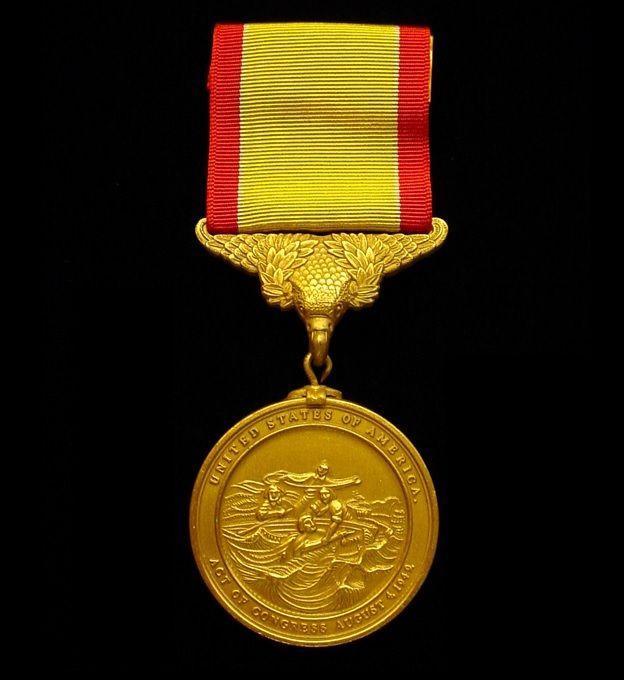
This is the CITATION issued upon the presenting of the GOLD LIFESAVING MEDAL:
The Secretary of Transportation of the United States of America takes pleasure in presenting the GOLD LIFESAVING MEDAL to
DONALD A. RICHARD
for acts as set forth in the following
CITATION:
“For extreme and heroic daring on the afternoon of 3 August 1978 when he rescued a young girl from drowning in the Skeena River near Terrace, British Columbia, Canada. Mr. RICHARD, a member of a Canadian National Railways crew working on tracks adjacent to the Skeena River, was on his lunch break when he and other members of the crew heard the young girl screaming and observed her hanging onto an overturned canoe being swept down the river. As other members of the crew went for help, Mr. RICHARD ran to the river bank and followed the canoe for approximately 850 yards. Then, with total disregard for his own personal safety, Mr. RICHARD entered the turbulent, frigid waters and began to swim to the girl. Reaching the girl after a swim of 145 yards, Mr. RICHARD’s calm assurance convinced the frightened girl to leave the canoe and climb on his back. Although exhausted from the swim to the canoe, Mr. RICHARD began swimming toward shore, with the girl on his back. Upon reaching the river bank Mr. RICHARD, suffering from exposure and exhaustion, ministered to the girl until additional help arrived. Mr. RICHARD’s unselfish actions and valiant service reflect great credit upon himself and are in keeping with the highest traditions of humanitarian service.”
For the Secretary,
J. B. Hayes
Admiral, U.S. Coast Guard

And on January 28, 1980, The Governor General of Canada awarded the Star of Courage to Donald Richard and he was invested on June 30, 1980:

Mr. Donald Anthony Richard
Usk, British Columbia
Decorations for Bravery
Star of Courage
Donald Richard saved a girl from drowning in the Skeena River near Usk on 3 August 1978. The girl and her father had been running the rapids when their kayak overturned. The girl’s father was drowned, but she continued downstream with the kayak. Her cries were heard by railwayman Donald Richard who was eating his lunch by the river bank with other men. He stayed on the scene while the others went for the police; and when he realized that the girl would be dragged into other rapids, he swam out to her. Rather than tow her to shore he took her on his back, and though they were carried along a considerable distance by the current, he was able to bring her to safety.
◀
