
S.S. Caledonia
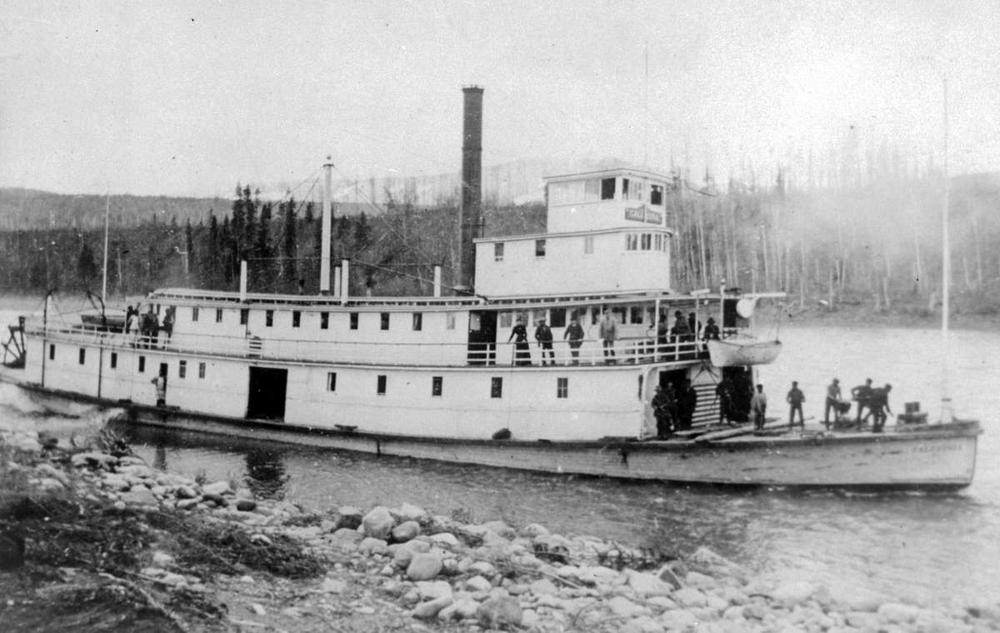
“In the early days the Hudson’s Bay Co. found it very difficult and expensive to supply their interior posts from Port Simpson, which at that time was the headquarters and main distributing point for New Caledonia, as the northern district of British Columbia was then called. All goods had to be taken in by canoe up the Skeena River and all raw furs brought out the same way. This not only was a very dangerous means of transportation, owing to the treacherous river and the hostile Indians encountered along the way, but was expensive and wasted a great deal of time. About the year 1889, on the recommendation of Mr. John Flewin, who was then government agent of the district, Mr. R. H. Hall, chief factor of Port Simpson trading post, decided to investigate the possibilities of running a stern-wheel steamer on the Skeena River as a means of lessening the expense as well as the hazards of distributing supplies to the interior. As a result Capt. George Odin, of New Westminster, a well known river steamboat man, thoroughly investigated the possibilities of negotiating the treacherous Kitselas Canyon on the Skeena River. Under his instructions the first Hudson’s Bay Co. sternwheel river steamer was built in New Westminster in 1890. Capt. Odin successfully negotiated the Skeena River to Hazelton with her in 1891” . . . The Beaver, December 1936, p. 51
| Name, Reg | Tonnage | Len x Wid x Draft | NHP | Engines | Passengers | Info |
| Caledonia, C-97162 | 237 | 100 x 25.4 x 4.7 | u/k | 16 x 72 | u/k | Built 1891 at New Westminster, BC by Alexander Watson 16 mph |
| Caledonia, C-97162 | 354 | 132 x 24 x 4.7 | u/k | 16 x 72 | u/k | Re-built at Port Simpson in 1895 |
| Caledonia, C-107145 | 569.06 | 142.4 x 30.4 x 4.0 | 17 | 16 x 72 | 100 | New hull built in Victoria in 1898 for the Hudson’s Bay Company, hardware from C-97162 used in construction. Macdonalds Steamboats & Steamships says she was run on the Skeena as the Northwestern. |
Captains:
Capt. Asbury Insley
Capt. John H. Bonser
Capt. John Clowness, Canadian Master under Capt. Stuart B. Johnson
Capt. Stuart B Johnson
Capt George Magar
Capt. Frank Odin
Capt. George Odin
Capt. James W Troup
Capt. Whelan
Thomas Hatherly, Engineer
William Daly, Engineer
Edgar J Crickmay, Purser
There are almost no references to Caledonia I or Caledonia II, just Caledonia, and you have to use the date to determine which hull is being talked about.
Ships Registry entry for Caledonia courtesy Library and Archives Canada:
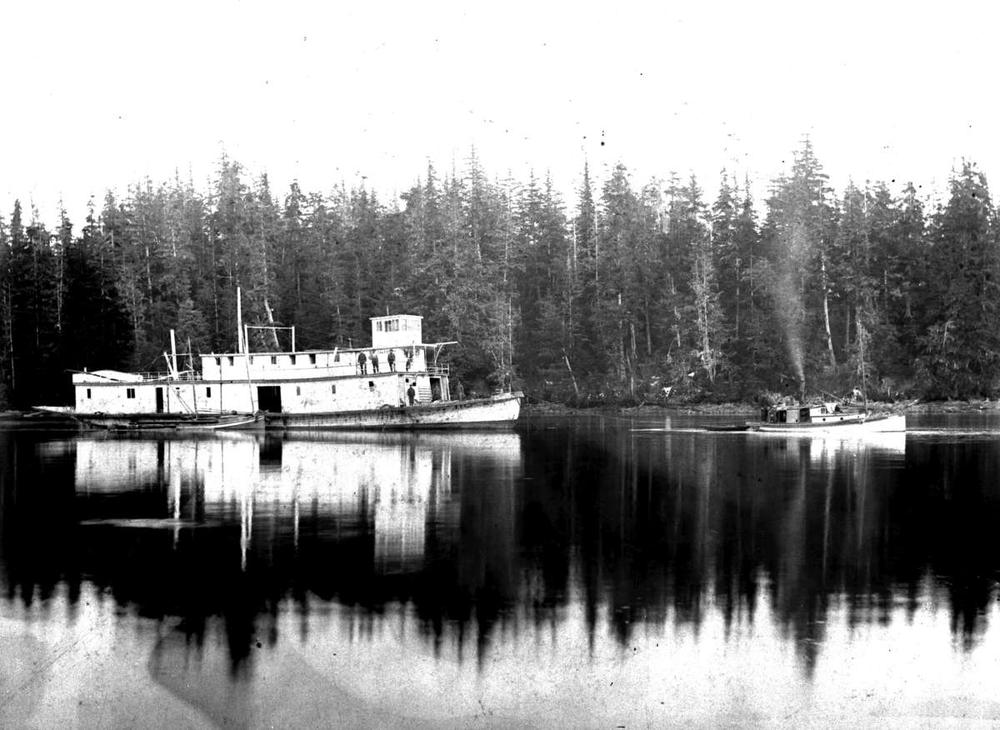
Caledonia C-97162
Was built at New Westminster BC by Alexander Watson for the Hudson’s Bay Company and based at Port Simpson. She was towed to Victoria for installation of the engines and machinery. She was in the command of Captain George Odin, with Thomas Hatherly as engineer. They got as far as the big canyon, Kitselas, with the river rising in its spring runoff. He stopped there and sent for his son, Frank Odin, also a captain, and when the river subsided, they struggled through to Hazelton. When they got back to salt water and their port at Port Simpson, the captain decided he had had enough of fighting the Skeena. The son made a second trip to Hazelton and when he got back to Port Simpson he also quit. So in 1891 just two trips were made. The summer of 1892, a James W. Troupe made several trips, then Captain John Bonser became captain.
Henderson’s City Directory of 1899 lists Capt John H. Bonser as Captain, William Daly as Chief Engineer and Edgar J Crickmay as Purser.
In 1895 when she was re-built at Port Simpson, Capt. John H. Bonser took command of the ship. She was rebuilt at Port Simpson to the specs in the second row of the above table. According to Macdonalds, in 1898, she was dismantled and replaced by the Hazelton. Her machinery was removed (as evidenced by the above photo) and placed into the hull of Caledonia C-107145.
While the Caledonia was in charge of Capt. Stuart B. Johnson, as he was a United States citizen, the Caledonia was required to have a Canadian master on board, and this was Capt. John Clowness.
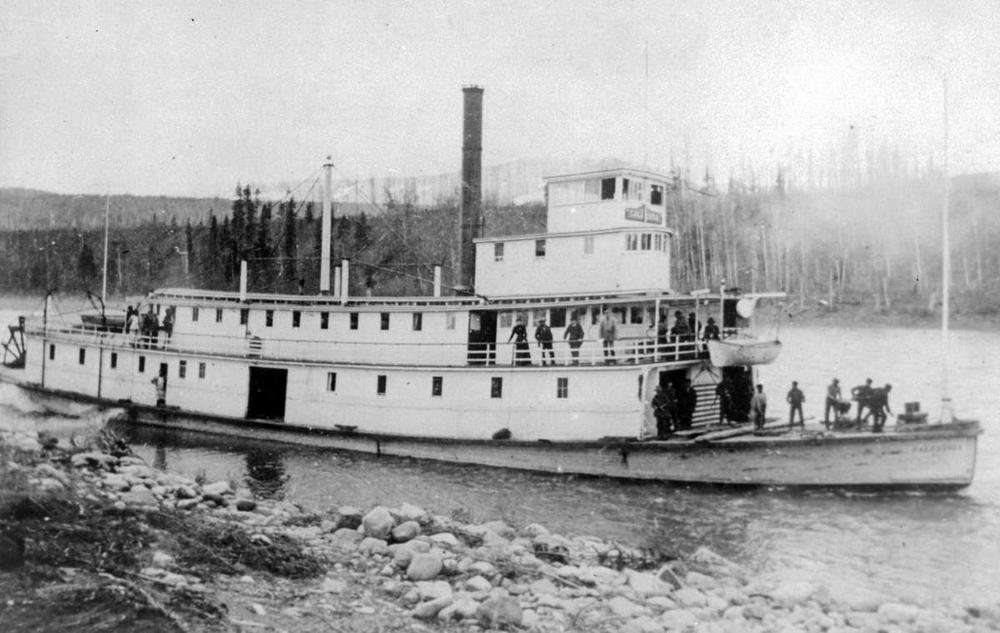
Caledonia C-107145
The Caledonia pictured above was built in 1898 at Victoria BC for the Hudson’s Bay Company for service on the Skeena River. She was more than twice the tonnage of the original Caledonia, but was powered with the same machinery from the first Caledonia. At one point she hit a rock upstream from Port Essington under Capt. J. H. Bonser and sank. She was raised and put back in service within three weeks.
Between 1891 and 1901, and 1907-08, Cunningham’s Diary kept at Port Essington recorded 47 trips that both Caledonia’s made up the river. This record of trips is not definitive since Caledonia was based at Port Simpson, and she could have made trips up river without calling in at Port Essington. Her last recorded trip from Hazelton in the Diary was on May 28, 1908. She was stored at Port Simpson due to lack of river freight and high cost of running. The vessel was found to be to heavy for the upper river.
On one of Caledonia‘s trips up the river, “she met with grief on a rock at Hankin’s Riffle near Philips Creek. The rock was henceforth known as Caledonia Rock.”
Wiggs O’Neill in his booklet Whitewater Men of the Skeena tells how the Caledonia made it down the river on one engine:
Ingenuity a Must
“In the steam boat days, there were no shipyards of any kind. The crew had to have a little bit of know-how to be able to get along. The following is an illustration. On one trip coming back to the coast after a good trip to Hazelton, just after passing through Kitselas Canyon, the Caledonia blew a cylinder head on the starboard engine. They were lucky it didn’t happen in a bad place, as they were able to launch a ship’s boat and run a line ashore and snub her into the shore and tie up.
There they were, lucky but helpless. There being no telephones or telegraphs, it would be necessary to send a small boat or canoe to the coast to catch the coast mail boat and order parts from Victoria. Captain Bonser and Pat Hickey the chief engineer went into a huddle and put their thinking caps on. Pat said, “From my end of the ship I’m helpless, with only one engine, she will either stick on top dead centre or bottom, and that’s it”. Captain Bonser got an idea “Look, Pat” said he, “if I have Paul Kato (the ship’s carpenter) remove a bucket (one of the paddles in the stern wheel) from the paddle wheel, that is in the water, when your engine is on top dead centre, and on dead opposite when she is on bottom, there being no resistance she will roll over herself and the eccentric will open your steam valves – what you think?” – “Well” said Pat, “go ahead and we will try it, but be sure you keep a line ashore, while we’re trying it”. They tried it out, tied up to the bank, and lo and behold it worked. They made their way back to Port Simpson on their own steam on one engine. Of course there was a terrible vibration, caused by being two paddles short, but they made it. Afterwards Pat Hickey said he doubted if he had a sound tooth in his head left.”
In 1907, she was sold to a syndicate in Prince Rupert headed by Major Gibson. Initially she was used as a hotel at Prince Rupert. They ran her on the Skeena as the Northwestern, however Cunninghams Diary shows no mention of the Northwestern, and referred to the Caledonia making trips up the river in 1907-08 after it had been sold to the syndicate. According to Large in his book Skeena, River of Destiny, Caledonia was put back in service in 1907-08 after the loss of the Mount Royal, until Port Simpson came into service in 1908. In August 31, 1908 the Daily Province reported that the Caledonia, owned by Foley, Welch and Stewart (probably under contract to FWS) struck a rock in the Skeena River and went to the bottom. She was 20 miles up river from Port Essington when the accident occurred. She settled to the bottom of the river and remained up right. The tide, which runs up the Skeena past the wreck site was at its peak, with the wheelhouse still above water. The Grand Trunk Pacific steamer Distributor with scows, was able to unload most of the cargo, which was saved. She was lightened enough to be re-floated and was taken to Port Essington. After running aground a second time, she was abandoned on Carnation Island near Telegraph Point. According to Macdonald’s she was dismantled and the fittings and engines where put into the Omineca.
In December 1909, Caledonia was struck from the Registry of Ships.
Macdonald’s has another entry for a vessel called the Caledonia:
Sternwheeler, built 1858 at Victoria BC by James Trahey for the Faulker Bell & Co. 100.0 x 18.5 x 3.0, 20×30 engines. In 1860, she ran the Victoria to Fraser River route. On Nov 3, 1859, enroute to the Fraser River her boiler exploded under Capt. Halsey. Fireman Charles Green was killed. She drifted ashore near Orcas Island, Wash. Later she was repaired and ran on the Skeena River, BC. In Nov. 1865, she was wrecked there.
Editor: I have found absolutely no reference to any ship being wrecked on the Skeena River in 1865, and no other reference to a ship called the Caledonia being on the Skeena in the 1860’s.
Sources:
Armstrong, Cliff Sternwheelers on the Skeena , 2001
Bennett, Norma V Pioneer Legacy: Chronicles of the Lower Skeena River, 2001
Henderson’s City Directory, 1899
Large, R. Geddes Skeena River of Destiny, 1957
Macdonald, Joseph F. Macdonald’s Steamboats & Steamships of the Pacific Northwest.
Frank, Floyd My Valley’s Yesteryears, 1991
Wright, E. W. Lewis & Drydens Marine History of the Pacific Northwest, 1967
◀
