
The Skeena War
No shots were fired, but it was a grand outing for Victoria’s soldiers–until it started to rain
by Ken Campbell, originally published in the Beaver, August-September 1989

“From the days of the Hudson’s Bay Company through the gold rushes and into Confederation, the Royal Navy protected British Columbia’s coastline. The men-of-war represented the British Empire in the distant colony, and kept the coast under the Union Jack through international conflicts with the United States and Russia. As well, the Royal Navy enforced civil obedience. Wherever outbreaks of trouble between whites and natives occurred, the remedy was swift and simple: Send in the gunboats. Usually the mere presence of the impressive naval ships was enough to have “a salutary effect”, a phrase used time and again to describe the results of a gunboat visitation on a coastal native village.
By the late 1880s the Tsimshian tribes who lived along the Skeena River and adjacent coast had been visited by Royal Naval vessels on five occasions. The natives had lived for over forty years in relative peace beside the local Europeans, the men of the Hudson’s Bay Company.
After B.C.’s union with Canada in 1871, however, new settlers arrived on the Skeena, attracted by the lucrative salmon runs of the river and gold of the mountains. By 1888 five canneries were operating on the Skeena, while the trails of the prospectors had opened B.C.’s northern interiors, developing the Skeena into a viable transportation route. In 1880 the Hudson’s Bay Company erected a post at Hazelton near where the Skeena and Bulkley rivers meet, to service its established forts in the interior over the new route. With more settlers encroaching on their land and various government agencies interfering with their lifestyle, setting out reserves and administering European laws, the Tsimshian found themselves more and more in conflict with the newcomers.
For a time the Royal Engineers had offered land based protection for the colony, but British Columbia had no such force from the Engineers’ departure in 1863 until the establishment of “C” Battery, Royal Canadian Army, in 1887. In October of that year, fifty men from “A” Battery in Kingston and fifty from “B” Battery in Quebec were drafted to the new force. With their wives, children and pets, they gathered at Carleton Place on the mainline of the new Canadian Pacific Railway bound for the West Coast. This was the first Canadian transcontinental troop train. In Victoria the new battery was housed in the old Agricultural Hall at Beacon Hill Park until barracks were completed at Work Point, near the entrance to Victoria harbour.
Victorians were pleased to have their own army detachment, but many were disappointed that the unit was Canadian rather than British. To many old timers and society people, Victoria was still a colony, and they resented the intrusion of the Easterners. Lieutenant G. H. Ogilvie, one of the officers transferred from Kingston, described the colonial atmosphere in his memoirs: “The people of British Columbia, the old timers that is, did not have much ‘truck’ with Eastern Canadians at that period and were really more English than the old country people themselves. They would not think of doing business with Eastern Canada and always passed through the United States via New York when travelling to and from England.”
The soldiers’ barrack duties, drill and other tasks were not onerous. The armaments at Work Point were so antiquated that the main benefit derived from artillery drill, according to Ogilvie, was the exercise. Commanding headquarters were in Ottawa, a week’s train journey away, so there was ample warning of an impending inspection.
But this relaxed style of life came to an abrupt halt in the summer of 1888. On 27 June the white residents of Hazelton sent a messenger to Victoria carrying the news that their lives and property were in immediate peril. On 19 June, the letters carried by the messenger advised Constable Green of Hazelton had gone to a neighbouring village, Kitwanga, to arrest a chief known as Kitwancool Jim for murder. While trying to make the arrest, Green shot and killed the chief. The Gitksan (People of the Skeena) were said by Constable B. W. Washburn, officer in charge at Hazelton, to be bent on retribution, demanding $1,000 and a man’s life in place of that of the murdered chief. “Am fortifying the Hudson’s Bay Co.’s building”, the Hazelton constable wrote. “Adopted it as our barracks. After three days hard work, moving in rain, have made ourselves secure”. He requested that the provincial government send fifteen or twenty men to bring about order. “It would nip the affair in the bud, and secure peace and law for the future”.
The messenger finally reached Victoria with the news on 11 July. Soon everyone in the capital city was talking about the apparent uprising. Rumours of inter-tribal warfare spread, tales were told of threats to the lives of the white people in Hazelton, even the death of Mr. Clifford, the Hudson’s Bay Company agent there. There were fears that the incident would have repercussions on the lower Skeena, interfering with the business of the salmon canneries which were manned largely by native workers.
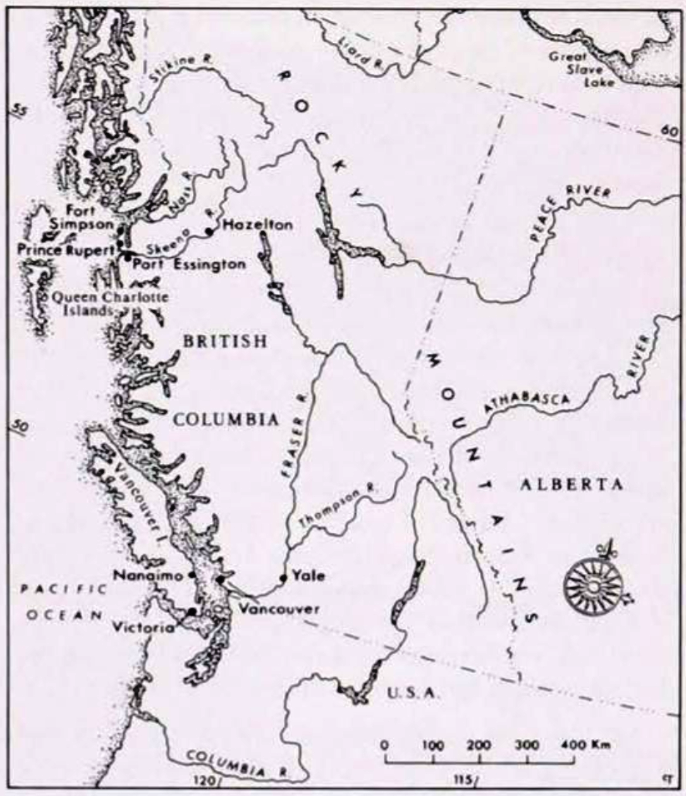
British Columbia’s Premier and Attorney-General, Alex Davie, had known about the murder case for months, working with Superintendent Roycroft of the B.C. Police to track down Kitwancool Jim, who had gone into hiding after being accused of murder. Now he called in Roycroft and twelve special constables to lead an expedition to Hazelton to “establish order in that hitherto turbulent and disaffected locality”. Falling back on the precedent of a show of strength, and perhaps sensing a potential repeat of the North-West Rebellion, he also called out eighty members of “C” Battery to support Roycroft. Thus he was dispatching nearly one hundred men, though Constable Washburn had requested fifteen to twenty, a number large enough in his estimation to “nip the affair in the bud”.
Davie’s orders to Roycroft were specific. He was to call on “C” Battery only if his progress to Hazelton was obstructed. “The executive desire to express to you most strongly the opinion that the Militia should not be called upon to fire, except in the case of last resort”. In a later communication he emphasized that the Militia was not to go up the Skeena if matters were settled, and if the senior officer insisted on proceeding further it would be at his own risk and responsibility. While Davie told Roycroft, ” Do not consider your discretion in any way fettered”. He seems to have put rigid restraints on Lt. Col. J. G. Holmes, Commander of “C” Battery, throughout the campaign. Within four days the plans for the expedition were decided upon and arrangements made. The special constables were to travel up the coast aboard the Royal Navy ship HMS Caroline, accompanied by “C” Battery. Roycroft would leave on an earlier ship, the Boscowitz, as would the bulk of the battery’s stores. Colonel Holmes chose special equipment for the campaign. Brown canvas clothing had to be specially made and was finished just hours before departure. Each man was to carry a pack that was light and easily removed. Holmes had used a similar pack on an elk bunting trip, he told his superiors in Ottawa, and found it quite suitable for rough country.
The colonel requested that the Caroline move to Victoria harbour closer to the barracks; when this could not be arranged, he asked that transportation to Esquimalt be provided for his eighty men. The Premier replied drily, “The Government having caused enquiries to be made find that they are unable to provide carriage for your men to Esquimalt.”
So it was that at 11:00 Monday morning, 16 July, “C” Battery’s parade was inspected by Lieutenant-Governor Nelson, who complimented the troops on their fine appearance and expressed the hope that they would return home safely, successful, but “not compelled to fire a shot”. The men embarked on the journey with mixed feelings of bravado and fear. One soldier proclaimed that he had fought Apaches and he had always found that “a brave has no use for, and will never shoot a white man whose hair was cut short.” His hair had been closely cropped the previous night. The tailor of the battery, unsure of his fate, made a verbal will. To the bandmaster, who would return from the North immediately, the tailor willed his shears and his goose.
Here were a group of Easterners less than a year in Victoria, bound for a mountainous northern land, densely covered with an evergreen rain forest; but if they were Easterners, they were also Victoria’s army, venturing forth to bring peace to the western reaches of the Empire. Residents filled the streets to watch the troops march from Beacon Hill to Esquimalt. They paraded through town, along Humboldt Street, Government and Johnson Streets, and over the railway bridge. Even this portal was crossed with ceremony as the Hon. Robert Dunsmuir, President of the Council, opened the gate for them to pass. So they marched on to Esquimalt, a distance of four miles, through the July heat and dust, with the band in the lead playing”The Girl I Left Behind Me”. By the time they reached Foster’s wharf their bright new uniforms were tarnished with the dust. There they joined with the special constables who had arrived on a “bus” armed with rifle, revolver and dirk, dressed in distinguished and clean uniforms.
The three-day journey took the troops through the splendour of the Inside Passage, that protected chain of sounds and channels that extends from Vancouver Island to Alaska. The soldiers seem to have enjoyed their tour immensely, despite having to adapt to the seaman’s life. The Colonist’s “war correspondent”, Dr. Chalmers (also one of the special constables), wrote in his report of the excursion, “it will be a very long time before we forget the good time we had on board the HMS Caroline and the generous treatment accorded us by all on board, not to speak of the fun we had with Jubilee, Ginger and Vandalia.” He provided no further details on the last three mentioned.
The soldiers and special constables had to bunk on deck. While they were searching in vain for soft planks the British “bluejackets” came to their rescue, offering the use of their hammocks. When the soldiers endeavoured unsuccessfully to climb into the hammocks without falling out, “the jack-tars came to our relief and soon we were as snug as we could well wish to be”.
The next morning at breakfast the men were greeted with a large tin of greasy cocoa. If anyone tasted the beverage that first morning, none were so brave the next, for the Caroline was passing through Queen Charlotte Sound, which is open to the Pacific Ocean. The hammocks swung in time to the pitching and tossing of the ocean swells. To make matters worse, sea spray drenched them. Chalmers described their plight; “Wet, hungry, sick and thirsty, we wended out way on to the top-gallant forecastle to pass a few minutes in admiring the wonders of the deep.” By lunch the sound had been crossed and the seasick landlubbers were in a better mood for eating.
The highlight of the voyage was the concert given on the last evening at sea. The Colonist printed the programe before departure, a curious detail given the shortage of time available for the journey’s preparations. Sir William Wiseman, captain of the Caroline gave two comic recitations “in his inimitable style” while the “gallant Colonel sang ‘The Midshipmite’ in his usual manly style.”
On Friday 20 July the Caroline anchored off Port Essington, near the mouth of the Skeena River. Essington was the hub of the north coast during the summer. A conglomeration of many races gathered there to fish for and work in the salmon canneries. Its stores, hotels and bars provided a welcome release for the fishermen. Port Essington was a one-man town, begun in 1871 by Robert Cunningham. This fiery Irishman had worked for the Hudson’s May Company at nearby Fort Simpson (today’s Port Simpson) until he decided to enter into his own trading business closer to the Skeena River.
The Caroline reached Port Essington before the Boscowitz, so Holmes, Wiseman and Turner went ashore to assess the situation while they waited for Roycroft. There they learned that the rumours heard in Victoria were false; Mr. Clifford was quite healthy and no further conflicts had occurred between natives and whites. However, all residents except a missionary had taken protection behind Hazelton’s strongly barricaded Hudson’s Bay Company post.
Roycroft arrived the next day, and the officials decided that the constables would leave for Hazelton as soon as canoes and crew could be found to transport them, while “C” Battery would camp at the river mouth awaiting word from Roycroft, and return to Victoria at the earliest possibility.
According to Turner, as he visited on the Skeena, “There was a general expression of opinion that the expedition would have a very salutary effect upon the Indian Mind.”
Holmes searched for a suitable camping spot and found a rocky, densely wooded point a mile and a half from Port Essington, on the Ecstall River, a tributary of the Skeena. Holmes did not want his troops too near the town, saying “it [is] desirable for many reasons that the men should not have free access to it.”
Early on Monday, 23 July the British sailors gave three cheers as the soldiers left the Caroline to begin clearing the camp. By the afternoon, the soldiers had transformed the wilderness into a semblance of military order. Turner described his visit that day. “Sentries were on duty, the tents were erected and the noonday meal was being prepared. Everyone was cheerful and contented; there were no mosquitoes and the weather was fair.”
This rocky point, still known today as Soldier’s Point was to be “C” Battery’s home for a month. At first the men lived in tents, but daily work improved the camp until an acre had been cleared and a number of log cabins built.
Reveille was sounded every morning at six. Breakfast came after an hour’s work on the camp, then the soldiers continued clearing until 2:30. The officers conducted rifle practice and drill, while Major Peters, who had served in the North-West Rebellion, instructed the men in “Indian Warfare”. He sent them out in skirmishing order and directed them how best to shoot in wooded areas. They held shooting competitions, aiming at blazes on trees.
The camp had many visitors from Port Essington, judges and fishermen, ministers and cannery workers. “When the canneries shut down packing, ” wrote one of the officers, “the Indian family, with their canoe load of goods, would paddle up the river to the camp and take a good look at the novel sight before starting up river for home.”
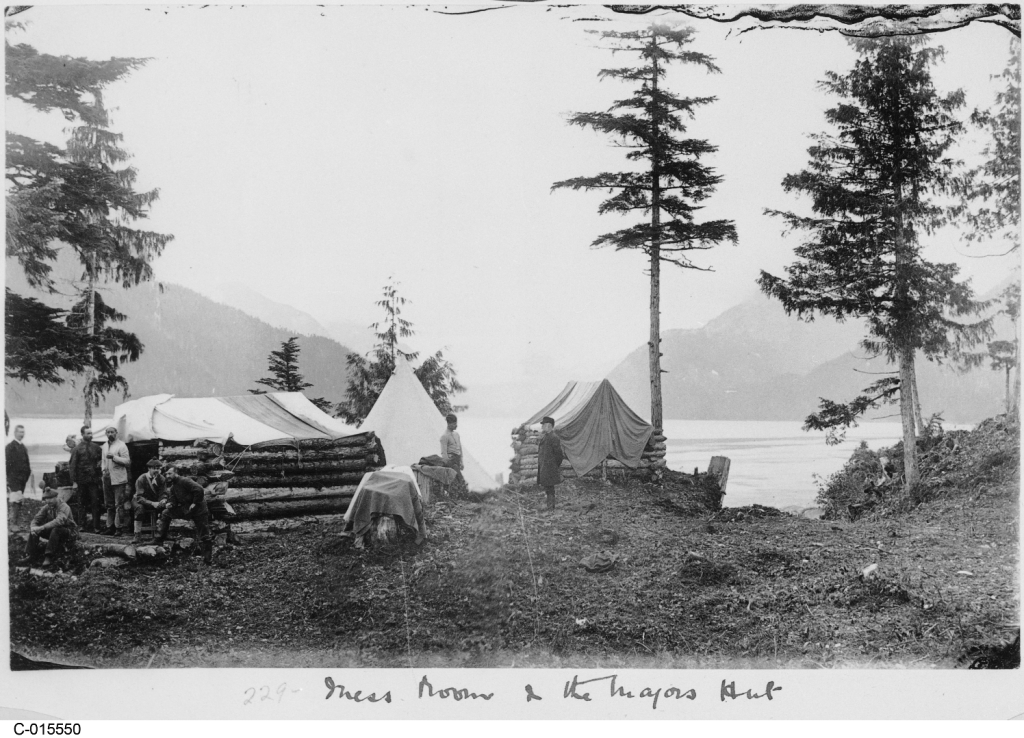
Photo probably by Major James Peters
Camp life was monotonous, but Colonel Holmes allowed his men the recreation of climbing the nearby mountains to hunt mountain goat and bear, many of which were brought back as trophies. He rationalized this departure from routine to his superiors, saying the hunting and climbing showed how adaptable the men were to work.
Back in Victoria the newspapers carried varied opinions on the uprising. “An Old Settler”, as one writer signed his name, supported the constables in teaching the Indians the law, while another writer, “M.P.P.”, felt that the white man’s law should not interfere in purely native matters. Robert Cunningham of Port Essington thought the trip would prove to be nothing but a picnic for the troops. Even Gabriel Dumont, co-leader of the North-West Rebellion, was asked for a statement: “All that I can say is that the government had better be careful with these Indians as they are dangerous. . .It is better to treat them kindly because if a genuine Indian uprising takes place the government will not have to face a few hundred men like the last campaign, but from 30,000 to 40,000 of them.”
On the sixth day of August, after the battery had been camped for two weeks, Holmes received word from Roycroft that the services of his men would not be required. The situation had been greatly exaggerated and was now peaceably settled. Two days later a letter from the Premier informed him that the steamship Cariboo Fly had been chartered to carry “C” Battery back to Victoria. Holmes assumed that since she had been chartered, the Cariboo Fly would arrive shortly, but day after day there was no sign of the ship. Roycroft and the constables arrived in Port Essington on 10 August and left a week later aboard the steamer Sardonyx. Holmes would have had his men aboard her too, but for the government order.
While the soldiers had enjoyed fine weather for most of the stay, the feeling of abandonment at seeing the Sardonyx depart without them was heightened by a north coast deluge. Tents and log houses that had served well in fair weather were now uninhabitable. Clothing, bedding and supplies were drenched. Even the usual Sunday church service was cancelled, “the difficult task of keeping dry being the sole work”.
When another steamer, the Princess Louise, arrived in Port Essington with an excursion party aboard, Holmes decided his men could take the northern camp no longer, despite official orders. Accordingly, he arranged passage on the steamer, which ran up the Ecstall River to within one hundred yards of the camp. Three hours later the site was cleared and gear and men were aboard the ship. By that afternoon, 20 August the Princess Louise was steaming down the Skeena. “Once on board, said the battery’s reporter, “our troubles were at an end”.
The return voyage was as uneventful as the rest of the campaign. The soldiers joined the tourists on a trip to the Queen Charlotte Islands before heading south. As Lieutenant Ogilvie later wrote, “We saw some wonderful Totem Poles and some remarkably pretty Indian Girls.” Six days later “C” Battery was back home, where the soldiers were greeted with a hearty welcome.
After unloading the supplies and outfit, they formed in column and marched to their barracks. Colonel Holmes told the press that he had thoroughly enjoyed the expedition, “though it was without the excitement of exchanging a shot”.
Once home, Holmes wrote to Premier Davie explaining his reasons for taking the Princess Louise rather than the Cariboo Fly. Davie was not unhappy with the colonel, however, and sent a curt note reminding him that he had been duly informed of the charter. “I have to point out,” wrote the premier, “that the contract with the steamer Princess Louise was not made with the Government or by its authority.” He never did explain, however, why the Cariboo Fly was so long in reaching the Skeena.
The cost of the expedition was over $8,000 and there was much debate over who should pay. The provincial cabinet felt that, as it was an Indian matter, the Dominion was liable. Ottawa refused to pay, saying the province had instituted the action. But all agreed that the presence of “C” Battery on the Skeena at the height of the fishing season had been worthwhile, even if the troops had seen no action. Holmes concluded his report of the affair to his superiors in Ottawa with the words: “Although the proceeding has had a peaceful termination, I feel and am happy to know that it will have a permanent salutary effect on the Indian element in the North-West.” And perhaps the “Skeena War” helped reduce the resentful feeling against “C” Battery among the old-timers of Victoria as well.”
———————————————————————
Ken Campbell has published numerous articles on the history of the Skeena River and Prince Rupert area. He lives in Prince Rupert.
