
The Wreck of the Mount Royal
reprinted from The Sun, July 13, 1907, published in Port Essington
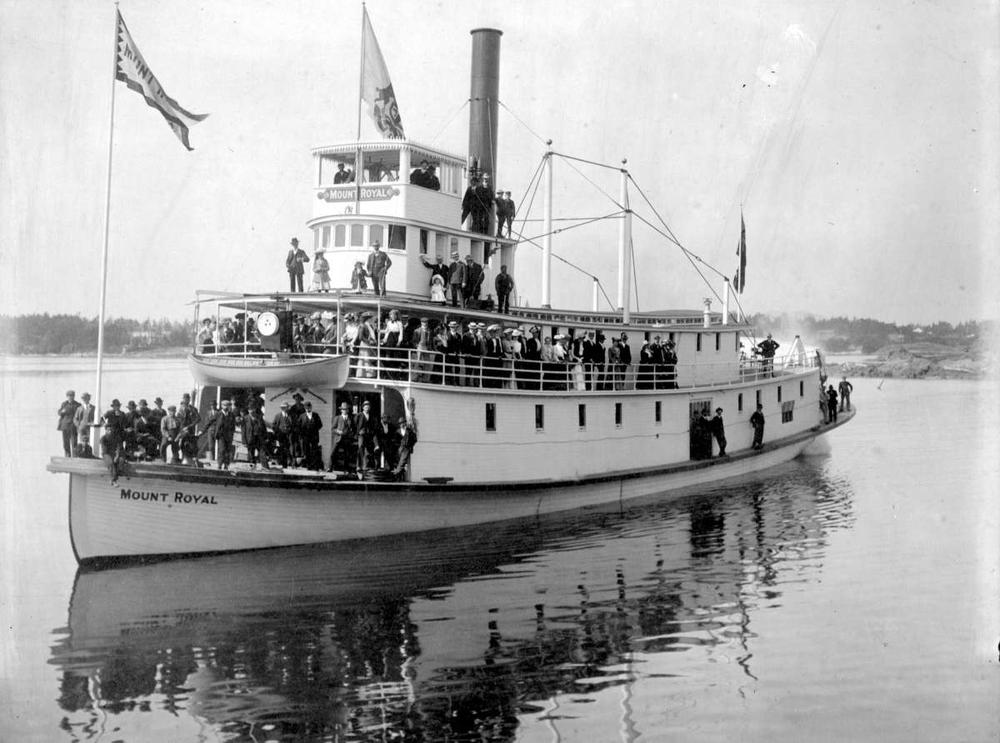
The Mount Royal is no more. She left Hazelton at 9 Saturday morning and struck Ringbolt Island at 3:04 in the afternoon and at 3:15 was going through the awful canyon in tatters, bottom up and unpiloted—a coffin for six of her crew:
W. L. Lewis, first Officer
James O’Keefe, Victoria , purser
Archie Willis, England, steward.
Bert Frayne, Victoria, fireman
J. Morishima, carpenter.
Frank Aneante, deck boy.
The remains of Steward Willis, the only body so far recovered, was rescued from a portion of the upturned boat at the little canyon, a short distance from where the accident occurred, and brought to Essington Monday in one of the rescued life boats. Accompanying the remains were six survivors, two of whom were ladies, Mrs F. M. Phillips, The Dalles, Ore., and Miss Tomlinson, Holy City, Skeena. Among the others were Monte Rhodes and Edward H. Besett, of St. Joe, Idaho, who were returning from the Telkwa after a year’s prospecting in that section; and Joseph Offett, one of the crew, who went through the canyon on the up-turned remnant of the stern wheeler.
At the inquest Tuesday over the remains of Steward Willis, Offett said that on approaching the canyon the usual order to stand by with fenders was given by the captain. At the canyon a strong wind was blowing and a gust sent the boat cross ways, held her in that position for a few minutes and drove her nose five feet up on Ringbolt Island, a small island at the entrance, coming down. Some twenty-seven passengers, mostly Indians bound for the fishing grounds, were ordered ashore by the captain and instructions given to throw out a cable, make the Mt. Royal fast to Ringbolt and save the boat. This couldn’t be done as the capstan had been injured underneath and put out of action. The mate then ordered a cable on the after cleat to keep the boat from swinging.
“Quick, said the purser…the boat is going to crack in 10 minutes”
This was impossible, too late, the boat was tilting with each succeeding drop of water coming over the guard, and started to turn and tear herself away from the portion anchored on the ledge, and as this happened, Offett went over when she turned, caught the rim of a life boat and scrambled on to the bottom of the turtled Royal as she started down six hundred yards of the roughest navigable water in the world, and landed below little canyon, where willing hands, with axes chopped their way through the bottom of the boat in the hope of rescuing what members of the crew may have been pinned in. The party were rewarded by finding the remains of Steward Willis in the submerged wreckage. Willis was working with Offett on the cable when ordered ashore. Fireman
William Jones was one of the men on the bottom of the up-turned boat who gave Offett a hand as the latter was scrambling out of the life boat. E. Harrison Besset said a strong wind was blowing when the Royal struck the island. The captain ordered the passengers ashore. The officers and crew were working with the boat to get it free from the island. They got a cable out, but the capstan would not work. The stern of the boat swung around and caught on the rocks on the opposite side of the channel. The passengers were all on shore. The boat listed or tipped over and took in a good deal of water. The captain came from the wheelhouse, looked at the boat and shouted “All ashore”. The boat then began to turn over. The captain jumped down the companion way, then to the lower deck and on to the rock as the boat was turning over. Saw the boat bottom up with four men on it. Heard noise of explosion of boiler. The house on the boat was broken off and the lower bow also ten or fifteen feet in length from the end of the boat. These four men were afterwards rescued. I did not hear the captain ask or command anyone to remain on the boat. Heard the first officer repeat the captain’s order for everybody to go ashore. Saw the steward just before the boat turned over.
M. Rhodes, a passenger, who stood on the island as the boat turned, was within thirty feet of his roll of blankets, but did not think the blankets were worth taking a chance for at that time. Wrapped up in the pack was a sum of money, records and maps of the Telkwa country, and represented the work of a whole year in the interior. All this disappeared in a twinkle. He said the boat appeared to be all right nearing the canyon, but a sudden gust of wind struck her and the captain lost control of the boat. She struck the rock, running up four or five feet, wedged herself there. The captain ordered the passengers on shore, and ordered the crew to get the cables out. The capstan would not work, having been broken underneath when the boat struck. Was across the channel and appeared to list and turn at the stern and taking in water before she went over.
Mrs. F. M. Phillips was a passenger on the fated Royal from Hazelton to her home in The Dalles, Ore. Mrs. Phillips was in her room washing her hands when the bump came. She didn’t think anything was wrong because it is a common thing going and coming down river to be bumped about. The purser came around and told us to go ashore. “I didn’t know whether he meant it or not,” she said. “ ‘Quick,’ said the purser, just as I was about to go back for my rings on the dresser, ‘the boat is going to crack in 10 minutes.’ and with this he caught a hold of me and carried me down a narrow plank to the rock. The white women were all carried ashore. The purser then went back to the boat and I never saw him after. Saw the captain come out of the pilot house, go to the side of the boat and look at the shore. He then shouted ‘Everybody ashore,’ and as he did this he stepped down the
companion way to the deck below and to the shore just as the Royal was turning. Another minute and the captain, too, would have been taken down the river. The whole thing was so sudden and so bewildered at the sight of the boat turning and breaking up that it was impossible to fix attention on any one person or object for a minute. I saw one half of the boat, with four men on it, going down; the other half must have submerged, for I saw nothing of it after the wreck.
“The Captain was cool and collected until he saw his crew were gone”
Transferring the passengers from Ringbolt Island was the most ticklish experience I ever had. We were transferred in canoes and roped across. A canoe would drift down to within a short distance of the island into an eddy and then caught. Five passengers would transfer at a time and this was continued till all were put across the awful place.”
Captain Johnson, of the Royal, arrived in Essington this morning with 16 of the surviving crew and three passengers. The passengers were E. E. Potts, Vancouver; K. H. Rolley, Matsqui, B.C. and O. Spidal, Camrose Alt. The last two were returning from the Bulkley when they met with the accident. Mr. Rolley was the first passenger to jump ashore. He said the captain was cool and collected till he found that his crew were gone. He then broke down and cried piteously and the efforts of Edward Bissett and E. E. Potts were necessary to keep him from jumping into the river when he saw four of the crew on the derelict going down stream.
When Captain Johnson was seen aboard the steamer Hazelton this morning he did not have much to say about the accident. “I don’t care to talk about the matter now, but this much I will say, though that I had the best, most loyal crew that ever stepped on the deck of a boat.” As the captain said this, the moisture in the eye denoted its sincerity. The captain will leave on the first boat south, which will probably be the Camosun.
The party in the boat accompanying the remains of Archibald Willis down river on Monday saw a mail sack opposite Graveyard Point but were unable to secure it.
Rescuing parties have been out all week searching for remains, but without success. A. A. Johnson and E. C. Kibbey found the trunk of Second Engineer Good at the little canyon and left it with Mrs. Eby at Kitsumgallum.
E. E. Potts found one of his satchels at the little canyon.
The remains of Archibald Willis were sent to Vancouver on the Princess Beatrice yesterday.
Two tons of furs were on the Royal when she went over.
