
Hole-in-the-Wall
by Charles LeRoss
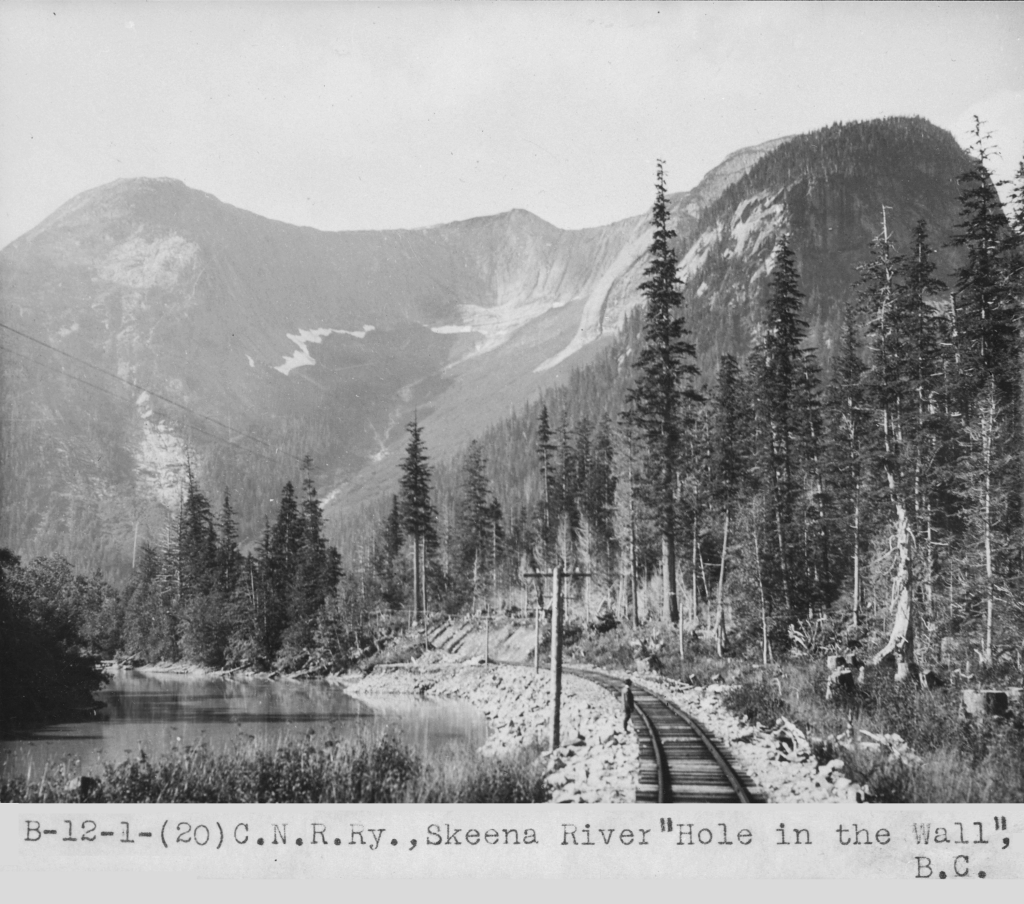
Growing up in Terrace, I remember hearing about a place called Hole-In-The-Wall, somewhere between Terrace and Prince Rupert. I don’t remember ever getting an explanation of exactly where Hole-In-The-Wall was or how it got its name. Since then I have learned that Hole-In-The-Wall was very near to where the Exchamsiks River flows into the Skeena River.
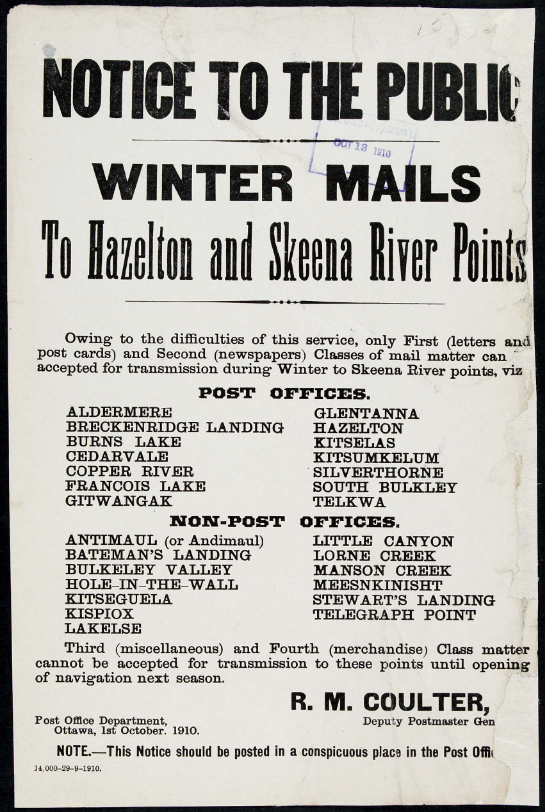
In October of 1910, the Canada Post Office Department issued a notice to the public of the Hazelton and Skeena River area advising that only 1st class and 2nd Class mails would be accepted for delivery to a list of Post Offices and Non-Post Offices during the winter. The reason for the restriction at that time was because all mail had to be moved by dog sled, along the Skeena River, that was mostly frozen over. The mail came from ships coming into Kitamaat or Port Essington. One of the Non-Post Offices listed on the Notice was Hole-In-The-Wall.
The Northern British Columbia City Directory published in Prince Rupert in 1916 lists a place called Hole-In-The-Wall with two residents:
C W Mitchell, operator
P Carron, farmer
I expect that C. W. Mitchell was the operator of the telegraph station. P Carron might have been his lineman, who went out and repaired the line from time to time.
In his book, My Valley Yesteryears, Floyd Frank at Page 40 suggests an explanation for the name Hole-In-The-Wall:
“And then there is the “Hole in the Wall”. Over the years countless people have attempted to find this place, pointing to a large deep hole at the base of the mountain in the Exchamsiks River as the probable hole, also a shattered crack in the mountain in the same area. But now, after all these years, it may be that a correct answer to the origin of the name may have been found. A local white man has stated that a few years back he was working with a native Indian in the vicinity of the Exchamsiks and the native told him what is very likely the answer. Years ago, before the white man arrived, a native Indian , living in or visiting the area, saw a number of mountain goats on this certain steep mountain, and decided to climb the steep slopes to see if he could kill one or two of them. He got trapped up on the mountain and perished up there. The man’s native name was something similar to “LAHO-LU-LUWAH”, which the white man interpreted as “Hole in the Wall”. It is an interesting explanation for what has been a very controversial place name.”
In Pioneer Legacy-Chronicles of the Lower Skeena Vol 1 by Norma V Bennett at Page 136 has another explanation about Hole-In-The-Wall:
“This name was given to the first gap in the long chain of mountains along the Skeena, near the present Exchamsiks River bridge. In 1948 a BC Provincial policeman, on patrol from Prince Rupert, visited Terrace and heard the following story:
“I remember sitting up late one night having a coffee with an elderly native trapper in the police office. He was in jail for some minor misdemeanor. He mentioned he had been caught trapping beaver out of season on the Exchamsiks River, at the terrible Hole-in-the-Wall. I was curious right away as I had been by it several times in the patrol car and I asked him why he used that description.”
“I heard it from my grandfather, who told me that because of the big salmon runs in from the Skeena, there was once a village at the mouth of the Exchamsiks River. The Exchamsiks flows through the Hole because it is the only way through the wall of mountains for miles along the Skeena.
“There was much raiding and fighting amongst the river tribes at that time. The sea warriors, the Massett Haidas, also raided us for women and slaves. Our clan posted lookouts, and when raiding parties came, we sent our women, children and old people up the Exchamsiks and through the Hole to open country. Our young men battled to protect our village from destruction. If they were lucky, many prisoners would be taken, and when our people returned there was great rejoicing. The prisoners were dragged to the high cliffs of the Hole-in-the-Wall and pushed over to be dashed to death on the rocks below.”
He called it haunted, as he had heard the wailing of the dead as he camped there on moonless nights. You may say it was the wind in the cottonwoods and the talking of the water, but I know differently.”
And in the same book at Page 151, Elsie M Whitlow, writing in the story, The Ranch at Kitselas briefly references Hole-In-The-Wall:
“Beyond stopping for cord wood piled on the bank at various places there were no stoppages, and beyond the telegraph station at the Hole-In-The-Wall, no point was passed until Kitsumkalum Indian Village.”
In Whitewater Men of the Skeena, Wiggs O’Neill has an amusing story that happened at Hole-In-The-Wall:
SALVAGED HOSPITALITY
“When I was employed on the Telegraph line, Bert Kergin, afterwards Member for Atlin in the Legislature, was my partner. A fellow named Jack Harstone came along in a row boat and wanted to know if we knew anything about a place called “Hole in the Wall”. He said he wanted to get up and look it over, with the idea of taking a contract for the rock work there. We told him he would never make it in a row boat and as we were going up river in the morning we persuaded him to camp with us and he could go up with us in our gas boat.
At the mouth of the small river coming in just above the Hole in the Wall bluff, a couple of Frenchmen had a cabin and were cutting wood for the steamboats. Mr. Phelan, the telegraph superintendent had made arrangements by letter with the two fellows to look after the telegraph line down past the bluffs as there was always plenty of line trouble in that area. They had not done a very good job on it, so we decided to have some fun with them.
Mr. Harstone got off and walked over the rock work and Bert and I ran up the river to their cabin. We told them we had brought Mr. Phelan up to look the line over. ‘Where is he” asked Mr. Vieux the tall Frenchman and they both got very excited. When we told them he had got off below the Hole in the Wall and was walking over the line, they fired up and started to prepare a spread. They opened up a trap door in the cabin floor and brought up a dozen bottles of all kinds of liquor, getting ready to treat Mr. Phelan royally.
Mr. Harstone arrived and was introduced as Mr. Phelan. The Frenchmen made a big fuss over him and went on to tell him about all the trouble they had all winter on that terrible piece of telegraph line on the bluff. They plied Mr. Phelan with liquor.
After a time Mr. Harstone forgot he was Mr. Phelan and said he was looking for a contract. Vieux stood up and pointed first at me then at Bert, “You O’Neill, you Kergin, you lie like Hell”. They claimed liquor in the cellar had been found floating in the eddy in the river. The wreck of the “North West” took place just a short distance above. This was a part of the river generally known as Hudson Bay Flats, where the steamer “North West” had sunk with a full cargo of booze. It was generally suggested they may have made a visit to the scene of the wreck where the harvest would have been easier.”
Phylis Bowman in her book, Klondike of the Skeena, she quotes a story from the Prince Rupert Daily News of June 30, 1924:
Line Closed
“Several Dominion Government Telegraph lines between Port Edward and Skeena Crossing have been closed in the “interests of economy”: Telegraph Point, Hole-in-the-Wall, Graveyard Point, Usk, Dorreen, Kitwanga and New Hazelton.”
One other story I found about Hole-in-the-Wall occurred in 1949 when the CNR in trying to create a supply of rip-rap, set off 40 tons (really?) of dynamite at Hole-in-the-Wall and loosened up 80,000 yards of rock. Unfortunately a large amount of rock landed on the track and the line was shut down for days.
So, out of the foregoing we can say this about Hole-In-The-Wall:
1) The locality was very near the mouth of the Exchamsiks River
2) It was a telegraph station
3) It was a place where mail was dropped
4) It was a stopping point for sternwheelers getting wood fuel
I tend to believe the explanation that Hole-In-The-Wall refers to the first significant opening in the “Wall” of rock that exists on the north side of the Skeena River from Tyee to the Exchamsiks River.
Let me know if you have a story to share or information about Hole-In-The-Wall and I will add it to the above.
◀
