
The No. 1 Armored Train
by Jim Suderman,
Mennonite Heritage Centre
This article was published in Manitoba History, Number 19, Spring 1990 by the Manitoba Historical Society
Some photographs of armored railway cars found in the collection of the Transcona Museum spurred the author to investigate the story of Canada’s Number One Armored Train.
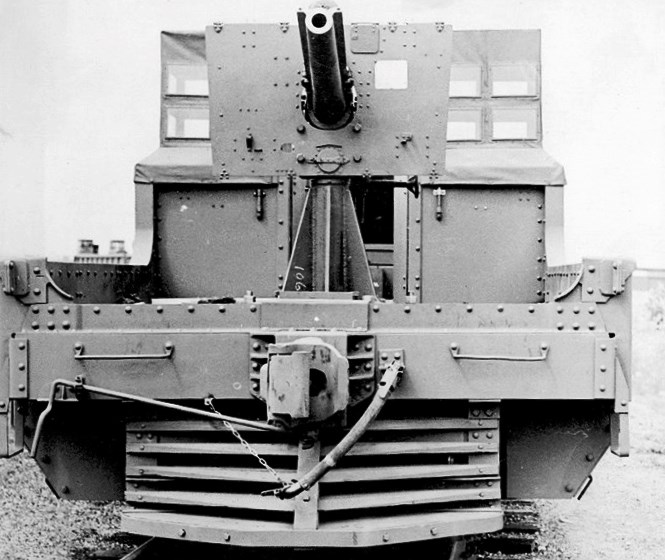
After the attack on Pearl Harbor in 1941, and the success of the Japanese fleet in the south-east Pacific, there were fears in Ottawa that the Japanese High Command would attack the port of Prince Rupert, British Columbia. Prince Rupert was, at that time, connected to the interior only by a railway which ran for ninety miles along the navigable Skeena River. To discourage any sudden descent by the “Yellow Peril” on the port, the Department of National Defence decided to construct an armored train to patrol the railway link. Its mission was to act as a rapid striking force to obliterate any sudden Japanese assault on Prince Rupert. Here was a case where the Dominion Government did do something “first.”
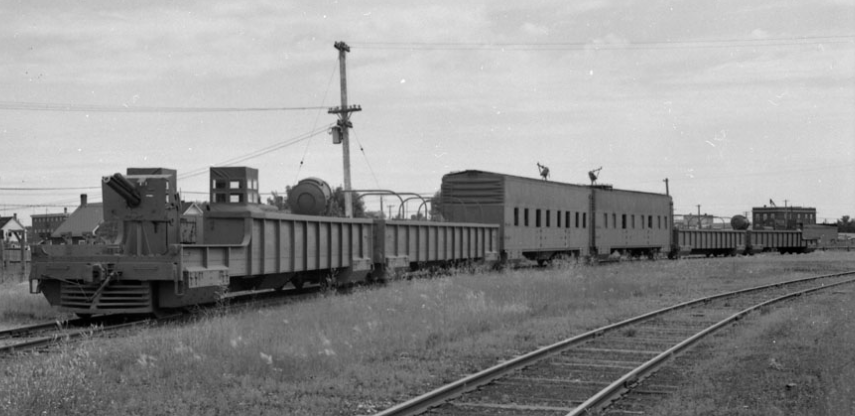
In April the Canadian National Railway was approached to provide the necessary rolling stock and motive power. Armor plate and armaments were requisitioned and sent on to the C.N. yards in Transcona, Manitoba. However, as with many projects hastily set into motion, not every step proceeded entirely according to plan. The first hitch, recalled by one workman, was the weight, or perhaps overweight, of the engine to be fitted with armor plate. The engine could bear the weight, but the tracks could not. The tracks were ripped from the railroad ties. Its maiden run had to be cut short at Dugald, just a few miles east of Transcona.
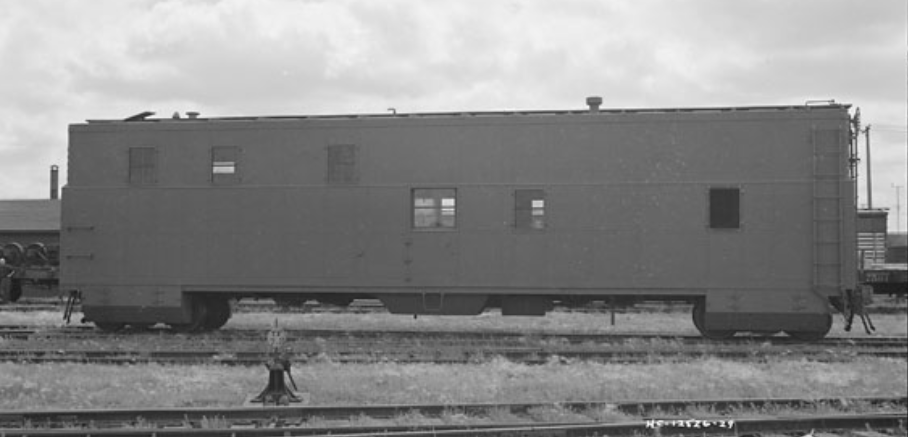
The problem of motive power remained throughout the existence of No. 1 Armored Train. The Department of National Defence wanted two diesel-electric locomotives (one for a backup). Unfortunately, the two locomotives selected did not have any engines. Undaunted by this setback, the Department approached the United States Navy for replacement engines. The U.S. Navy was already deeply embroiled in the war against Japan, but they were willing to help out as best they could. They promised delivery of the necessary diesel-electric engines in as little as two to four months.
One wonders whether the U.S. Navy felt that the request was construed as a negative comment on their ability to carry out their commitment to defend the entire Pacific coastline. D.N.D. felt that a higher priority might be given to the delivery of the engines if the case was pressed in the right circles in Washington. In the end, this latter course was not followed.
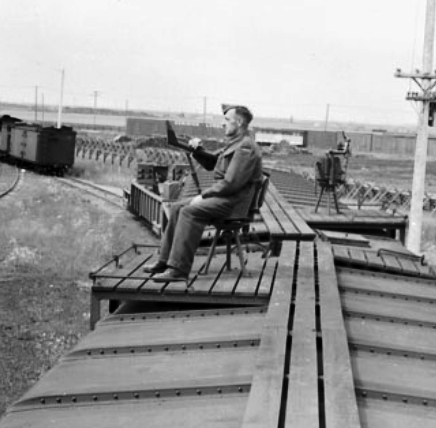
Library and Archives Canada
The rest of the train progressed rapidly. Fifteen millimetre armor plate, which is not really thick enough to stop anything heavier than rifle fire, and fittings were attached at the Transcona yards. Then, with the question of diesel-electric engines still in the U.S. Navy’s hands, the train steamed off to war, powered by an unarmored steam locomotive. The train arrived in Prince Rupert on July 28, 1942, and it wasn’t a day too soon. Just a little over a month before, a Japanese submarine had shelled the rocks of Estevan Point on Vancouver Island, reviving fears of a Japanese invasion.
Upon arrival in Prince Rupert, the train was taken over by “A” Company, The Winnipeg Grenadiers, Captain N.K. Gateson, Officer Commanding. In the War Diary of the Armored Train, Captain Gateson describes the first day of operation, July 29, 1942:
“The Armored Train made first trip from Terrace, B.C. to Prince Rupert, B.C. and returned. Distance 193 miles. The train speed was 25 mph and found to be a little too fast. It was cut to 20 mph so that equipment would not be shaken too much on the rough road bed. Train rides and handles very well.”
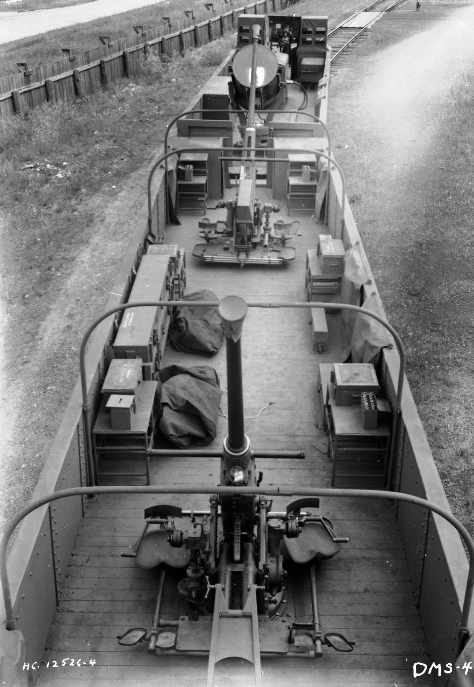
Capt. Gateson was happy to note that all the guns and mountings cleared the tunnels, bridges and wires along the way. He was less pleased with the knowledge some of his men had of the weapons they were supposed to operate.
He also didn’t reveal all the shortcomings of the road bed. In fact for curves the train had to slow to 10 mph, slower than a person can run and there are many curves in those 90 plus miles of railroad. One wonders if a detachment of marching soldiers might not have provided as “swift a striking force.”
By the third day of operation Capt. Gateson was noticing that the soldiers were exhausted from lack of sleep and the thirteen hour round trip. The troops also had to contend with the guns which, when swivelled, would knock crew members off the train. Use of the guns meant other problems as well.
Another railway workman recalled that after a trip to Vancouver for repairs, a request was made to fire the AA guns outside of Vancouver. Permission was granted to fire them into some sand hills outside the city, but all the spent shells had to be dug out afterwards. Capt. Gateson elected not to hold gunnery practice that day.
Initially, the train traveled its patrol route daily. This regular schedule caused some confusion for the phlegmatic but determined civilian populace of the area. Returning to Capt. Gateson‘s Commentary:
“Armored train left Terrace for Prince Rupert at 0900 hours. [This was the 6th day of operation.] At Barrett Station a civilian got on the train and refused to produce identification card, [he was] put under arrest and turned over to civil authorities at Prince Rupert.”
No. 1 Armored Train’s career was short-lived. It died from neither enemy action nor excitement. Its termination was largely due to the efforts of the U.S. Navy, which put an end to any designs the Japanese High Command may have held on Prince Rupert. On September 10, 1943, the long–awaited diesel electric was finally ready, but was held in Transcona on order from Ottawa.
Library and Archives Canada
By the end of September, fourteen months after it commenced operation, but only three months since the Government and the CNR had signed the contract outlining the terms of its use, the train itself was put on the inactive list and its steam locomotive, having survived in spite of its lack of armor plating, was reassigned. Then, on October 5, the train was moved to Pacific for dismantling, although it wasn’t actually dismantled until it arrived back in Transcona in September, 1944.
For the railroad buffs out there, Ted Hackett in his account CANADA’S BEST KEPT SECRET OF WW II – The Armoured Train, had this:
“The locomotive was a CN class H-10, number 1426 and 4-6-0 commonly called a “10 wheeler”. That last bit of information is for any railroad buffs amongst our readers. There were plans to replace the steam locomotive with a diesel electric and CN No.9000 was chosen, but by the time it was obtained through the US Navy the need for the train was downgraded.”
If anyone has a picture of locomotive 1426 I would like to add it to this story.
◀
