
Deadly Snow Slide at North Route Service
by Charles LeRoss
It’s been 50 years since volunteer Firefighter Rick Olsen and I, members of the Terrace Volunteer Fire Department, and several members of the Terrace RCMP responded to a call about a snow slide that had come down at Mile 28 of Highway 16 between Terrace and Prince Rupert. Mile 28 was the location of a motel, restaurant and gas bar called North Route Service, operated by Charlie Daumont.
It was January 22, 1974. I remember earlier that morning coming out of my apartment, and pushing my way through the 16 inches of light powdery snow that had fallen during the night, on my way to the Terrace Fire Hall for coffee. While at the hall a call was received that a snow slide had come down at Mile 28, and it was not clear what damage or injuries had occurred.
“I came into land (the helicopter) and it (the motel) was gone, completely gone; not a sign of life.”
Clifford Schwindt, helicopter pilot
Rick and I were requested to respond as the first aid contingent of a first response team organized by Corporal Wib Weldon, of the RCMP. With our first aid gear in hand, we were driven to a snow cat requisitioned from BC Hydro in which we rode to the scene. On the way we stopped at a welding shop on the highway towards Prince Rupert. There we picked up a quantity of ¼ steel rods for probing the snow slide. Along with Rick and I were Cpl Weldon and one other RCMP officer, and also Don Daumont, the son of the owner of North Route Service. The ride out to Mile 28 was quiet and somber, particular with Don present; we had no idea how safe some of his family was after the slide.
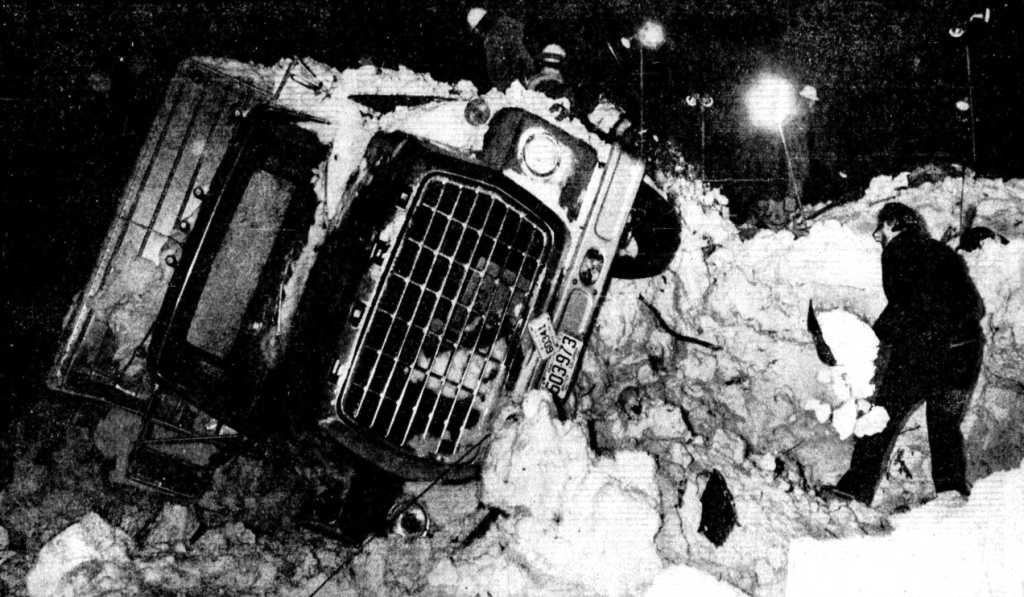
—Vancouver Sun
There had been several slides that morning on the highway to Prince Rupert. At Mile 35, Allan Wayne MacDonald, 23, a highways employee from Terrace, Donald Lagimodiere, 27, of Prince Rupert, Hans Peter Engler, also of Prince Rupert and Volkmar Werner (Bill) Zobel, 30 a mail truck driver from Terrace were waiting at a slide for it to be cleared. They could have waited in their vehicles, or as they decided, they could return to North Route Service at Mile 28. At the cafe they met Charlie Daumont, the owner, Steven Mentenko, Charlie Daumont’s brother in law, Ted Armstrong, a grader operator and Denise Daumont, Charlie’s daughter, who worked as a waitress and was still asleep. While having coffee and breakfast in the cafe and discussing the snow and weather, at 8:30 am the slide came down.
At approximately 9:50 am “The avalanche was discovered by a Vancouver Island Helicopters pilot, Clifford Schwindt, who was checking for broken telephone lines along the Skeena Valley.” When his helicopter started icing up he flew to the motel/restaurant with the hope of landing to correct the icing problem. “I came into land and it (the motel) was gone, completely gone; not a sign of life. Just some pieces of lumber and junk sticking up through the snow.” He then alerted the police in Terrace. The slide area was estimated to be 400 feet long, 100 feet wide and up to 30 feet deep.
After leaving the welding shop, we arrived at Mile 28 and noticed the highway had been cleared of the slide by a snow blower. There was about 4 feet of snow that covered the highway from the slide. The slide had gone across the highway, across the tracks and out into the frozen Skeena River about 30 feet, from what I saw. The snow slide was littered with sticks, tree bark, moss and other debris that was picked up by the snow coming down the mountain. We realized immediately that we did not need the snow cat and after unloading the steel rods, Corporal Weldon organized a line of volunteers to set up a probe line with the steel rods. The probing was futile as there was to much debris in the slide, mostly roof and walls. I observed Don Daumont walking around the site. He was trying to understand what had happened to the motel and restaurant. He was using the mostly buried gas pump, on the west side of the site as a reference point to the buildings. There was nothing where the motel should have been, only a mound of snow littered with the slide debris. I think Don found it quite bewildering. It was not until we dug into the slide later on that we realized the large mound of snow was actually the roof, covered with several feet of snow. The slide came down, blew out the walls of the motel and restaurant and then the roof collapsed on top of the walls and was covered with snow. Corporal Weldon started to organize a systematic dig of the site, starting at the west entrance to the site. Using shovels and a front end loader we slowly moved into the huge pile of snow and building debris.
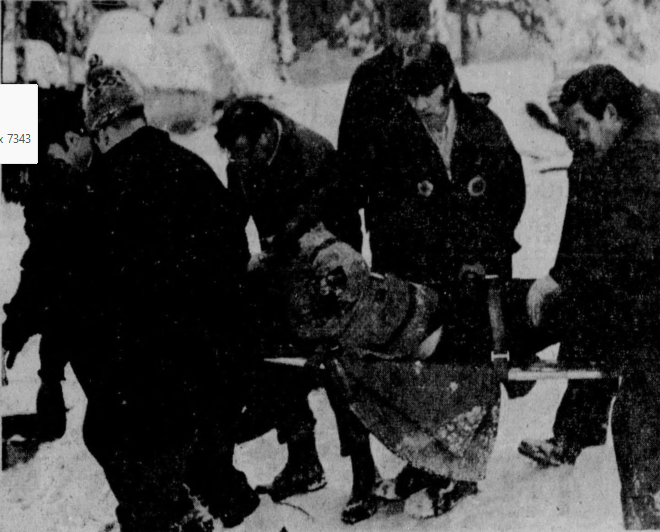
The first body was found at 2:45 pm under 3.6 m (12 feet) of snow. We then found Volkmar (Bill) Zobel a half hour later, who survived the slide under 1.5 m (5 feet) of snow. He was buried completely for 6.5 hours. When we got to him, there was a surge of excitement in the rescuers. Rick and I quickly checked him over for any significant injury or bleeding. He was a wild man. He was waving his arms and kicking with his legs at anything and everything. We tried several times to get a blanket around him and he would just rip it off. This was understandable. After being packed in snow for hours, not able to move, the last thing you would want once you were free was to be wrapped in anything. We eventually got him tied to a stretcher and transported him to the helicopter that had arrived.
Dave Newman, the helicopter pilot who flew Zobel to the hospital, said: “He was hollering like a bull when he was pulled from the snow. He continued to thrash around, babbling incoherently and we had to wrestle him all the way to hospital.” He was at the hospital in Terrace within a half hour.
“Later on Zobel told the police, he recently started driving the mail truck between Prince Rupert and Terrace. The previous driver had died when the mail truck left the highway and went into the Skeena River, six months before the slide. Zobel described being in the North Route Cafe drinking coffee and playing cards with Allan McDonald, about 8 am that morning while waiting for the weather to clear so they could be about their business. He said they did not get any advance warning of the slide—he just heard a loud crash and then he found himself being hurled about in snow and wreckage. He never lost consciousness during the whole time he was buried, he recounted, and if he tried to struggle, he found the effort only consumed more of the scarce supply of air. Finally he was able to stretch into a somewhat more comfortable position, and as he was warmly clad in a heavy wool sweater and wool long johns, he did not feel the cold.”
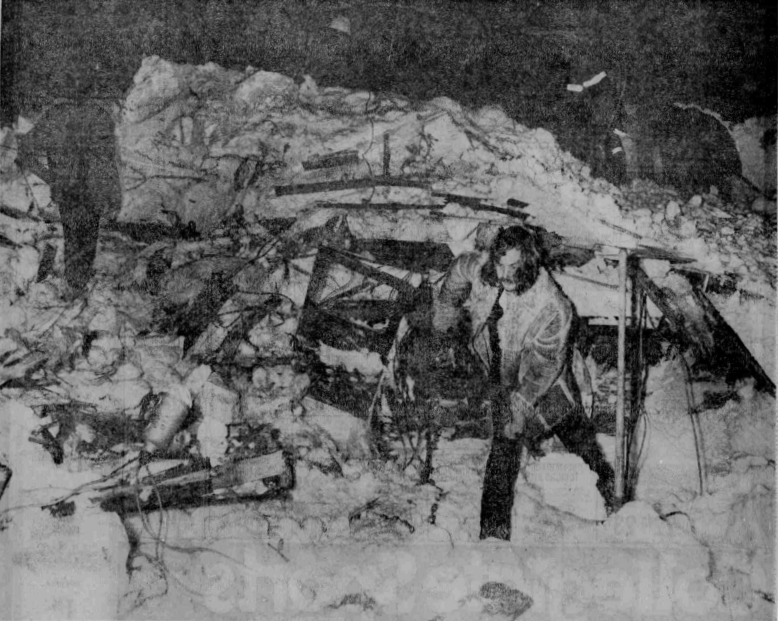
As more volunteers arrived, I believe they were organized into digging from the east entrance driveway and worked their way slowly up into the debris field.
Later that afternoon, snow slide technicians from the Ministry of Highways came on the scene and I had occasion to walk up into the path the slide had taken. The snow slide technician pointed out to us where the slide had started and the general course it took when it came down. I remember observing several trees where branches had been stripped off the trees to a height of 20-30 feet as the slide went through. You could still see snow stuck to the trees from the slide.
During the day somebody from the Terrace newspaper arrived and retrieved the camera ready copy from the cab of the mail truck, for the next edition of the paper.
In the afternoon, Augie Geeraert at the Terrace Hotel sent out a large urn of coffee and a bunch of sandwiches for the rescue volunteers, which was greatly appreciated, since the weather had turned wet and miserable.
Later that day after dark, Rick and I were relieved by other Volunteer Firefighters/first aid attendants from the Terrace Volunteer Fire Department.
Here is the timeline of the recovery of the 7 victims and 1 survivor:

Vancouver Sun—Ray Panavis photo
January 22, 1974
2:45 pm body of truck driver operator found
3:15 pm Volkmar (Bill) Zobel found alive
4:30 pm body of cook found
5:30 pm body of businessman found
11:55 pm body of machine operator found
January 23
2:30 am body of owner found
3:10 am body of second businessman found
3:30 am body of the daughter found
On the morning of January 23 at 6:30 am the search/recovery was suspended due to steady rain and concerns about the possibility of a further slide.
On January 24th, the police along with a front end loader finished digging through a small pile of debris that had not been checked, concluding the rescue and recovery operation.
In an inquiry conducted by Coroner Don Murray, and based on experts who were consulted during the inquiry, it was found that logging conducted by Charlie Daumont above the site of the motel/restaurant at North Route Service was a contributory factor in the slide that destroyed the business and caused the death of Charlie Daumont and the six other victims of the slide.

In the Avalanche Accidents in Canada report referenced below, the North Route Slide was considered a large destructive avalanche and was the result of several weather factors:
– Unusually deep snow. The total snowfall at Terrace Airport for January 1974 was a new record for the month
– A heavy snowstorm that deposited 135 cm (4.5 feet) of new snow between 16 and 18 January and 60 cm (2 feet) between 19 and 22 January at Terrace Airport. At the North Route site the snowfall was probably greater by one third.
– A high precipitation rate of 2.8 mm/h (1/8 inch per hour) between 9 pm on 21 January and 8:00 am on 22 January.
– Low temperature during the week previous to the snowstorm, rising to 0 Celsius (32 F.)during the storm.
– Moderate wind
“ The avalanche moved through the forest above the service centre without breaking fir trees with diameters greater than 0.5 m (1 ½ feet), but it stripped the trees of their branches up to 10 m (30 feet) above ground. The average depth of avalanche snow in the area surrounding the buildings and on the highway was 1 m (3 feet), but the snow was up to 8 m (26 feet) deep at the buildings, probably because it was caught by plowed snow and the structures. The avalanche ran out on the ice of the Skeena River, with the tip of the deposit 250 m (820 feet) past the service centre. These observations lead to the conclusion that the avalanche must have contained dry snow with a rather low density. The estimated speed of the avalanche when it hit the buildings was 108 km/h (just under 70 miles per hour).”
SOURCES:
(1) Bowman, P. Road Rail and River! Prince Rupert, BC Canada, Chilliwack: Sunrise Printing 1981
The Vancouver Sun, January 1974, Vancouver BC Canada
Stethem, C. J. and Schaerer, P.A. Avalanche Accidents in Canada, I. A selection of case histories of Accidents, 1955 to 1976, National Research Council Canada, February 1979
◀
