
Pioneers of Pacific, B.C.
by Ruth McCubbin
Many explorers of the north coast of what is now British Columbia had unwittingly sailed past the mouth of the Skeena. The Queen Charlotte Islands and the Naas River were explored and some settlements established.
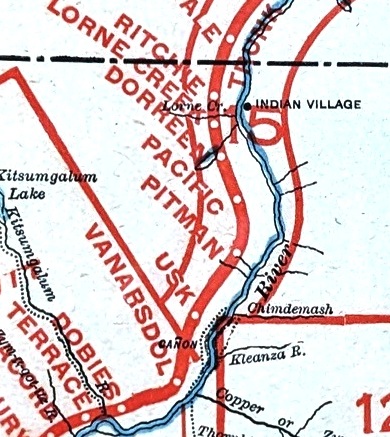
In 1834 the town of Port Simpson was founded and the Hudson Bay Company established a post there. It became the headquarters of the fur trade, and ships came and went from Fort Vancouver and Victoria.
In 1859 Governor Douglas commissioned an Englishman Major Downie to visit and search the Queen Charlotte Islands for gold. He was unsuccessful and decided to investigate the Skeena River to find a suitable route for a proposed transcontinental railroad. He followed the river up to Babine Lake and to Fort St. James and it was his report to the governor that contributed greatly to the opening up of the Skeena country.
Early in 1871 Robert Cunningham of Port Simpson chose a site on the south bank of the Skeena on which to build a trading post. On this site which became known as Port Essington, the Hudson’s Bay Company built a store. Soon there was a permanent population of several hundred and a large cannery was built. This became the fishing centre and also the port of call for all riverboats on the Skeena. These river boats were the only means of transportation from Port Simpson to the various Indian villages up the Skeena as far as Hazelton until the river froze each winter.
In 1907 a start was made on the clearing of the west side of Kaien Island at the mouth of the Skeena. One hundred and fifty people, mostly labourers put up a tent city which would be the start of Prince Rupert. In 1909 the new town mushroomed to a population of three thousand. This was to be the Pacific terminus of the Grand Trunk Pacific Railway. There was a real land boom, lots going for fantastic prices and soon permanent roads and buildings were built and one of the best deep sea ports on the Pacific coast became operational.
Kitselas was an Indian village just before the Skeena Canyon and it became a port of call for the riverboats. Soon there was an influx of white settlers and it became a thriving town. It consisted of three hotels, three general stores, two poolrooms, a tent church, a jail, a newspaper, “Big Canyon News”, with Enoc Jones, editor.
About 1912 when the railway came through from Prince Rupert to Hazelton riverboats became a thing of the past and the railway delivered passengers and supplies in all weathers. At this time Kitselas folded up as the riverboats were its reason for being. Today there is no sign of the old Kitselas and the Indians have moved across the river.
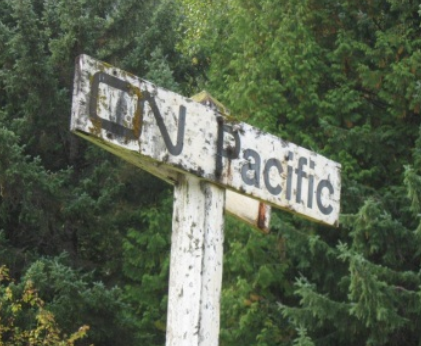
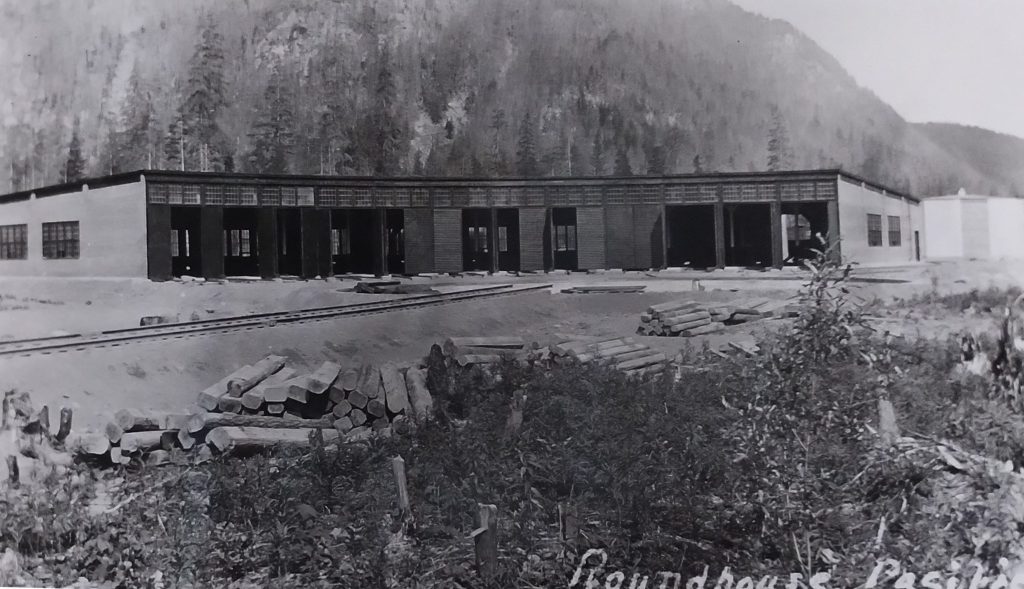
As the railway progressed eastward from Prince Rupert, locations were chosen for divisional points about every one hundred and twenty-five miles. The first one from Prince Rupert was about twenty miles east of Kitselas at a small settlement called “Nicholl” which the railway in 1913 changed to “Pacific”. Large brick roundhouses were built in the railway yards, also a station house, and restaurant. Several small homes for employees were also built.
This town was homesteaded in 1909 by Jens Anderson, born in 1877 in Asase, Denmark. He sold part of his property along the bank of the Skeena to the railway. He built a cabin near the river bank which was destroyed by fire when the railway workers were clearing the area for the railway yards. The railway replaced it in a different location. He went to Minnesota, U.S.A. in 1909 where his marriage to Mary took place on August 5, and they arrived back in Pacific on August 20th. In the summer of 1910 she gave birth to a son in the Hazelton Hospital who died at birth.
In 1912 expecting again she returned to Minnesota where her son Edward was born in 1912. They returned to Nicholl (Pacific). Mr. Anderson formed a partnership with Mr. C.W.D. Clifford and Mr. John Walker Patterson and built the Nicholl Hotel around 1912. After the railway station and yards were completed the hotel business fell off and the partnership disbanded, Mr. Anderson keeping the hotel.
Mrs. Anderson’s brother, Nels Thompson, left Denmark shortly after his sister did, also going to Minnesota. U.S.A., where he stayed for a while then went west to Portland, Oregon where he worked as a carpenter. He then moved to Canada and worked for the Grand Trunk Pacific as a carpenter and helped build some of the railway buildings at Pacific. After the hotel partnership disbanded he quit the railway and worked at the hotel. He also bought a few lots and built houses on them, one of which became the school. Edward started school at five years of age in 1916 in order to provide the required number of children to open a school. The first teacher was Mr. Wheeler. Mr. Anderson enlisted in the army February 18, 1916 and was discharged in March 1919 returning to Pacific. As the hotel business was very slow he took the job of ferryman and was drowned in the Skeena River in September, 1920.
Nels stayed on at the hotel for some time but later moved to one of his houses. Before Nels moved from the hotel he had acquired a pool table in a rather unusual way. He had gone to Terrace (approximately 100 [sic] miles to the west) and while there a Mr. Sparks was selling poolroom equipment to provide more space for his drugstore. He tried to talk Nels into buying one of the tables but Nels said he had no place for it and did not want it. However a week or so later the station agent informed Nels that there was a pool table at the station for him and would he please come and get it and pay the freight. Nels was all for sending it back but some of the local prospectors and railway men twisted his arm and he set it up in the lobby of the hotel. After having it for a few weeks he got a bill for fifty dollars from Mr. Sparks which he paid. This table was well used and is probably still in Pacific.
Edward writes, “As you may well Imagine it was a rather startling experience for my mother used to living in well-populated areas such as Denmark and Minnesota – traveling by riverboat up the Skeena then being deposited on the river bank in the midst of the wild British Columbia forest with only a log cabin for shelter. The nearest neighbor was two miles downstream, a riverboat wood-cutter. She often spoke of how tame the squirrels, rabbits and other animals and birds were as they had not yet learned to fear man. She was also amazed at the quantity of fish in the river, being before the canneries, or commercial fishing started on the coast.
“She also said that at first she was very much afraid of the roughly clad, usually unshaven travelers, with their huge packs on their backs, that came walking up or down the river. Of course all stopped for a rest and a cup of coffee or a meal and an exchange of news. Mother said at first she was so afraid of them she would hide in the attic of the cabin until they went, leaving Dad to entertain them. However as the railway construction crews moved in she became more accustomed to these frontier-men and her fears vanished.
“Construction contractors for clearing railway right-of-way was Foley, Welsh and Stewart – two camps were located near Pacific, one was east of the station just east of Corley a farm, the other at the sand bar west of the station. Some of the log cabins were still standing when we were kids.
“Mother told me of an occurrence which shows how people’s views change. During the late fall of 1909 or 1910, one of the last paddle wheelers belonging to the Hudson’s Bay Company, either because of unusually low water, an early freeze-up or mechanical problems caused the skipper to deem it unwise to continue upstream to Hazelton. He made a deal with my parents to store his cargo over winter to be picked up by their first boat upstream the following spring. Now it was either a very long winter, or my parents had miscalculated their food requirements of flour, beans, rice, etc. Anyhow towards spring their supplies ran low and some time before the first boat arrived they were completely out of many items and living on very short rations. Although there was ample quantities in storage they felt it would be wrong to touch these. When the boat did arrive and they were paid for storage and bought applies, the boat’s captain was astounded and instead of being thanked for being honest custodians he berated them for being foolish. They hadn’t yet lost their old country ways.”
It was through kindness of Edward Anderson that I was able to obtain this, detailed history of his parents and the very beginnings of Pacific. Edward and his wife, Gladys, and two children have lived in Calgary for many years. His mother, Mary, left Pacific in the late sixties and lived in a rest home in Calgary until her death in the seventies.
Nels Thompson was the last remaining resident of Pacific. He bought up most of the land as people moved away. In the early seventies he took ill and was taken from Pacific to a Terrace Hospital where he died.
Three names keep coming up in the story of the early days on the Skeena – Charles Clifford, Jack Patterson, and Wiggs O’Neill. I will give a brief account of each of then with material obtained from the British Columbia Archives and Dr. R.G. Large’s book, “The Skeena. River of Destiny”.
Charles William Digby Clifford was born in Ireland in 1842. He came to British Columbia for the Gold Rush in the Cariboo district. In 1885 he started working for the Hudson’s Bay Company at Hazelton until 1891. Then he moved to Port Simpson Hudson’s Bay Company, and left there in 1897 to engage in active development of his claims is the Skeena District, .
In 1910, he was a Justice of the Peace and townsite owner at Kitselas; he built a hotel and store there in 1907. When the railway was being built through the canyon, this hotel was the only licensed liquor outlet available to the construction gang. After completion of the railway, the Kitselas townsite was abandoned. He still had mining interests around Kitselas.
He thought Kitimat would be the terminal of the railway, and he invested heavily in land there, built a store, a wharf and a warehouse there, and started on a hotel. He lost it all in 1907 when Kaien Island was chosen for the terminal.
He was elected to the Legislative Assembly in 1898, 1900 and 1903 for the Skeena District, but did not run in 1907.
He married Margaret O’Neil, daughter of a river-boat captain, on May 24, 1888. He retired to Vancouver where he later died on May 10, 1916 at the age of seventy-three.
John Walker “Jack” Patterson appears to have been closely associated with Mr. Clifford. Dr. Large, in “The Skeena River of Destiny”, writes of him running Mr. Clifford’s store in Kitselas. Edward Anderson tells of him being in partnership with Mr. Anderson and Mr. Clifford in the Nicholl Hotel. He also owned the general store in Nicholl which Tom McCubbin bought. Surprisingly, the B.C. Archives makes no mention of him.
W.J. “Wiggs” O’Neill was born in 1882 in Barkerville, and moved to Port Simpson where he attended school. He started a bakery in Port Essington, and later was connected with the Dominion Telegraph line. In 1907, he built a river boat with which he ferried passengers and freight from Port Essington to the construction camps, and up as far as Hazelton.
He wrote several entertaining books about his days on the Skeena River.
CHAPTER TWO
FROM SCOTLAND TO THE SKEENA
The MCCubbin family originated in the city of Ayr, Scotland. John McCubbin, Sr. was a tailor, a cripple, cause unknown, who was confined to a wheelchair. He and his wife Elizabeth had two sons. Thomas Hazle born 1877 and John Stevenson born 1864.
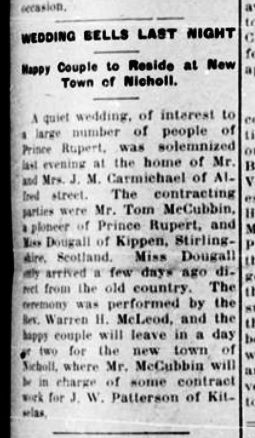
Tom learned tailoring from his father and worked at his trade in London, England and then had a shop in Rothesay on the Isle of Bute, Scotland. While in Rothesay he met Elizabeth Shirra Dougall of Kippen, Sterlingshire, Scotland, who was working in a shop belonging to her brother Jim Dougall, a well known Rothesy businessman. They became engaged and in the spring of 1910, Tom left Scotland to make his fortune in British Columbia.
It is hard to imagine the courage and spirit of adventure that led this thirty-two year old man to leave his family in Ayr and venture into the wilds of British Columbia.
The trip across the Atlantic took about two weeks, with crowded sleeping quarters showing the effectiveness of the Canadian immigration campaign and the strong desire of the British middle and lower classes to attempt to better their living conditions.
The train across Canada was probably even less comfortable than the ship with nothing in the way of sleeping accommodation or food provided. From Vancouver the journey would be by steamship to Prince Rupert which was at that time, 1910, a rather primitive town of about three thousand people. Tom and another Scotsman, Alex Finnie, batched together. They used to catch fish in the harbour and buy a loaf of bread to feed themselves as neither one had employment for a while. Alex Finnie stayed in Prince Rupert working as a bookkeeper until he retired and was a much respected citizen.
Tom finally got work in Kitselas working for Jack Patterson in his general store there. Jack Patterson was Postmaster of Kitselas from 1907 to 1916, so Tom probably got his first experience of handling mail at this time.
In 1909 Kitselas was the largest community between Port Essington and Hazelton and was the port of call for all the Skeena River boats. The railroad was being pushed through from Prince Rupert to Winnipeg and the large crews of railway construction workers swelled the population. There were three large tunnels which had to be blasted out of the canyon rock walls, a massive undertaking.
After about a year in Kitselas Jack Patterson offered Tom the management of his store at Nicholl which was about eighteen miles east of Kitselas. His salary was seventy-five dollars a month, a high one for those days. A few years later he bought the store.
Lizzie’s Parents
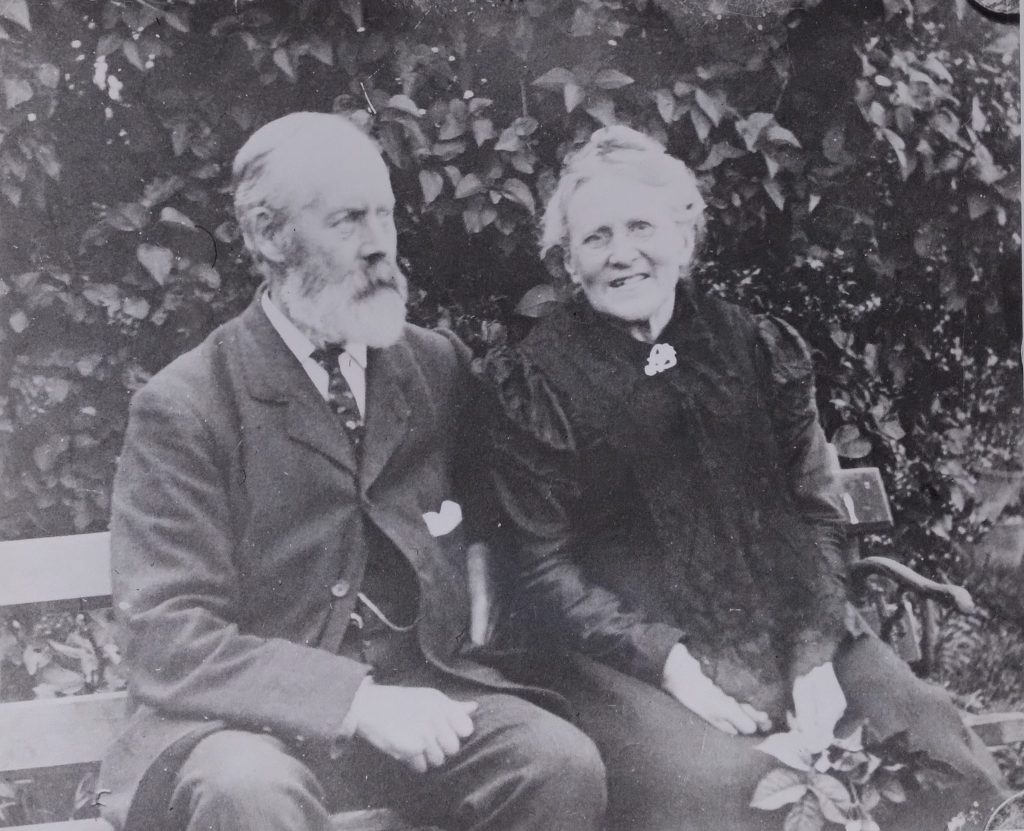
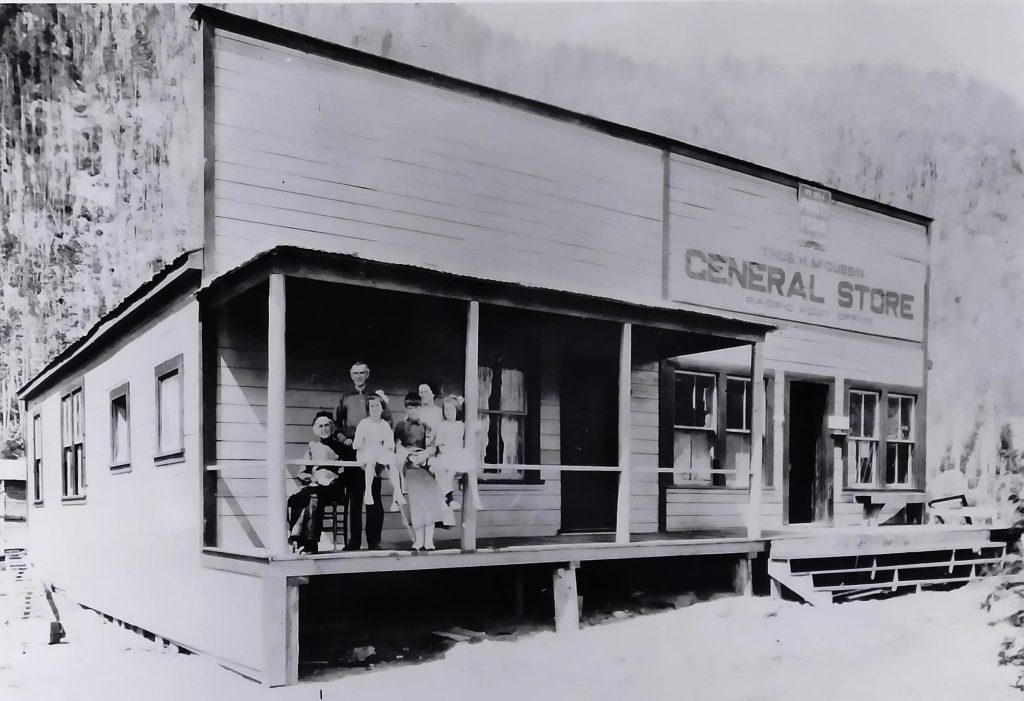
His fiancee, Lizzie Dougall, came out to Prince Rupert in June 1912, and stayed there with Tom’s friends, Mr. and Mrs. Carmichael. She left behind her a large family of brothers and sisters, twelve in all, in Scotland and with her marriage to Tom in 1912 started the life of a frontierswoman.
Their daughter Beth writes, “They set off by river boat for Nicholl. Mum told me she had on her light grey wedding suit (hobble skirt). They had to portage around the canyon and a fire had burned through the trail leaving black logs to climb over. By the time Mum arrived at her new home her skirt was black to her knees and in tatters.”
Wiggs O’Neill in “Whitewater (Men) of the Skeena” says “They had the option of walking over a wagon road or staying with the ship. Believe it or not every man walked and the two ladies (a Mrs. Martin and Miss Sawl) elected to stay with the ship. They sat on top of the pilot-house with their legs dangling over the side, cheering all the way through the Canyon!” Such was the caliber of our pioneer women.
At first Lizzie and Tom lived in a one-roomed house and then moved into living quarters attached to the store and gradually enlarged them.
Their first child was a son John “Jack” Carmichael (named after the friends in Prince Rupert) born 1913 in the Prince Rupert General Hospital. Lizzie stayed with the Carmichaels until she was well enough to return to Nicholl. Beth writes that when her mother was pregnant, she was so sick, and Mary Anderson brought her some fresh orange juice which was the first thing she had kept down for days.
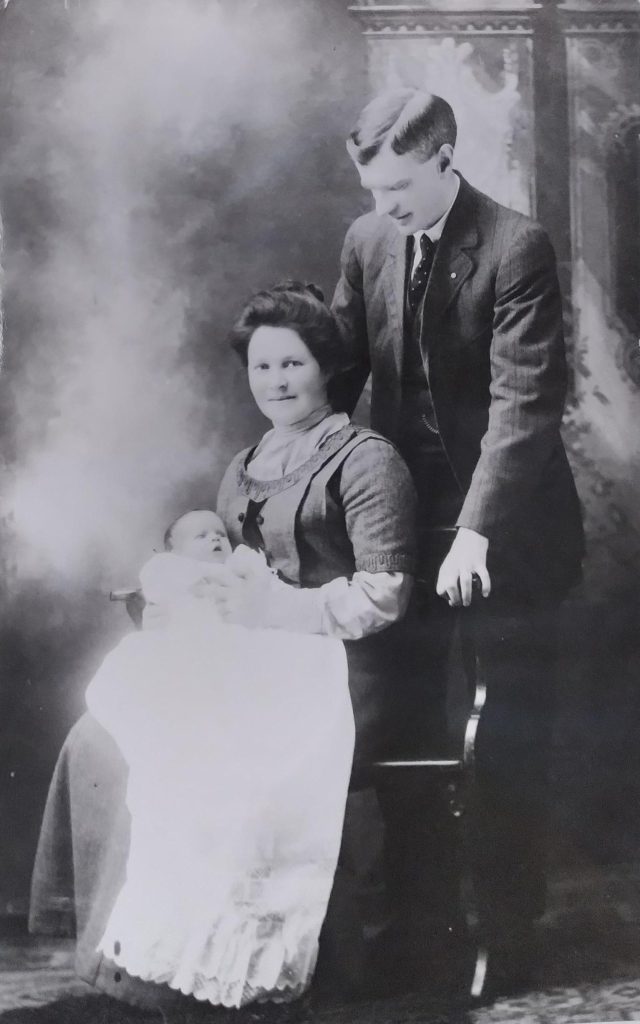
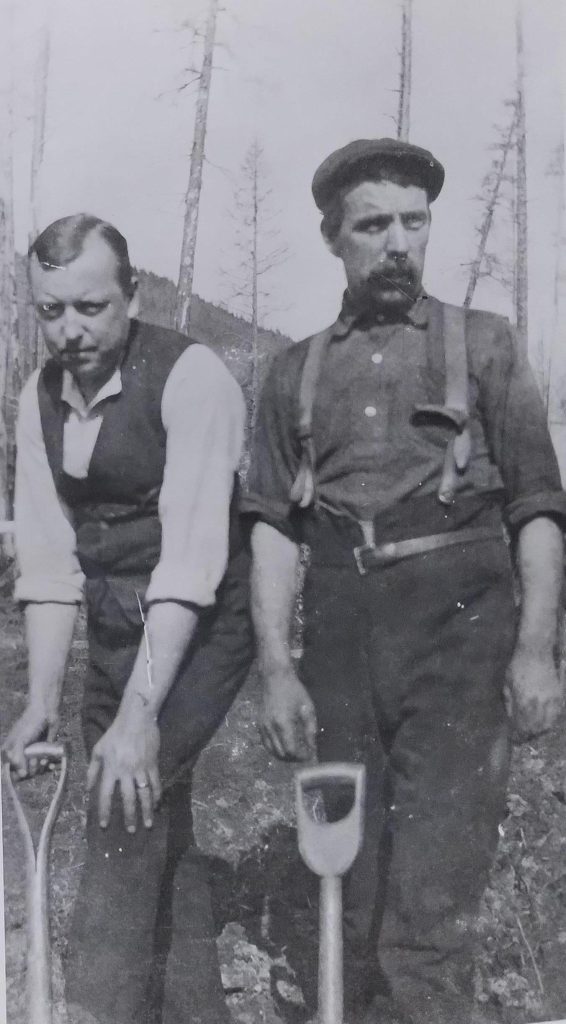
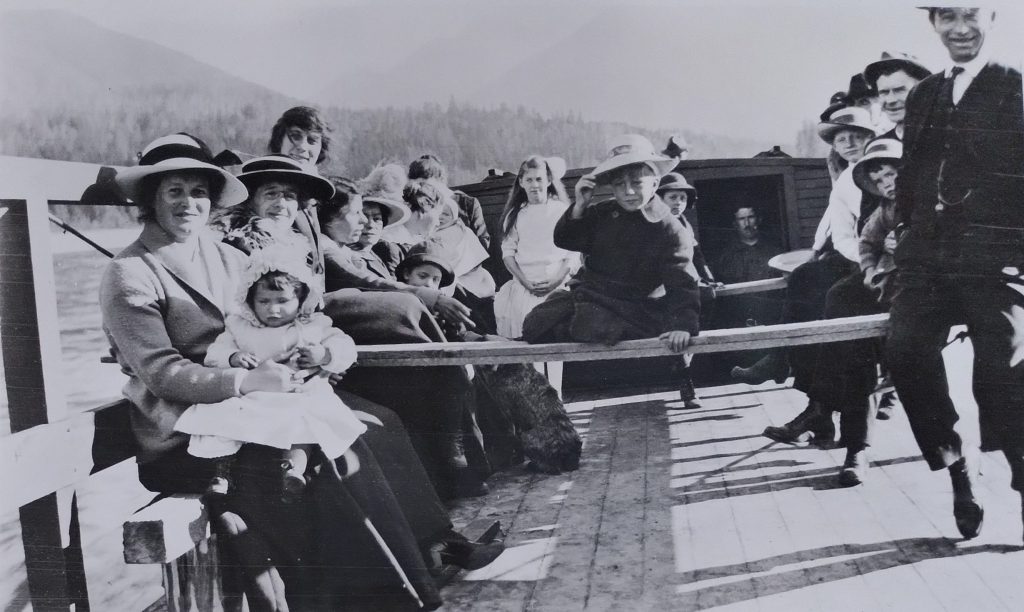
Jack still has a letter written by Thomas W.S. Parsons of the Provincial Police and William Noonan, the Station agent at Nicholl, congratulating his father on his first born.
Norma, their first daughter was born in a nursing home in Terrace run by a Mrs. Donald in 1915. She was called Norma after her mother’s youngest sister and Dougall which was her mother’s maiden name.
Their second daughter, Beth, was born in Terrace in 1917 at a farm owned by Mrs. Landfairs and Mrs. French. She was a breech birth and a very difficult delivery. The doctor gave her up for dead, but the ladies put her alternately into warm and cold water and she finally cried. The ladies gave her the name of Theodora – loved of God – and wrote a poem about her birth. So she has the impressive name of Elizabeth after her mother, Theodora Stevenson (her grandmother’s maiden name), and has always been called “Beth”.
The children spent holidays at this farm in Terrace, and Jack remembers the lovely crisp lettuce they grew. He also tells how he mischievously squirted milk from the cow at his sisters!
Pacific School
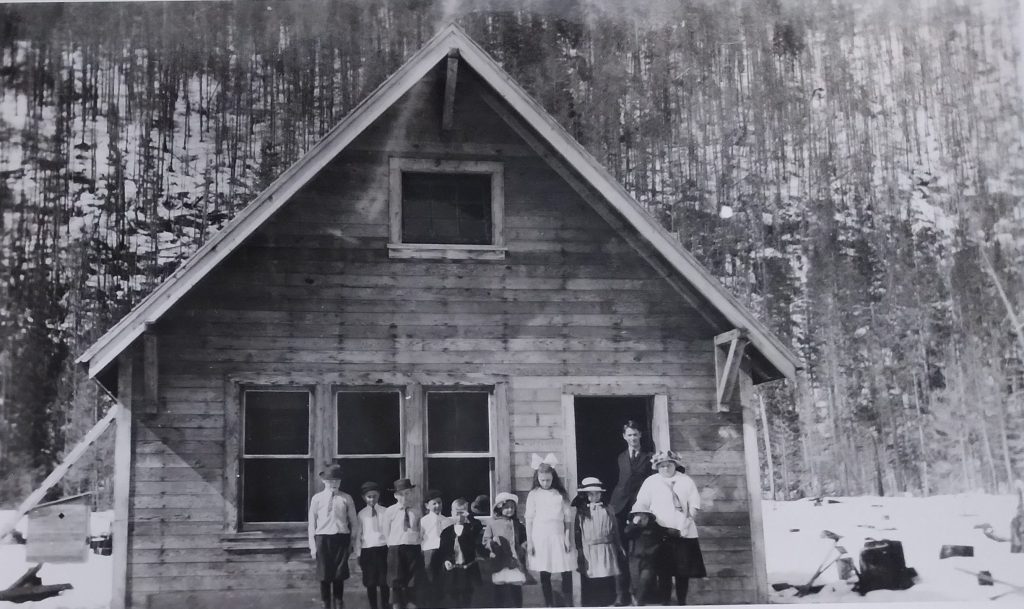
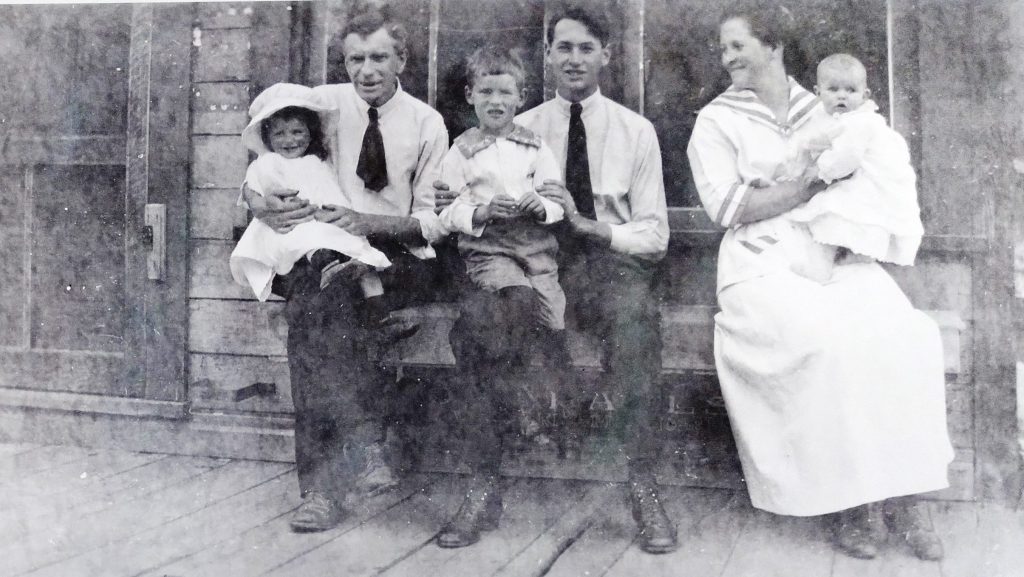
When Jack was four and a half he bumped into his mother carrying a pot of hot tea, and the pot broke sending the hot liquid over his shoulder and chest. His father got excited and pulled his sweater over his head, and took all the skin off. He went to Terrace Hospital for treatment and it was several months before it healed. He still bears the scars today.
He also went to Hazelton Hospital for a hernia operation when he was ten years old. The doctor’s son Harold Wrinch, a similar age was playing with his bicycle and invited Jack to try it. He had never ridden one before so jumped at the chance even though he was still a bed patient, and rode down a steep hill meeting the doctor coming up to the hospital. Needless to say that was his first and last bike ride for a while.
Anyone who had never visited Pacific would imagine it was a primitive, place with very little entertainment. This was certainly not true for the children they had a wonderful time. There was a good-sized slough about a mile and a half long, near the river, fed by a couple of tiny streams. All summer long they swam and boated here, and in the winter played and skated on the ice. They built rafts and paddled them and on numerous occasions fell over board. Jack tells of trying out the new ice on his way to school one day, and falling through it. When he arrived cold and wet at the school, the teacher made him strip down to his long underwear and stand by the pot-bellied heater at the front of the classroom to dry out. He still remembers his terrible embarrassment to this day. There were also berries to pick in summer, long hikes In the woods and up the mountain at the back of Pacific to a lake. And fishing in the Skeena had to be seen to be believed They caught so many that it was quite a problem giving them away to the residents as there were no deep freezers in those days. They also used to hike along the railway tracks to the next community of Doreen.
The adults played cards frequently in the evenings. The men always enjoyed a game of pool at Nel’s pool-hall and games of poker, too.
There was a good community hall built by Nels Thompson and very enjoyable dances were held there. People came by train and speeder from miles around.
I remember many evenings around the piano or organ in the McCubbin home, having a good sing-song with Lizzie playing and Tom accompanying us with his flute.
They had an old government telegraph phone in their home – the only one in the community. They had to turn a handle to crank out so many long rings and so many short rings which signaled who you were calling in Terrace or Hazelton. They used it to order their meat once a week from the Terrace butcher, which arrived by train. It must have been quite a gamble to order enough for unexpected company and not too much that it would go bad in the ice-box. Lizzie was a wonderful manager and always put a good meal on the table in spite of her limited supply of meat.
Another problem the ladies had was ordering clothes by mail from Eaton’s catalogue. They would go down to the station all dressed up in their newest mail order dresses, to see a train full of Indian women heading for a cannery in identical dresses!
CHAPTER 3
When Pacific was chosen as the Divisional Point on the railway, this called for many additional buildings. First was needed a roundhouse, a circular shaped brick building containing stalls for locomotives. Below the track in each stall was a pit where men could work on the engine from beneath it. There was a large turntable to turn the locomotive into whichever stall it was to go. There were also shops for major repairs. Next they needed a station, and the one in Pacific included a good-sized restaurant and a kitchen for food preparation. There were living quarters upstairs and a large supply of coal in the basement. But the remarkable part of this station was its waiting room. It was very large and was used for many years by the school for Christmas concerts, and by the community for parties.
The whole station went up in flames in the 1930’s, and Jack tells of rushing into the burning building to rescue the station agent’s typewriter. A woman from the restaurant pled with him to go upstairs and bring down the four hundred dollars she had left under her pillow, but it was impossible to enter the building by then. It was totally destroyed.
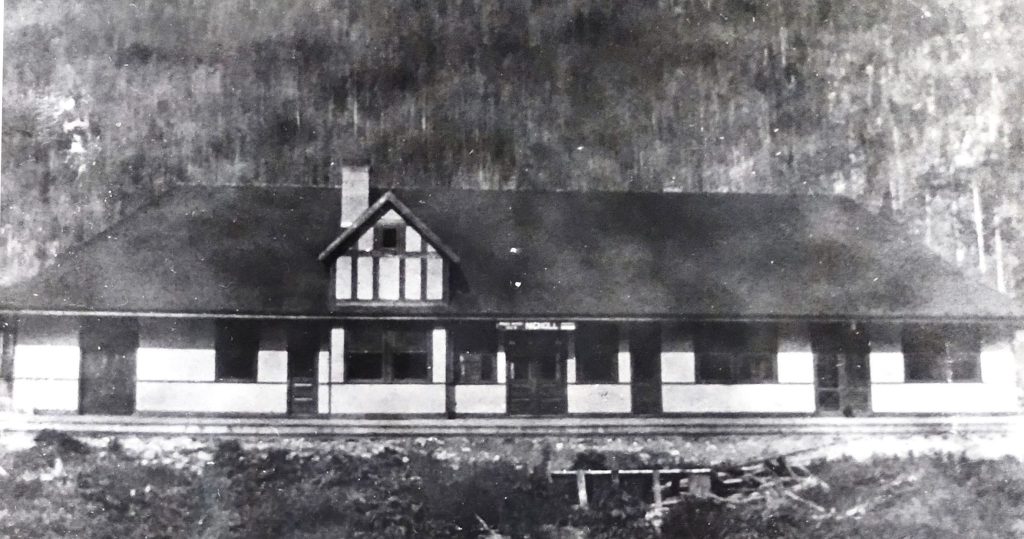
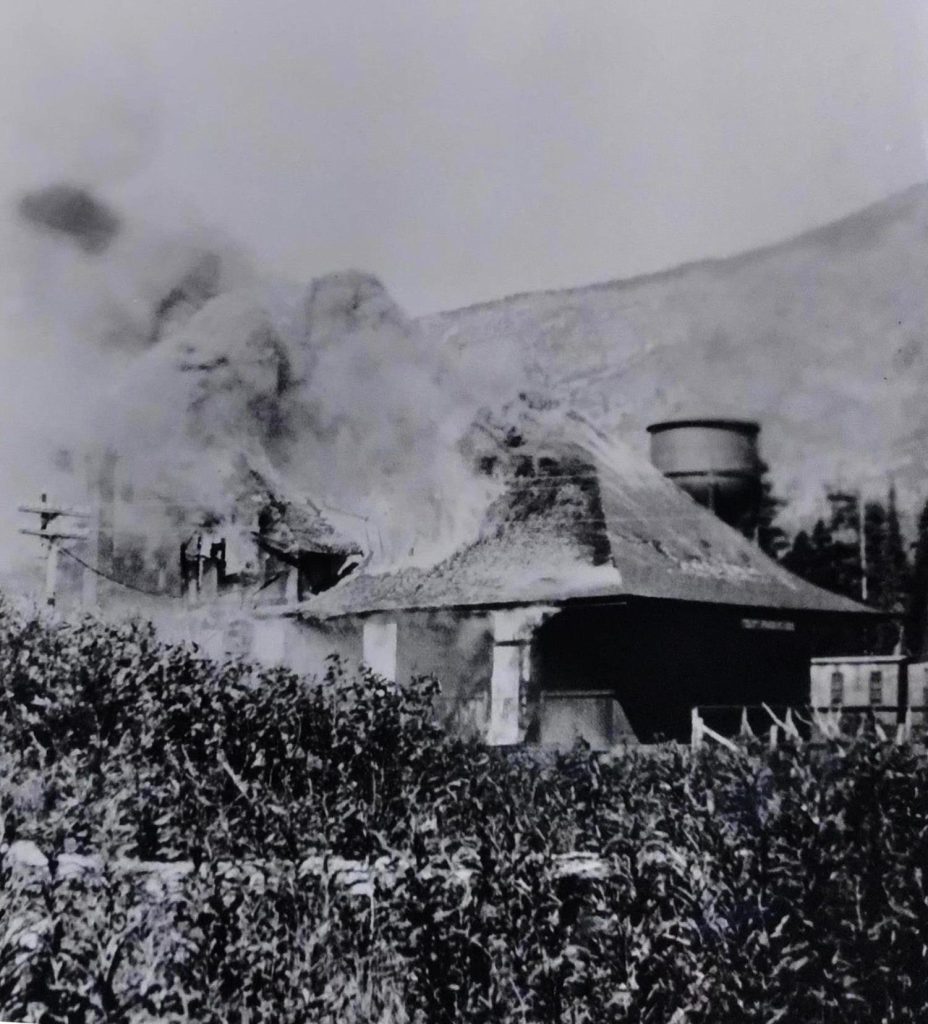
It was replaced by a small, station, and a box car was converted to a restaurant. In time Nels Thompson built a sturdy community hall which still, stands in good condition today.
Tom had a younger brother, John Stevenson McCubbin known as Jack, who was born in 1884, in Ayr. He came out to Prince Rupert in May 1911, and probably found employment in the district although little is known of his whereabouts during the next three years, except that he was a patient in the Hazelton Hospital in September 1913. He joined the army, and served overseas, 1914-1918. He came back to Pacific after the war with tuberculosis, and spent the summer in a tent near Tom’s store. Jack left for California that autumn, and married Gwendolyn Profit, a nurse in Los Angeles, in 1924. They visited Pacific once after their marriage. He died in El Cerrito, California, on October 5, 1926 at the age of forty-two. There were no children.
Tom’s widowed mother, Elizabeth, came out from Scotland to make her home with Tom’s family in Pacific in 1918, at the age of seventy. Her possessions, in large trunks, and her grandfather clock came by way of the Panama Canal some months later.
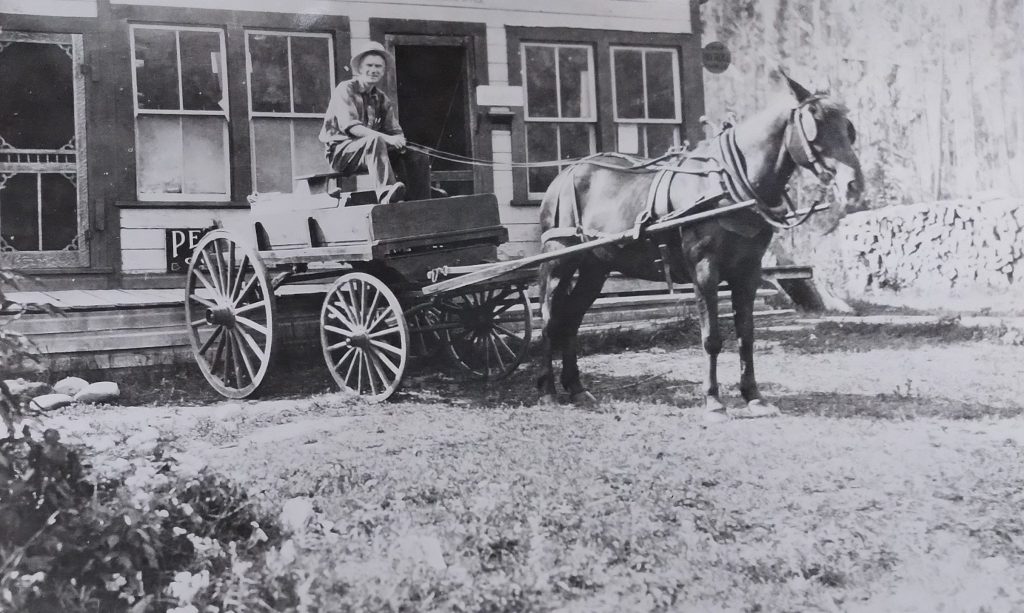
Stack of 3-foot cordwood (at right) for sternwheelers.
One can only imagine what adjustments this elderly lady had to make. She was a slim, dignified, old fashioned lady who made her presence felt in the home. She was a strict disciplinarian, yet had a good sense of humour. She usually dressed in a long black or dark-coloured dress and wore a little lace-trimmed black cap. Lizzie must have resented this intrusion on her family life, but accepted her graciously for Tom’s sake. She died at home in Pacific on September 18. 1935, and was buried in the Terrace Cemetery.
I always felt that the McCubbin home was a warm, friendly place, and I enjoyed my visits there. One year when I was there, at least five other young girls around my age were also visiting. I can remember the big crowd around the large dining room table, everyone talking and laughing, and enjoying themselves. Even the walk down the back path to the privy did not seem to be a drawback in those days. Yes, they were happy times. Perhaps the fact that I met my future husband, Jack in that home makes the memories especially precious.
CHAPTER FOUR
THE FLOOD
Living on the banks of a river had one disadvantage. Every few years after an unusually heavy snowfall, an early warm spring, and some heavy rain, the river would go into flood. Mostly the damage would be minor but a couple of times there was real hardship.
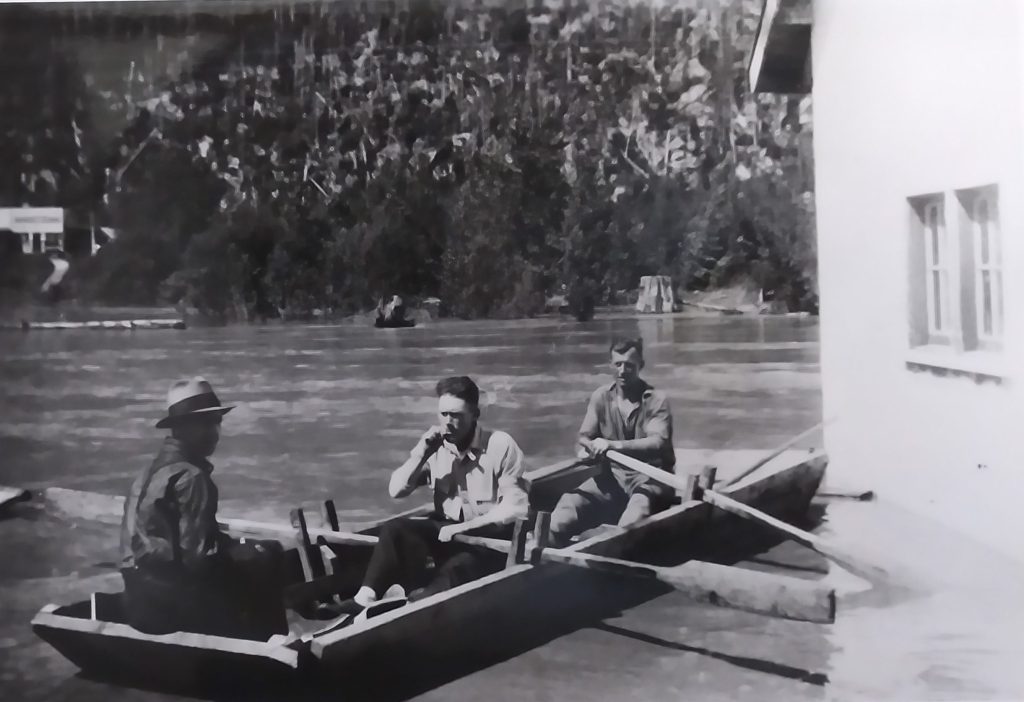
In 1936 the worst flood occurred washing out bridges, railway tracks, sixty miles on each side of Pacific. Many buildings and homes were flooded and some moved and washed away.
There was no train service for six months and Pacific was virtually cut off from the rest of the world.
Several homes belonging to the Railway were flooded out but fortunately there was a large work train at the station as well as some spare coaches which helped to house the people who lot their homes. The McCubbins had a small empty house to which they moved a prospector who lost his shack.
They were able to get food from Terrace by means of a rowboat with an outboard motor. And more important, the men were able to obtain their tobacco and snuce which got pretty scarce for a time!
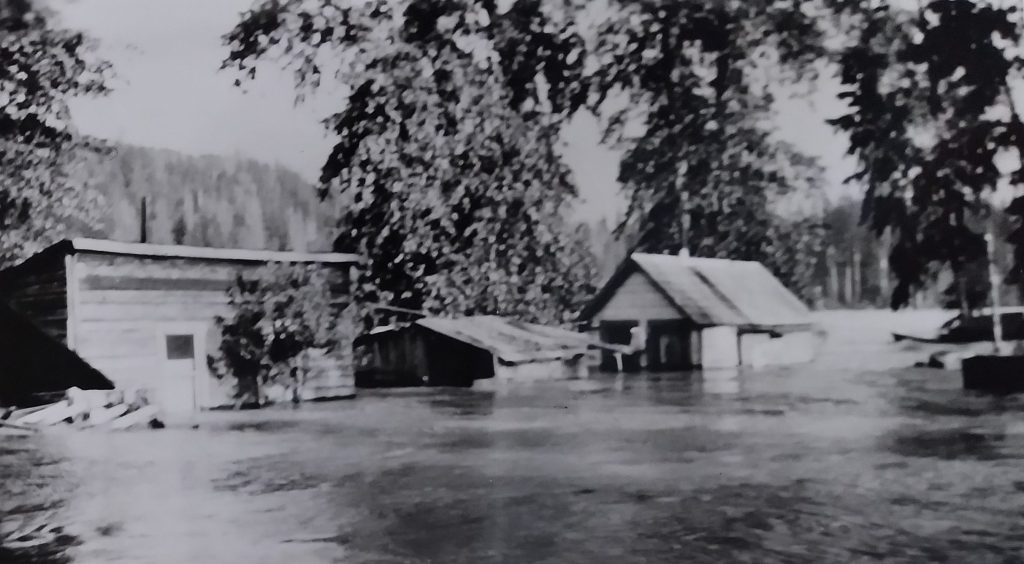
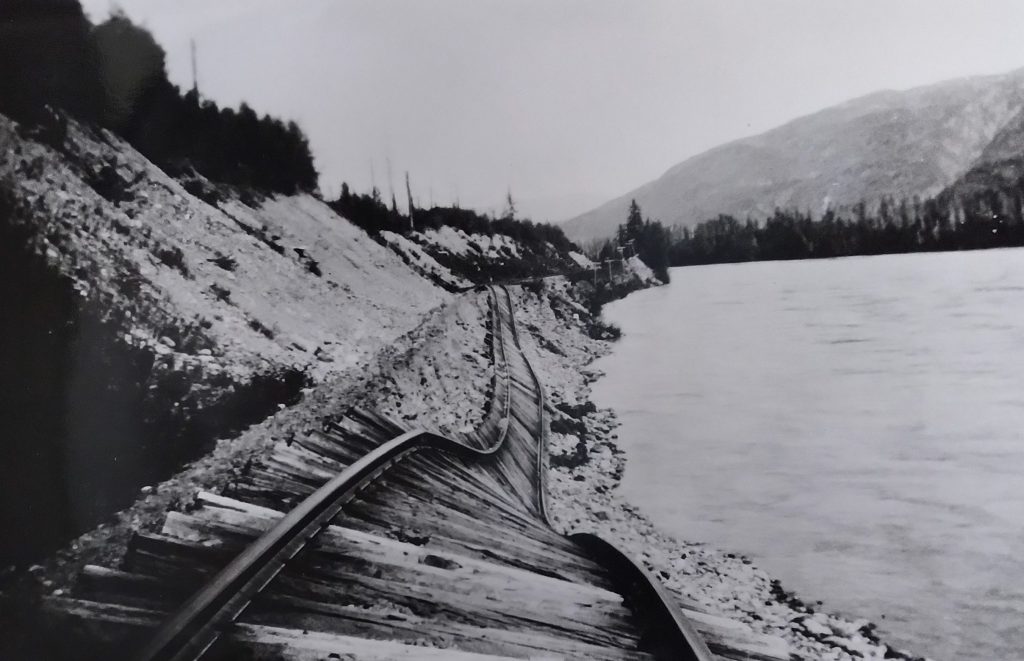
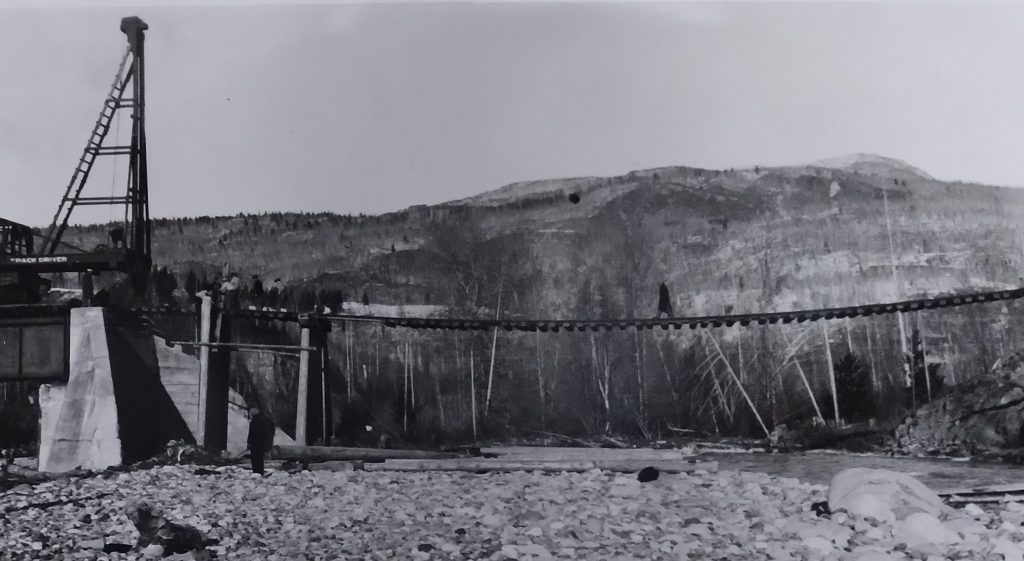
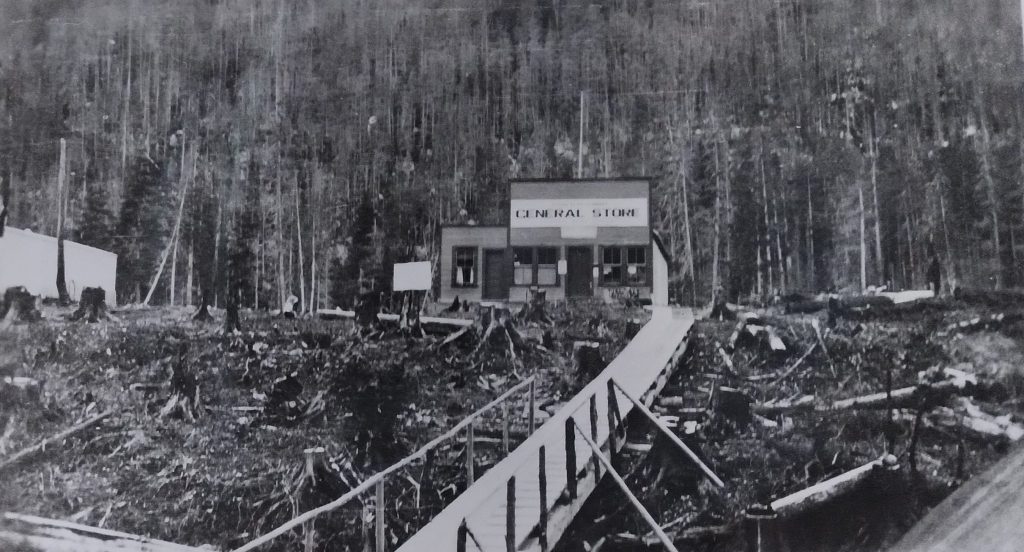
Fortunately the McCubbin store was up high enough above the river to escape the flood, though the store at Doreen was not so lucky as it was surrounded by water.
The bridge across the slough at Pacific was washed out so Jack had to get busy and build a new one.
The store sold goods that had been sitting on its shelves for twenty years, including old fashioned boots (pointed toes) and hats and shirts and the customers were happy to get them. It was no time to be fussy.
Jack and Edward Anderson did a lot of fishing so there was always fish when meat was scarce.
The horse, Molly, got stranded on a grassy knoll during the flood so the men had to push the cart down to the supply boat to load up and then pull it up the hill to the store. That was real man power! When the water receded, they had to swim Molly across the slough and had quite a time getting her out of the water and up the soggy, slippery bank.
The square ended boat in the picture was built by the Bridge and Building gang who were working to repair the flood damage to the tracks and it was a very busy means of transportation.
This, indeed, was a disaster that will always be remembered by the people of Pacific.
CHAPTER FIVE
TOM AND LIZZIE’S DESCENDANTS
The McCubbin children had all of their elementary and most of their high school education in Pacific. While attending school Jack also helped his father with the store and Post Office. He hauled the freight and bags of mail from the train to the store. For years the only transportation they had was a cart drawn by Molly the horse, who was almost one of the family. When he finished school he spent two summers. prospecting for gold with small success. He also had a trap-line. One year he spent working in Dawson City and Whitehorse in the Yukon which was quite an adventure but not very remunerative. Then he got work in the Kelly-Douglas warehouse in Prince Rupert where he was working when his father died and he had to go back to Pacific to run the store until it was sold to Peter and Hilda Mark in 1941.
Norma took her last year of High School in Prince Rupert, 1931-1932, which was where I met her. After graduation I was invited to her home for a holiday which is when I met the McCubbin family and saw Pacific for the first time. Norma took teachers’ training at the old Normal School in Victoria, with the clock in the tower, which is now Camosun College. Her first school was at Woodcock on the Skeena River, then Prince Rupert. She married Clinton Halliday August 4 1939, and lived in Prince Rupert. She had two children, Shirra, born 1940 and Grant, 1945.
After Tom died Lizzie made her home with Norma in Prince Rupert. She visited Beth in Saskatoon and Jack and I, in Victoria. In fact she stayed with us and looked after Gail and Jack when I was in the hospital having our second child Tom, which we appreciated. She developed cancer of the bowel and had surgery in Prince Rupert General Hospital from which she never recovered. She died in 1951 at the age of seventy years.
Norma went back to teaching in Prince Rupert for several years. She also had cancer of the bowel and had a colostomy but taught for about two years until she had to give it up. She died November 30, 1960 in the Prince Rupert Hospital at the age of forty-five years.
Beth had some of her high school in Terrace and the last year in Cumberland on Vancouver Island where she boarded with Reverend and Mrs. H. T. Allan. She then took nurses’ training at the Prince Rupert General Hospital, and continued on the staff after graduation.
She was there in February 1939 when her father came in for surgery and died a few days later at the age of sixty-one. His death was a terrible shock to the family as the surgery should have been routine. He was greatly missed in Pacific in the store and Post Office. He was also Mining Recorder, Notary Public, and general advisor and helper of the whole community. Many a hungry prospector was given a grubstake by this kindly man. Beth married Leo Siekawitch (later changed to Spencer) who was in the air force and stationed in Prince Rupert. The wedding took place at Norma’s home and Jack and I were also present as Jack was on embarkation leave. Jack went overseas shortly after and spent time in England, Germany, and was in Holland at the end of the war. After his safe return we had another visit with Norma and Lizzie in the autumn of 1945.
Beth and Leo lived in Saskatoon after the war where Leo took his degree in mechanical engineering. Then they moved to Edmonton where they have lived ever since. They have two sons, Thomas Gerald born 1946, and Brian Philip born 1949. After Norma died Beth and Leo took her son Grant, and raised him with their boys. Last year, 1980, Grant and his wife Barbara and young daughter and son were transferred to Edmonton from Montreal so are happy to be close to the family once more. Grant’s sister, Shirra, married Doug Main and they live in Enderby, B.C. They are both teachers and have two teenage daughters and two sons.
Gerald Spencer works with his father In Edmonton making x-ray cameras and dark rooms for working with pipelines. He and his wife, Brenda, have a daughter, Terry, and a son, Chris.
Brian Spencer graduated from Edmonton University in medicine and interned at the Royal Jubilee Hospital in Victoria. He took post graduate studies in obstetrics in Auckland, New Zealand, and is now practicing in Victoria. He and his wife Fran have a young son, Paul.
After Jack returned from the war he had a Variety Store and Post Office on Haultain Street for over twenty years and is retired now. Our family is scattered around British Columbia. Gail and her husband Terry Blagdon and their two young daughters are in Mission where Terry is an engineer on the Albion Ferry.
Tom and Sheena both teach in Prince George and had their first child, a daughter, Jana, in December 1980.
Norma and her husband Gordon Callow live in Saanich with their, three young daughters. Gordon is employed by the Royal Oak Cemetery.
CHAPTER SIX
It it impossible to record all of the many people who lived in Pacific in the early years. Among those who made the town their home were Mr. and Mrs. Ed Barnes. He was a Car Inspector for the railroad. Mr. Bert Taper was the night locomotive foreman, and he and his wife had a son and daughter of similar ages to the McCubbin children. Dan Taper achieved his doctorate in Agriculture, and recently retired after teaching many years at MacDonald College in St. Anne de Bellevue, P.Q. His sister, Lillian, died of tuberculosis in her late teens.
Mr. and Mrs. Bud Corley were some of the few people, besides the Andersons, Nels Thompon, the McCubbins and the school teacher, who did not work for the railway. They eked out a precarious living farming on the outskirts of Pacific.
The first station agent, Bill Noonan, arrived in 1912, and married Ann Lever who worked in the Nicholl Hotel. Tom Parsons, the district policeman was his best man. They lived in Pacific for many years.
Mr. and Mrs. Fred Rogers were early arrivals – he was day locomotive foreman. Mr. and Mrs. Sam Alger were also old timers. Their daughter, Ivy also trained at the Prince Rupert General Hospital. The Gardiners, the Dishers and the Barkers were also early residents who made Pacific their home for many years.
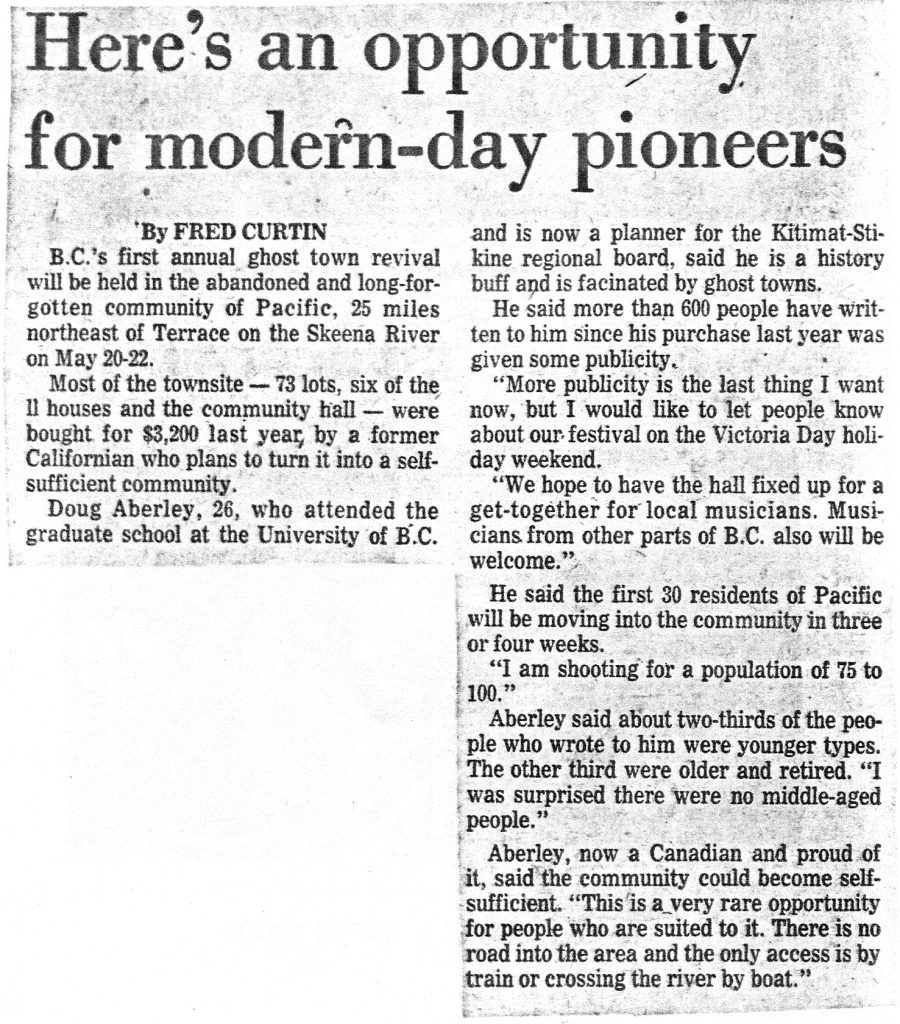
After Pacific’s last citizen, Nels Thompson, died in Terrace in the early 1970’s his property at Pacific (which was most of the town) was bought at an estate sale from the Crown by Doug Aberly for three thousand, two hundred dollars. He had dreams of bringing Pacific back to life with a colony of people living off the land, using alternate energy sources, and barter systems, and thus becoming a self sufficient community.
I quote an article in the “Smithers Interior News”, written by Sheila Peters on May 28, 1977:
“Aberly emphasized that he is one of the group of Townspeople, for there are six people living in Pacific now. Signs of loving care are appearing on some of the buildings, most of which are broken down shells.. An orchard has been planted and some gardens seeded.
But the Community Hall is as sturdy as can be and is decorated with Pacific memorabilia including such things as brass bedsteads, saw blades, and furniture worked together in delicate designs. Delightful arrangements of the town’s past worked to blend in with and add to the beauty of the present.”
An article in the “Victoria Times”, in 1977. states – “B.C’s first annual ghost town revival will be held in the abandoned and long forgotten community of Pacific, twenty-five miles northeast of Terrace on the Skeena River on Nay 20 – 22nd.”
The revival was apparently a huge success as approximately one hundred and fifty people from as far away as the Queen Charlotte Islands and Houston, B.C. arrived by train.
Quoting from Sheila Peters’ story again:
“Upon arrival all were greeted with welcoming shouts and the pleasing warmth of fires blazing beside the tracks. After passing through immigration we all entered the ground of the Northwest Nation, otherwise known as Pacific. Doug Aberly welcomed visitors with the following “This week is a time to celebrate the revival of Pacific as a living, small community. As you can see there’s lots of work to do, but the potential is here and the folks that are starting to call Pacific home are more than capable.”
But people shared the miserable weather, the brief flashes of sunshine, dripping tents, and laughing music, west coast halibut, clams, and Skeena salmon, and for a weekend the sound of people filled the town.”
The (re)colonizing of Pacific has been less than successful and is just another chapter of broken dreams for that lonely site. It is a beautiful but isolated spot in the summer, but the winters are long and cold even for the hardy.
Jack and I hope some day to go to Prince Rupert and take the train to Pacific (the road is across the river). It cannot be anything but a sad visit with a lot, of nostalgia.
VICTORIA DAILY TIMES
APRIL 1977
Text and photographs courtesy of the British Columbia Provincial Archives.
