
Rescue on the Skeena – 1872 style
as obtained from the Victoria Daily Times, July 12, 1887
Courtesy the Provincial Archives of British Columbia
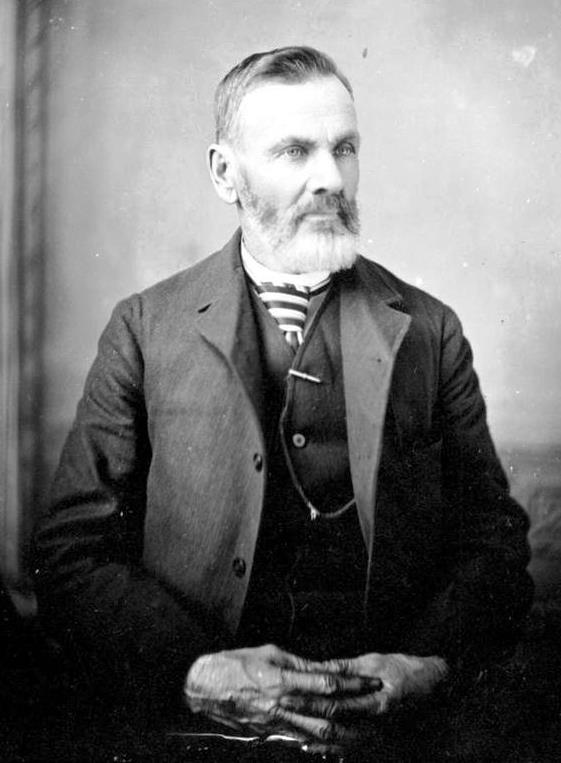
Moses Cross Ireland was a native of Sebec, Maine and at the age of 19, came out to California where he got involved in gold mining, “became possessed of a competency”, and returned to his eastern home. He found his life back east was humdrum and decided to head back out to California for three more years. He then proceeded north to the wilds of unexplored British Columbia. Ireland was in the Cariboo in the autumn of 1862, and when winter came on suddenly, he and five companions decided it was time to go back to Victoria for the winter. While hiking over Bald Mountain, Ireland had to convince his party that the route he wanted to take was the correct one. They reluctantly followed him. Eventually they came upon a large party of thirty nine men and three woman, encamped in the snow and lost. His rescue of this party is a story of determination, courage and heroism exhibited by Ireland, which I will not cover here.
Fast forward to the fall of 1872 and “Ireland was freighting goods by canoe up the Skeena River, en route to the Omineca country. On his last trip of the season, ice was forming on the Skeena and his trip into Hazelton was difficult. While unloading the freight in Hazelton, a group of miners were on their way to the coast and were looking for transportation. Ireland agreed to take them back to the coast, and was soon on his way with two canoes and thirty five men. One of the canoes was chartered by Nelson, a trader and it contained fourteen men and a consignment of furs. Ireland directed the other canoe. From the beginning, they had difficulty with the ice floes in the river. Expecting to get further supplies at Kitselas, they were surprised and dismayed to find the store closed and abandoned. The cold increased and snow storms were frequent. The Indians informed Ireland the river below was closed. They had no alternative but to push on. The natives themselves were scarce of food and dried salmon. These salmon, normally 5 cents a piece, were now $1.00 each, but Moses bought all he could. At every few hundred yards, a jam of ice interposed, over which they had to make a portage. Ireland’s crew being the stronger, assisted the other canoe. They traveled in this manner for three days but made little headway, the snow being two feet deep on the ice, and they having to travel more on the ice than on the water. They calculated that at the rate they were going, it would take them three weeks to reach Port Essington, the nearest inhabited place.
“The outlook was gloomy. That evening Ireland’s company encamped and waited in vain for the other canoe. The men held council and decided that unless the other party came up with them that night, it would be suicide to wait for them. After dark Ireland, fearing the men would keep their word, said: ‘I’m going back to get that party and bring them up.’ The rest said nothing and let him go. Ireland found them encamped on the river a mile up. He told them they must push on with the rest. They refused to budge, and Ireland, in vain, trying to get them to consent, told them he would get help and come back for them. In fact the party intended to die where they were and did not even answer Moses. Their privation had broken their spirit and they had no one to lead them. Ireland reached his own party again and told them they must reach Essington or die.
“In fact the party intended to die where they were and did not even answer Moses. Their privation had broken their spirit and they had no one to lead them.“
-Victoria Daily Times
He said ‘To do this you must put your confidence and trust in me and obey my commands.’ They were made of better stuff than the other party, and shouted feebly with renewed hope, ‘Ireland and Essington.’ They had made their choice. He then demanded that all provisions be placed in his hands and doled out fairly as long as they lasted. He counted twenty two dried salmon and a few biscuits. One day’s ration under ordinary circumstances. Next day the men, on short rations, became ravenous and delirious, but Ireland would give them no more than a few ounces each. Soon they began to slowly starve, and all of them, including Ireland, wasted away to shadows. But Moses was a giant in will, if his substance was being wasted, and he fought them away with the strings of salmon he kept in his pack.
At three days from Essington, the last precious shred of dried salmon was gone, and they faced death in its most awful form. Some decided to lie down, and under the numbing, soothing influence of the cold, die and make an end to it. Some of the men were constantly raving and jabbering like idiots of home and mother and sweethearts, there wild imaginings making them believe they were at home surrounded by their relatives and the comforts of luxurious existence. There were but three men besides Ireland who remained rational. They held a meeting apart, and Ireland asked them what they would do. One of them boldly said ‘One of them must be killed. One of the idiots that the rest be saved.’ Two others agreed. Ireland said ‘No; I will make one more effort to save the party. Be men, brave men, to the last; I am going to do my best. If you must die, do it decently. Obey me now that I may save you.’ In the morning the snowstorm had buried the canoe, and only after a search could he find it. Ireland and two Indians dug up the canoe and at 2 o’clock p. m. it was placed on the top of the snow. By this time they were exhausted and went into camp for the night. Next morning the weather was fine, and Ireland recognized a landmark by which he knew they were not far from salt water. This fact he communicated to the rest. Then he pushed moodily forward, and finding the storm had driven nearly all the snow from the river, they betook themselves to the ice, and at the close of the day were rewarded by reaching the open water. Although it was night and the tide was still receding, they determined to drift down as far as possible so as to be clear of the ice which would meet them with the return of the tide. The canoe was soon launched and they embarked. They encamped about two miles further down next morning, the tide being full, and large portions of the floe-ice were above them. For the next four miles of the journey they had but little trouble. Then, meeting with a field of ice which extended across the bay and about two miles in length they were obliged to cross it on foot. Their troubles were then over, and in two hours more they landed safely in Essington.
“Proceeding at ounce to the nearest store, they seized crackers, cheese and every form of food they could find. The poor fellows crammed into their mouths with such greed that either to chew or swallow was impossible. There they stood, presenting the ludicrously pitiable spectacle of men, from whose mouths the dry food was falling, while they sought to satisfy the intense craving of their hunger. No wonder that the clerk in charge thought them insane. He hastily summoned to the scene the Hudson’s Bay Company’s agent, who at once took in the situation, and with all possible dispatch had suitable food prepared, and so judiciously administered, that in a very little while they were comparatively happy.
“Mr. Ireland’s first thought now was for the unfortunate ones who were left behind. He consulted with Mr. Feek of the Hudson’s Bay Company, and Mr. Cunningham, informing them of the position of affairs, and assuring them that unless relief was at once forwarded, those fourteen men must die—that, in fact, the chances were it was already too late, but an effort must be made. Both these gentlemen did their best to procure either white men or Indians to undertake the task, but all considered it too perilous. Neither promises nor money would induce them. To effect the rescue or die in the attempt was Mr. Ireland’s unwavering determination; but he was now in a dilemma as to what plan to pursue. Finally he adopted an ingenious expedient. He had considerable experience with Indians and knew their weakness as well as their good traits, and though it was a violation of the law, he decided to bring liquor to his aid. He took the clerk into his confidence, and arranged that a supply of provisions be secretly put in the canoe, so that if the Indians consented to make the trip they should have no time to reconsider the matter. He soon found four stout, strong Indians who had worked for him during the summer, and began to speak to them of ‘old times,’ and of the many dangers they had passed through. “After praising them for the efficiency of their past services, he asked them to take a drink. They needed no second invitation, and were now freer to converse than before. He treated them again and again until he thought he had them properly primed. In reply to a question put by him, they swore they would go anywhere with him. He then said, ‘We have plenty of muck-a-muck, pack that demijohn of brandy to the river, and we’ll go up the river.’ This they did, and having procured their blankets, started right out. Thus we find Mr. Ireland, after only one night’s rest from his fearful experience, starting out again.
Courtesy the Provincial Archives of British Columbia
No one who has not been with Indians while making their way in frail canoes among vast masses of ice can form any idea of the expertness and nice skill which they display, and which is absolutely necessary to avert the imminent peril to which the voyagers are, in these circumstances, exposed. Since the arrival of the men at Essington the wind had been blowing a stiff breeze up the river, driving all the ice from below Essington up to that portion of the river over which the rescuers had to travel before gaining the solid ice, making it so difficult that it took three days to cover this part of their trip. They had to, from the start, encounter great masses of broken ice, which were moving with the tide. On every point of land with which the ice could come in contact it was piling itself ten or twelve feet high. Their starting place was from a sheltered nook. As the ice was floating past, they had to watch attentively, and as soon as they saw the first opening the Indians gave a shrill whoop and shot out amid the ice and went floating up with the tide. They had not gone far when the ice closed in on them.
The Indians, who were on the alert, sprang two on each side from the canoe, and lifted and drew it bodily upon the ice. After getting their canoe up they were compelled to remain quiet and watch for an opening ahead of them; then they would launch their frail bark and proceed till the scattered ice should again close, when the above described performance had to be repeated. So extreme is the danger at such a time as this that should the Indians fail to spring at the right moment the canoe must in the next instant be shivered to atoms by the resistless blow of the rapidly closing ice. Mr. Ireland was too weak to render the Indians any assistance, and could only remain in the canoe. It was necessary for him to take charge of the brandy, and to deal it out to them in such quantities and at such times as to keep them in proper condition. If he gave them too much they would themselves become a source of danger to him, or be rendered altogether useless. If he allowed them to sober up their courage would vanish and they would effect a landing and refuse to proceed. At each ebb of the tide they landed and erected a tent, and during the whole of each night, Mr. Ireland had to guard the liquor and awaken them at intervals to give them a drink.
“In about two days after gaining the solid ice they came in sight of Nelson’s party, from whom Ireland had parted seventeen days before. As soon as Mr. Ireland saw them he ordered the Indians to make a large fire and cook a square meal, while he went on and brought the famished men into camp. After Mr. Ireland had left them they had lived on dried salmon for two days, after which they made soup by boiling down bearskins which had been used as wrappers for the furs. It took them some time to accustom their stomachs to this kind of fare, as the hair and grease were inseparable. Feeble and emaciated, they were nearing starvation point, and had lain in camp for two days, having given themselves up for lost. But the day Mr. Ireland met them being fairer than any before, they had started once more in the direction which help must come—if it came at all.
“Having eaten as much as men in their condition could eat, Ireland took command and made them push on. On the up trip they had to wade through snow and slush to a depth of two feet. But during the first night of the return trip it froze solid, and the walking next day was first-class, which enabled them to reach the open water that evening. Finding, to their surprise and delight, that the wind had driven all the floe-ice down the river, and the tide being favorable, they at once embarked, and at 10 o’clock that night arrived at Essington.
“Upon landing on the beach the rescued party gave three cheers for Mr. Ireland. The steamer Otter had been lying at anchor there for several days. Captain Lewis kindly waited over to see if Mr. Ireland returned and whether he would bring the men with him. The men on the steamer, hearing the cheer, at once replied with cheers. The inhabitants this time were prepared for them, and on hearing the cheers they rushed down to the beach and escorted the rescuers and rescued to the Hudson’s Bay Company’s store, where a sumptuous repast awaited them.
“As happened after the rescue in the Cariboo, the rescued wanted to give Moses some gold in appreciation of his rescue efforts. He refused the gold, but did agree to accept the gift of a watch. One person was given the gold and proceeded to Victoria to buy it, but instead gambled it away. In a panic and fearing his fellow miners would lynch him, he pleaded to Ireland to not divulge his breach of trust to the miners. It never was. Ireland was not that kind of man. The Daily Times in Victoria, which published this story in 1887 stated that several persons were still alive that were able to vouch for the accuracy of this story.
There is no record of Ireland staying on the Skeena with his freighting business, mostly due probably to the end of the Omineca gold rush; although the rescue experience on the Skeena would sour anyone to canoeing on the Skeena.
Moses Ireland went on to become a noted and very successful timber cruiser. He along with 3 partners set up the first steam powered sawmill on the Fraser River in 1876. He had a long and successful career in the logging industry and while living on Valdez Island (Quadra Island), he died in 1913 at the age of 83.
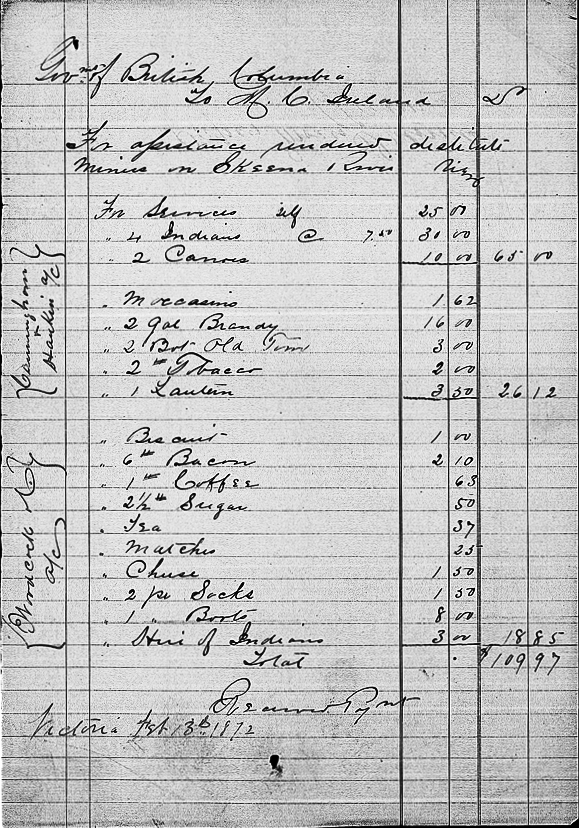
This is a transcript of the letter Ireland enclosed when he sent the above bill in to the BC Government in an attempt to get reimbursed for his expenses in the rescue effort. Unfortunately I could not make out all of his writing:
“ We left Hazelton with the canoe loaded with passengers. The history of the trip is well xx and needs no repetition.
When we were within about 60 miles from the mouth owing to excessive fatigue and xx xx of proper nourishment the xx party in xx canoe were satisfied that they would be unable to xx the xxx xx they could obtain relief.
I consented to go ahead and return as quickly as possible with provisions and assistance. On my arrival at Port Essington, I endeavored to engage Indians to return but finding it impossible and xxx xx xxx admitting no delay. I dispatched a messenger in a canoe to W. H. Woodcock whose place was about 9 miles from there to get me some men (at any price) and send them immediately.
Before their arrival the ice had run out with the tide and by promise of furnishing liquor to the Indians I employed four and started back. Before my departure, Mr Feek of the H. B. C. arrived and stated that Capt. Lewis was authorized to assist me and others in the xx. I obtained provisions? of the Company and a xx which they did not have. I purchased at Cunningham & Hankin. The bill at Woodcocks was contracted in fitting out the canoe which he dispatched according to directions. The bill contracted with the H.B.C. and has been paid and the others have not.
Everything being in confusion – I had no time to present him the bills.
The xxx xx xxx of funded relief can testify whether it was a case of necessity or not.”
M. C. Ireland
Sources:
The Daily Province
The Daily Times (Victoria)
BC Archives
◀
