
Telegraph on the Skeena
by Charles LeRoss

Telegraph service on the Skeena came in several stages:
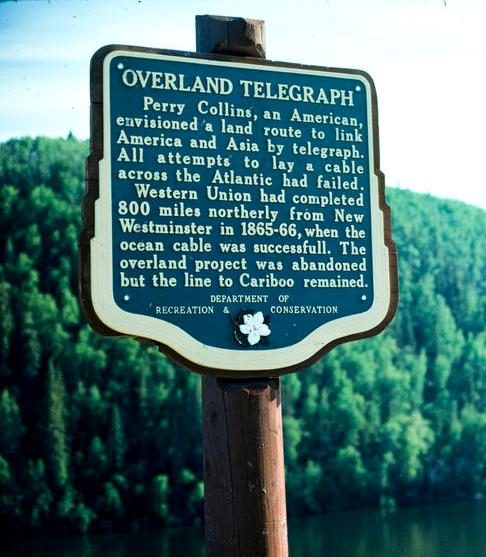
1865 – Collins Overland Telegraph
Construction of the Collins Overland Telegraph began when a line was put in from Vancouver to Quesnel and up past Hazelton, with the intention of building it all the way to Russia and connecting it to Europe. This line was never finished because a cable across the Atlantic was connected to Europe. Western Union Telegraph abandoned the line from Quesnel to Hazelton but continued to operate the line to Quesnel until it was taken over by the Canadian government. See this post describing Charles F Morison’s experience in the work he did on the Collins Overland Telegraph line.
Drag map to view, Scroll mouse to zoom
1900 – Yukon Telegraph Line – Quesnel – Hazelton – Atlin

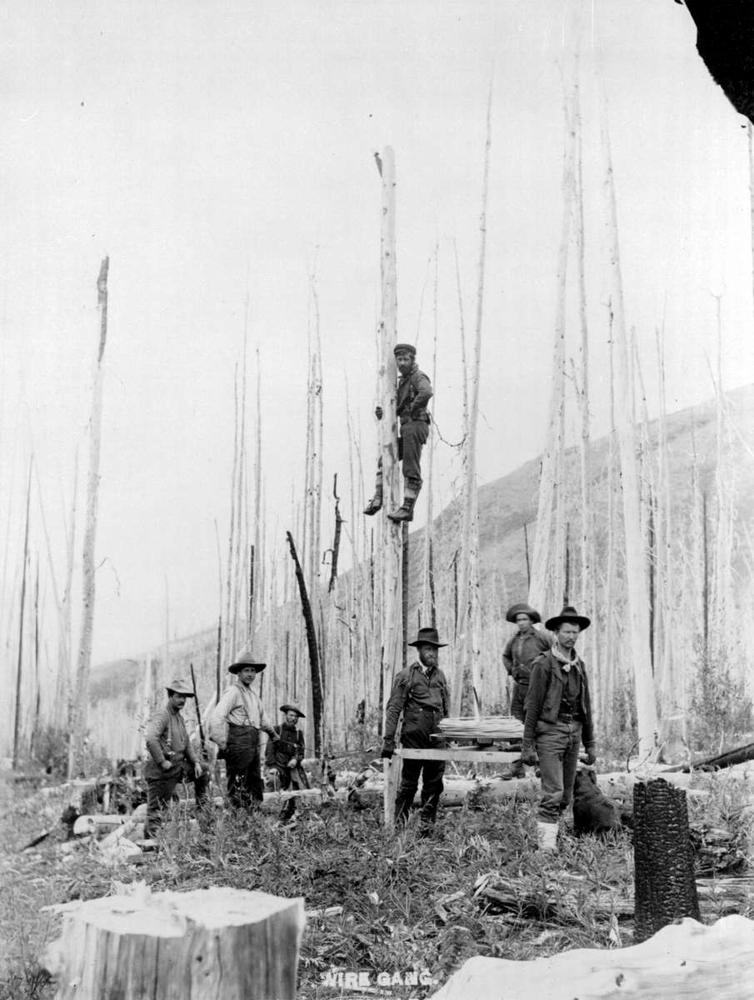
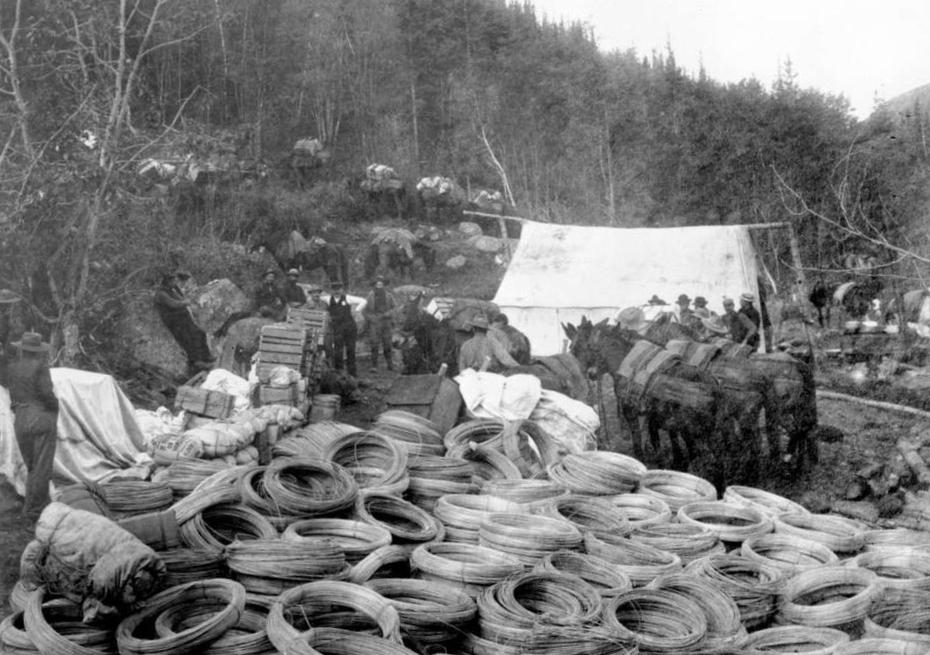
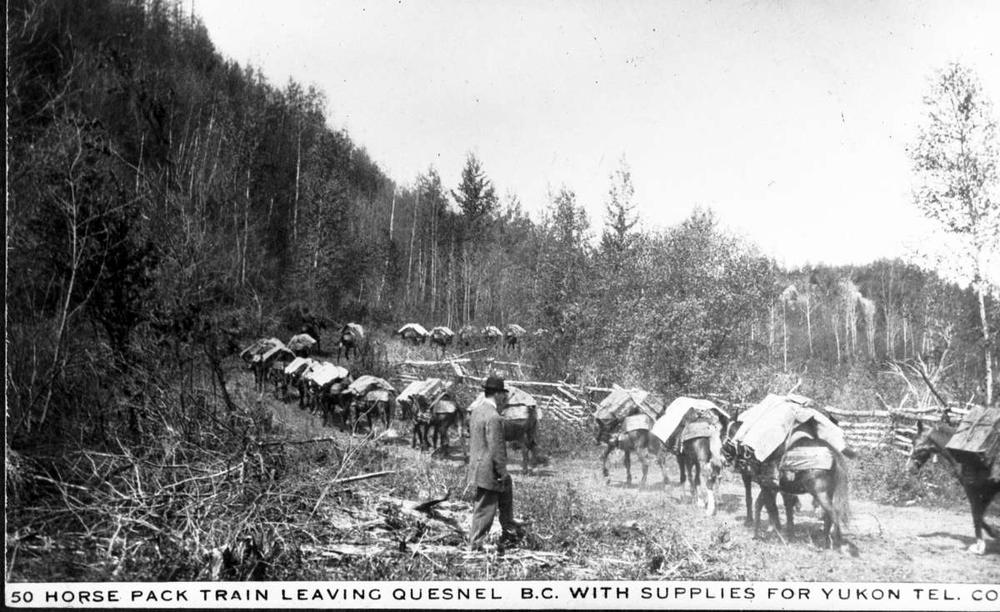
Because of the tremendous influx of people (mostly Americans) into the Yukon during the Gold Rush, the Canadian Government realized it needed to build a telegraph line up to the Yukon and began constructing the line from Quesnel to Hazelton at the end of March 1900. Around the same time, construction was started at Atlin and the line was built south to meet the line coming from Hazelton. J B Charleson was Superintendent and Manager of Construction. For white people, this was wild and in some cases unexplored country through which the line went, and construction was arduous. All of the construction supplies, wire, food for people and horses, and tools had to be moved by horseback. The land along the line had to be cleared of all dead-falls and trees. Bridges had to be built over eleven rivers. On one particular river, a bridge 110 feet long had to be built that would carry horses and all supplies.
There were 47 telegraph stations and linesmen cabins that had to be built 40 miles apart. Between these cabins smaller refuge cabins were also built. These provided a place to stay if the linesman could not get back to his cabin while doing repairs.
Building telegraph lines was broken into specific tasks:
- Clearing a 20 foot right of way by removing obstacles and cutting and removing trees.
- Trim trees back from the right of way and cut/erect poles.
- Attach insulators.
- String the wire.
- Build telegraph station cabins every 40 miles.
- Build refuge cabins between telegraph station cabins.
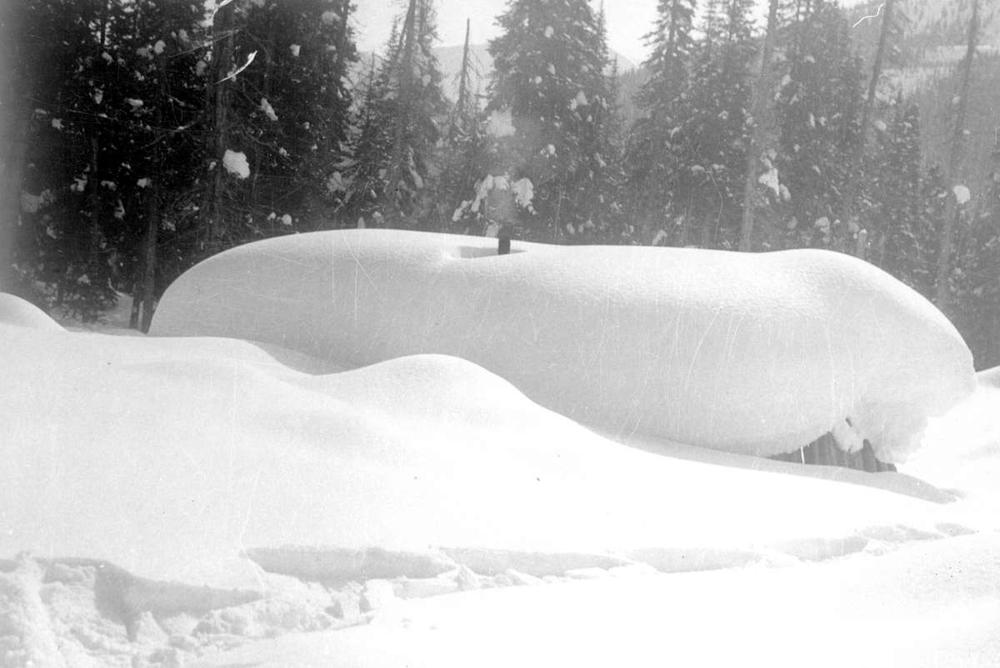
The line was not completed that year because of a severe winter of cold and deep snow. Because of the deep snow, fodder for the horses was not available and they lost many horses to starvation. Construction stopped in the fall and Charleson was anxious to get the men and horses out before winter set in. Charleson estimated there was a unfinished gap in the construction 30 miles long, but it would turn out to be a gap of 120 miles which would not be determined until the following spring.
The distances requiring construction were as follows:
| Stations | Distance apart |
|---|---|
| Atlin to Telegraph Creek | 241 miles |
| Telegraph Creek to Hazelton | 400 miles |
| Hazelton to Quesnel | 405 miles |
| Port Simpson to Hazelton | 200 miles |
| Eby’s Landing (Kitsumkalum) to Aiyansh/Stewart/Atlin | 200 miles |
Stations on the Hazelton to 9th Cabin Section


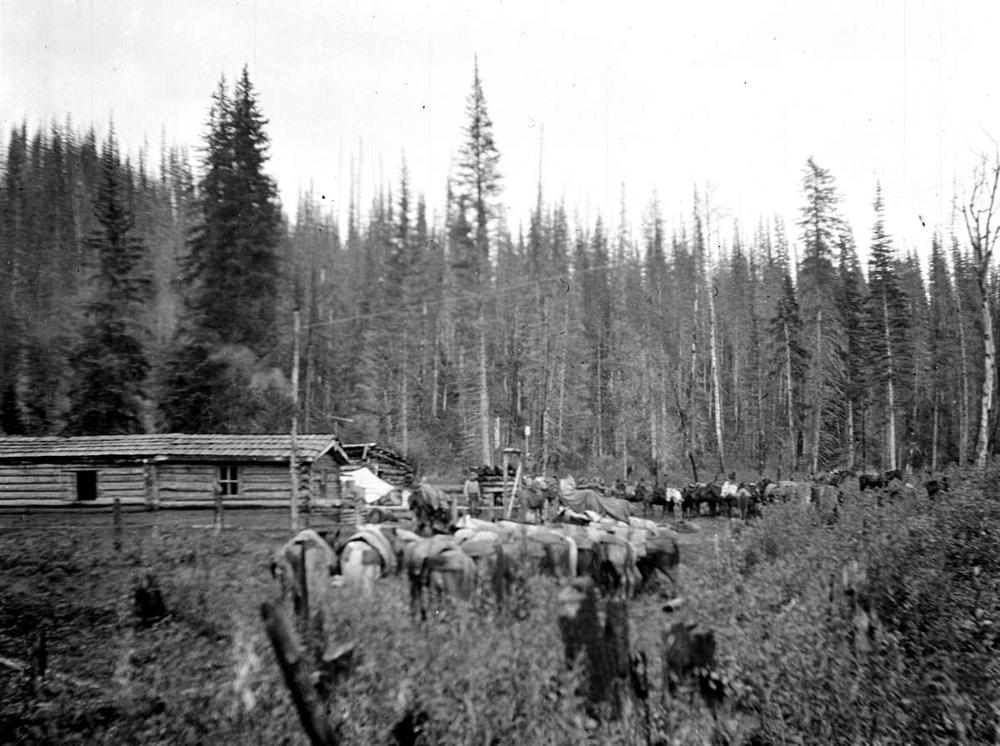

| Station Name | Operator/Lineman/monthly pay as of 1905 |
|---|---|
| Hazelton (Battery Station, 150 wet cells and repeater station) | G M Swan, Operator, 100 E R Cox, Lineman, 100 J C K Seeley, Lineman, 75.00 E E Charleson, foreman, storekeeper, 150.00 |
| 1st Cabin | H A Cullon, Operator, 75.00 Hugh Taylor, Lineman, 70.00 |
| Kuldo | G T Carpenter, Lineman, 70.00 G W Smith, Lineman, 70.00 |
| 3rd Cabin | Chas. Martin, Operator 75.00 |
| 4th Cabin | P Burnell, Operator, 75.00 J McMenamin, Lineman, 70.00 |
| 5th Cabin | E A Hawley, Operator, 100.00 C E Loucks, Lineman, $3 per day |
| 6th Cabin | G T Brown, Operator, 100.00 W Ross, Lineman, $3 per day |
| 7th Cabin | J A Armstrong, Operator, 100.00 L Dubois, Lineman, $3 per day |
| 8th Cabin | J Muir, Operator, 100.00 G Duhamel, Lineman, $3 per day |
| 9th Cabin | T E Harkin, Operator, 100.00 G Hill, Lineman, $3 per day |
1901 – Port Simpson – Skeena River – Hazelton
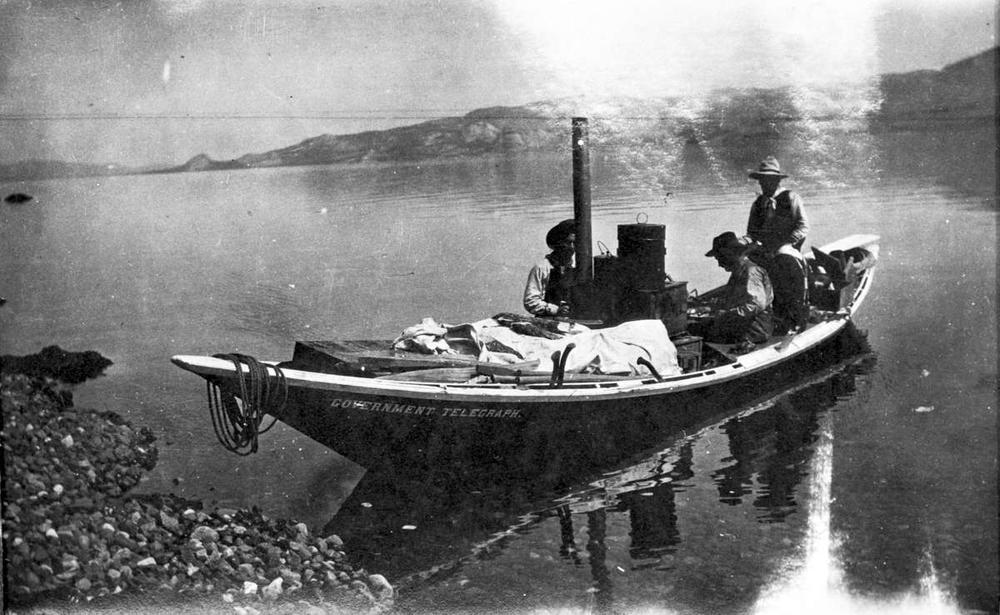
In March 1901, J B Charleson in charge of the Telegraph Line construction realized he could get his crews working early in the year on the line from Hazelton to Port Simpson, because of the ease of river transportation and lack of snow along the river. He immediately started on construction of the line from Port Simpson, (now called Lax Kw’alaams phonetic: La-kwa-lahms), down the Tsimpsean Peninsula to Aberdeen Cannery and then up the north side of the Skeena River. By the beginning of May, the line reached the Canyon of the Skeena (Kitselas) with the line being complete to Hazelton on June 14, 1901. One of the reasons construction on this line was so quick was ease of transporting men and equipment in boats on the river, rather than all construction being done by horse back.
At Port Simpson, Mr. Callaghan was the first telegrapher, but was not there long because of his close relationship with the spirits. The Superintendent of the Telegraph Line, John T. Phelan learned that a young 21 year old Martha Washington O’Neill (sister of Wiggs O’Neill) living in Port Simpson had taken an interest in telegraphy and that she was a satisfactory operator but had little experience. Phelan took a chance and hired her as the new Operator, albeit at a patriarchal misogynistic rate of $50.00 per month compared to all other Operators, whose standard rate of pay per month was $75.00. Her memoirs do not indicate she was bothered by this “discrepancy” in pay. Because Port Simpson was a battery station, O’Neill was also responsible for the maintenance of 130 wet cells that made up the battery. And she had to learn about electricity and batteries as she went:
“What a time I had learning the “tricks” of electricity. I am sure I died many times within myself. Sometimes when things went wrong with the batteries or wires, my hair fairly stood on end, as there was no one I could appeal to for advice so I had to learn by experience. What a line that was. My battery consisted of 130 wet cells, the only one on the line west of [the] Hazelton office, 180 miles by the crow. Sometimes the glass batteries would crack in extreme cold or thunderstorms and bluestone water [the conducting agent] ran all over the office. “
Stations on the Port Simpson – Hazelton Line


| Station Name | Operator/Lineman/monthly pay as of 1905 | Final Disposition |
|---|---|---|
| Port Simpson (Battery Station, 130 wet cells) | Mr. Callaghan, Operator, $75.00 Martha Washington O’Neill, Operator $50.00 | |
| Aberdeen (Haysport) | G Coutu, Operator, 75.00 B F St Amour, Lineman, 70.00 | Transferred to CNR with closure after railway station closed. |
Telegraph Point | W J O’Neill, Operator, 75.00 C Peterson, Lineman, 70.00 | Closed in June 1924 |
| Hole-in-the-Wall | Added later during railway construction to facilitate location of line breaks caused by construction. | Closed in June 1924 |
| Graveyard Point | S W Dobie, Operator, 75.00 J D Wells, Lineman, 70.00 A E Johnston, Lineman, 70.00 | Closed in June 1924 |
| Eby’s Landing (Terrace) | Added during railway construction. | Moved to Terrace |
| Canyon of the Skeena (Kitselas), later Usk | A Daoust, Operator, 75.00 C Durham, Lineman,70.00 F Dresser, Lineman, 70.00 | Closed in June 1924 |
| Dorreen | Added during railway construction. | Closed in June 1924 |
| Lorne Creek | A J West, Operator, 75.00 J D McIntosh, Lineman, 75.00 | |
| Meanskinisht (Cedarvale) | E Lily Tomlinson, 50.00 R Tomlinson, 75.00 | |
| Kitwanga | Added later during railway construction to facilitate location of line breaks caused by construction. | Closed in June 1924 |
| Hazelton (Battery Station, 150 wet cells and repeater station) | G M Swan, Operator, 100.00 E R Cox, Lineman, 100.00 J C K Seeley, Lineman, 75.00 E E Charleson, foreman, storekeeper, 150.00 |
1907 – Extension to Prince Rupert from Aberdeen
1907 – The line along the Skeena River was extended from Aberdeen to Prince Rupert, with the Aberdeen station moving to Haysport. Also that year, the Marconi Wireless Telegraph company was tasked with establishing wireless stations on the north coast and also installing wireless sets in the Canadian Pacific coastal steamers, the Princess May, Amur and Princess Royal. In July, the steamer Camosun arrived at Port Essington for the first time equipped with a Marconi wireless.
1910 – Eby’s Landing (Terrace) to Aiyansh (Gitlax̱t’aamiks, phonetically GIT LA DAMIKS)
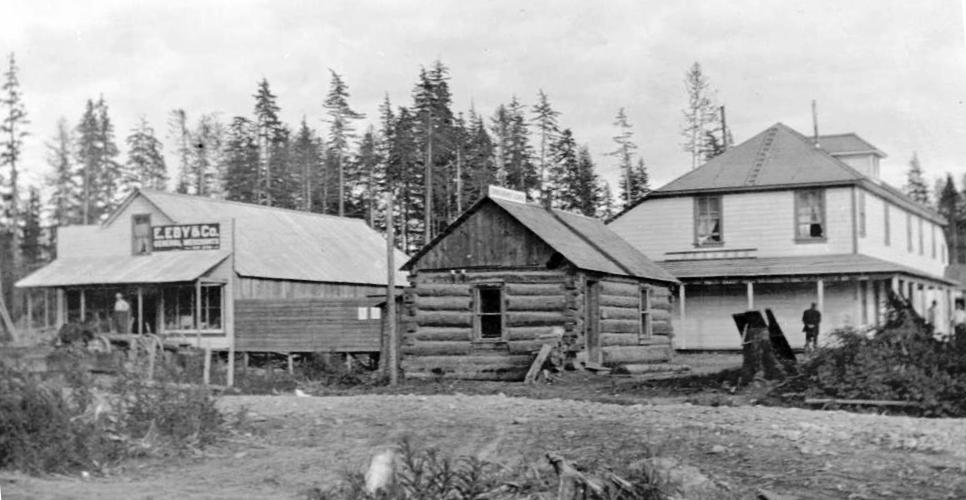
1910 – The Canadian Government built a line from Eby’s Landing (Kitsumkalum) up the east side of the Kalum River to Aiyansh (now Gitlax̱t’aamiks, phonetically GIT LA DAMIKS), on the Nass River. Here, it connected with a line that had been built simultaneously from Anyox and Stewart. A telegraph lineman’s cabin was built at the north end of Kalum Lake. The lineman’s cabin survived and was donated to the Heritage Park Museum in Terrace by Jaunita Hart and is on display to this day. This line had stations at Cedar River, Aiyansh, Goose Bay and Stewart.
In 1909 it cost $1.24 to send a ten word telegram from Prince Rupert to Vancouver and $1.50 from Hazelton.
In 1924, the Telegraph line between Port Edward and Skeena Crossing was transferred to Canadian National Railways telegraph service (formerly the Grand Trunk Pacific Telegraph Service).
In 1925, the line from Hazelton to Telegraph Creek was shut down when the company attempted to introduce the use of wireless radio to handle traffic, and telegrams were sent from Telegraph Creek north to Dawson City where they were then forwarded on by wireless to Edmonton. This did not work as well as hoped, and the wire was once again put into use. However, progress was coming and the use of wireless was inevitable. On August 1, 1935, telegraphers on the Hazelton-Telegraph Creek Line received a blunt, impersonal message over the wire: “Abandon station, no supplies ordered”. Later they were told to take all personal items with them and leave all equipment and supplies in the cabin. The Yukon Telegraph Line became the Yukon Telegraph Trail.
During World War II, the wire telegraph lines were re-stored because of security concerns. Open broadcast of information on wireless could be listened to by the enemy and wired telegraph was considered more secure.
Excerpt from The New Garden of Canada by F A Talbot
We had gained the top of a hillock. Masses of poplar, willow, and open patches surrounded us. But there, in the middle distance, was a shimmering, irregular blotch on the prevailing green. We hustled our horses and in a few minutes were among the bushes fringing Tsinkut Lake. But a more conspicuous feature compelled our attention. Just above our heads trailed across the azure of the sky a thin, dull-grey thread, festooning regularly along the trail through the forest. We could not suppress a strange thrill. We were shaking inanimate hands with civilization stretching in an unbroken line from Vancouver to the far north, threading dense forests, jumping wild ravines, spanning roaring rivers climbing and dropping over lofty storm, rain, and snow swept mountains, until at last Dawson City is gained. It is a slender link, bringing isolated, distant Klondike into direct touch with the restless throbbing pulses of the world as surely as London is connected with New York —the YUKON TELEGRAPH!
Life on the line – Cabin Fever
“There were two men to each cabin, an operator and a linesman, and their term of service was three years at a stretch. Some government official with sympathy enough to realize that one’s best friend may get on one’s nerves if one lives with him for three years and sees no other soul, decreed that there should be two separate cabins at every post after the first cabin, north of Hazelton. But, even so, one can imagine the taut nerves. Mr White, who might be of a serious turn, moody and a rare talker, shut up for three years with Black, who is facetious and never stops talking!
We can sympathize with the operator who sent a telegram to headquarters to say that he couldn’t stand the way the linesman sniffed. He had stood it for two years and three hundred days, but was blessed if he could stand it for another minute. Then he walked away into the bush and never came back. He was never heard of again.”
And there was this story:
“Listen, he says, following a particularly long spell of bitter weather which kept both men Indoors: “I have listened to your curbstone chatter for more than four long, weary months. ‘It’s getting so I’d welcome the tinkle of a drop of water falling from a leaky faucet in preference to your vapid vocalizing. And you know the Chinese use this method to torture their victims. But, If I had to choose a winter mate between you and a spavined, yellow cur one of us now would be wagging a tail and yelping at the stars.”
From afar, people who had never been isolated for more than a day or two, could not help but think living cooped up in a tiny log cabin for months at a time had a romantic bent. In 1912 a reporter with the Vancouver Daily Province newspaper wrote a tough story of life on the telegraph line with a little romance thrown in for flavor:
Most Remarkable of Telegraph Lines
That from Ashcroft to the Yukon has never Ending Romance.
What the Line Means to Prospectors and Pioneers.
From Ashcroft on the old Cariboo road in British Columbia, zigzagging its way northward for 2500 miles runs the Yukon telegraph, the most remarkable telegraph line in America. Its romance is never ending. It was born in the gilded days of the Klondike rush in 1890. Its first messages were of “lucky strikes” that had turned penniless miners into millionaires, and of gold seekers who had perished by the trail.
The story of the building is an epic of adventure, a saga of man’s conquest over the silent places and silent forces of the stilly north. Even today, when the glory of the old-time Dawson has departed, and the wickedest camp on earth has become respectable and industrious, the Yukon telegraph has not backslid to the extent of earning its own living. Our Ethiopian friend, Splotas, may still hover round the old camp, strumming his banjo and recalling its halycon [sic] days. But the Yukon telegraph, in its most recent year of business, can still boast a prodigal life. Last year when it carried nearly one hundred thousand messages each way, to and fro, in the frozen north, like one of the old-time gamblers it can hold its head aloft and announce that it was “out” $80,000.
Of course the truer and kinder way to state the fact would be to say that the line gave to the public of Canada during the year service to the extent, of $80,000 more than the aforesaid public paid for. “The best $80,000 that the government spent last year,” said an old northern traveler to me as he looked at the financial statement of the line.
In Touch with Civilization.
“It means a lot to the prospectors and the pioneers to be able to go into the wilds for a thousand miles and not lose touch with civilization, “I agreed. “I was not thinking of it as philanthropy for the people in the north. I was thinking of it as a cold business proposition for the government,” rejoined my friend in correction. “Have you noticed,” he went on, “that the valleys are filling up in the north—the Bulkley and the Kispiox and the Naas —are those through which the telegraph passes. The telegraph opened the land to the first landseekers; it is still helping to bring the settler on to the land. Where there is no line of railway to follow, the line of settlement is the government telegraph.”
There is truth in the argument. The Yukon telegraph is making possible much of the commercial development of northern British Columbia. For the thousands of white men in the scattered communities from Prince Rupert clear through to the Arctic circle, the government telegraph forms the link, and the only link, with the great news events of the world. On the occasion of the great International event which occurred at Reno on July 4, (a boxing match) two years ago, when every Anglo-Saxon between the forty-ninth parallel and the North Pole, was anxiously awaiting the result, the fateful message, “Johnston wins in fourteenth,” was received in Prince Rupert within three minutes of the catastrophe. The same flash would be received in Dawson a minute later, the wires having been kept clear for the momentous news.
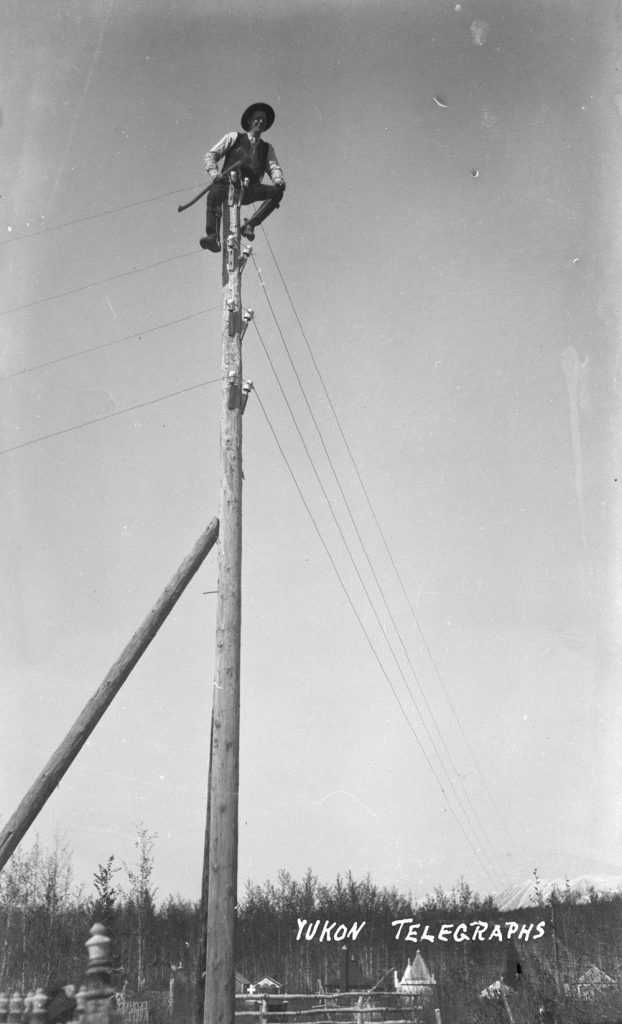
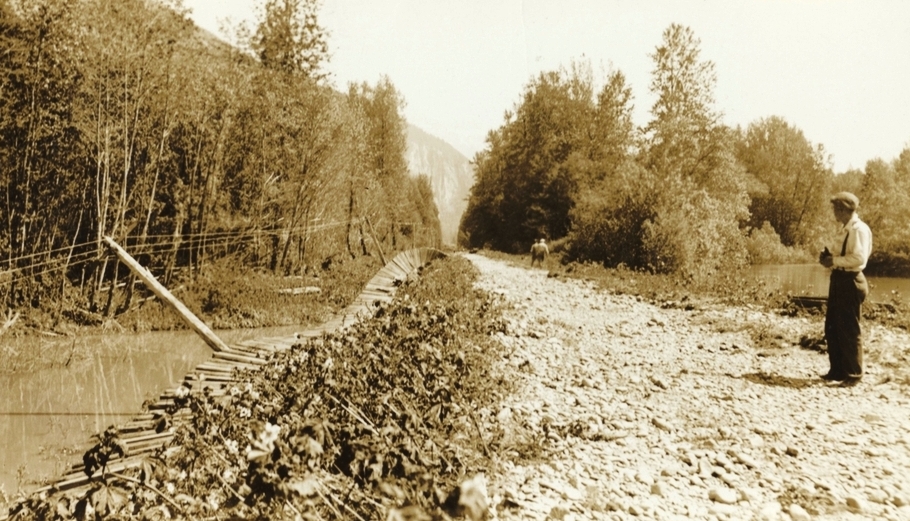
The visitor who sees the line for the first time is liable to make merry over it. Strung on low straggling poles, with the wire sagging down within reach of the hand in places, the line seems to be built more for the domestic “wash” than for conveying important messages. After following the line in its tortuous course up the north bank of the Skeena river for a couple of hundred miles the same cabinet minister became filled with, admiration for the line and its intrepid builders. A conventional line strung taut on tall, straight poles would be immensely more difficult to maintain in repair. The low, loose wire strung on low poles, on the limbs of trees and over the faces of rocky cliffs is quite as effective as a more ornamental line, and a hundredfold easier to keep in working order.
Operators Lead Lonely lives.
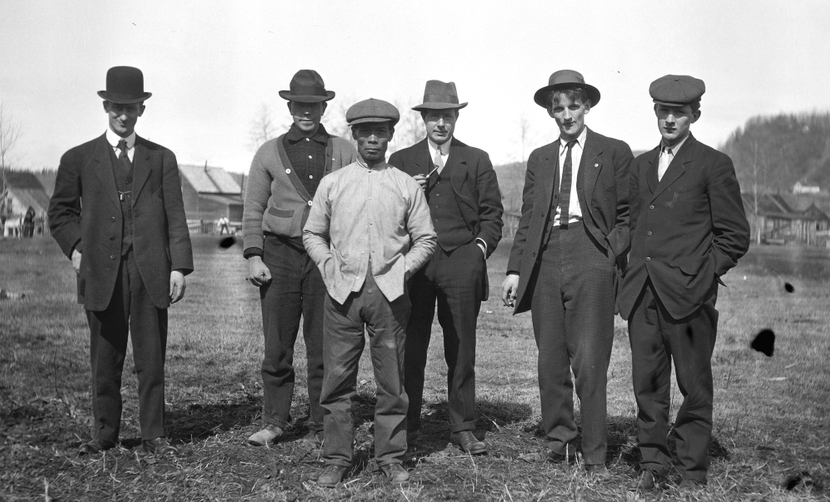
At intervals of from seventeen to fifty miles along the whole length of the line are the cabins of the operators. Each operator is an expert lineman and responsible for keeping his own section of the line in repair. The man who has fifty miles of line to look after is on flat land, and has a horse to ride out on along the trail to locate breaks in the line. The men with shorter distances to protect are in the mountains, where in winter hazardous journeys on snowshoes must be made. In some of the stations it is practically winter all the year round. Twice a year food and supplies are packed in, and the operator gets relief from the terrible silence of his lonely life. For the rest of the time the operator is dependent on breaks in the line for his chief means of providing him with company. When a wire goes “dead” the operator on either side of the break takes his tools on his back and goes out in search of the break.
“A break in the line.” it sounds a small and simple matter, but there is no break without its own story of hardships overcome. “We had frequent breaks in the line, owing to fires on the Yukon river and to storms between Atlin and Dawson, but repairs were always quickly effected and the line was kept open all winter,” stated Superintendent J. P. Phelan in his last published report to the government. The writer had occasion during the period covered by the report to see one of the reasons for a break in the line. it was an avalanche of ice and snow that had swept great rocks and giant trees like matchwood before it in its thunderous passage down the mountain side. The “slide” measured 1200 feet across and 80 feet deep. No snow sheds could stand before such an avalanche. it could have buried out of sight a good-sized town. I was not privileged to see the report made on it, but I imagine it was dealt with in some such perfunctory way as this:
“Break in line at mile 44; caused by slide at 11:30. Proceeded to spot and got repair made by nightfall.” At any rate, the affair was considered of so little importance that the superintendent never mentioned it at all in his report to the government.
A Characteristic Report.
Here is a characteristic report as it was handed in by one lineman. It is a hard-boiled account of a day’s work that started at 7:30 a. m. one day and lasted until 5 a. m. on the following day:
“May 5, 1912, 7:30 a. m.; started on line north from Maple Bay; removed two trees; replaced wire on four poles two miles north of here; put up quarter mile of wire at camp at Swamp Point; replaced two blocks, two glasses, near White Point; replaced wire on five poles, used five blocks, three glasses; removed three trees: fell off bluff here into deep water; lost tool bag with spurs, come alongs, pliers, connectors, hardware and safety belt; had hard time keeping afloat until Daigleish [sic] picked me up, account wearing hip rubbers and raincoat; removed one tree; replaced wire on two poles three miles north of Tad’s Cove. Home 2 am, 6th.”
The exact chronological order observed by the narrator in telling of how he narrowly escaped death in the water and then went on to remove two trees, the incident not even dignified by a whole sentence to itself defies all art. The incident was too obviously a part of the day’s work.
Yearly Extensions
Every year sees the government line extending its branches, always a little ahead of the settlement and development of the districts. The main line connects at Ashcroft with the Canadian Pacific Railway system. At its northern extremity it connects with the United States signal service telegraph system at the Alaskan boundary. The latter system is, of course, controlled by the United States department of war. Branch lines are run from principal points on the route into the settled districts. Lillooet, Barkerville, Quesnelle Forks and the mining camps along Cadwalder creek are thus served. The longest branch is that which runs from Hazelton, an old Hudson’s Bay trading station, down the Skeena river to Prince Rupert. It measures 200 miles. From Kitsumkalum, halfway down the river, another branch was built last year, running a distance of 175 miles to Stewart. In its passage through the Naas valley and river, the line links up the mining camps on Observatory inlet and the Portland canal. This year a branch, from 150-mile house on the Cariboo road, is to be built through the Chilcotin country to Bella Coola, situated on the coast about halfway between Vancouver and Prince Rupert.
Near Early Proposed Route.
A strange coincidence connected with the route of the main line is that, without intention, it almost duplicates the route laid out by the Western Union Telegraph Company (Collins Overland Telegraph) half a century ago, when that company, after the breaking of the Atlantic cable in 1859, decided to lay a land line through Alaska and Siberia to Europe. Over $3,000,000 had been spent on the line when the company recalled their plans for the land line, having in the meantime picked up the Atlantic cable again. Some of the engineers and linemen were then so far inland that it was nine months from the time the order was sent before it could be delivered to them. Telegraph creek and Lake Le Barge, the latter named after one of their engineers, still preserve in their names the memory of the Western Union project. For many miles of the route portions of the old line built by the engineers of the Western Union are now being worked as a second wire by the government operators.
Such is the work of the Yukon telegraph and of the men who operate it. Leading lives of sturdy adventure and hardships. In the wilds, the achievement of their ambition is embalmed in the customary phrase that finds it way into each annual report—”That the line was kept open all winter.” The Spirit in which the men of the Yukon telegraph “do their work and hold their peace and have no fear to die” invests with a halo of romance the daily operation of what may without exaggeration be styled the most romantic telegraph line in America.
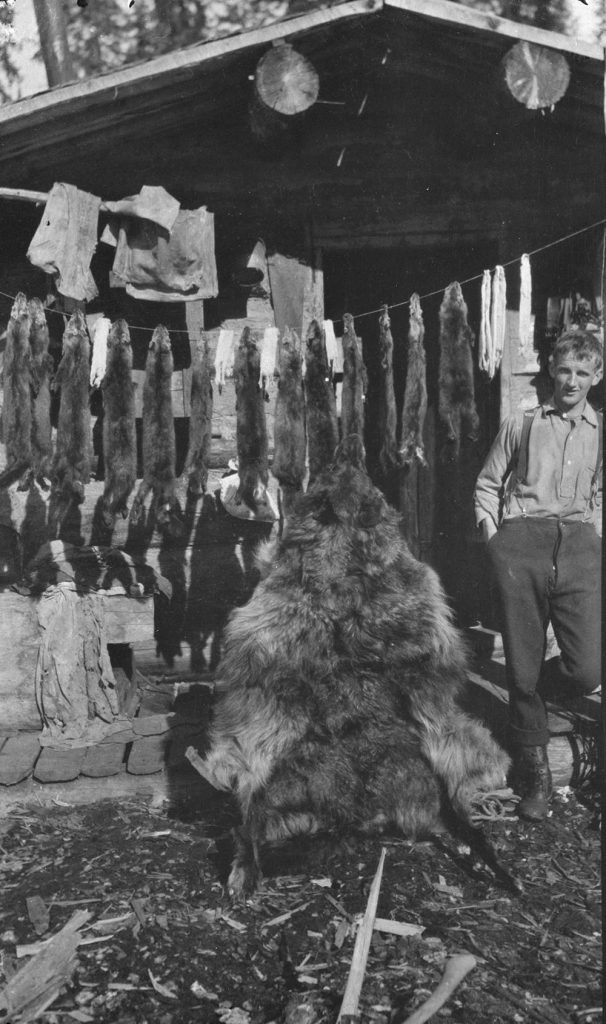

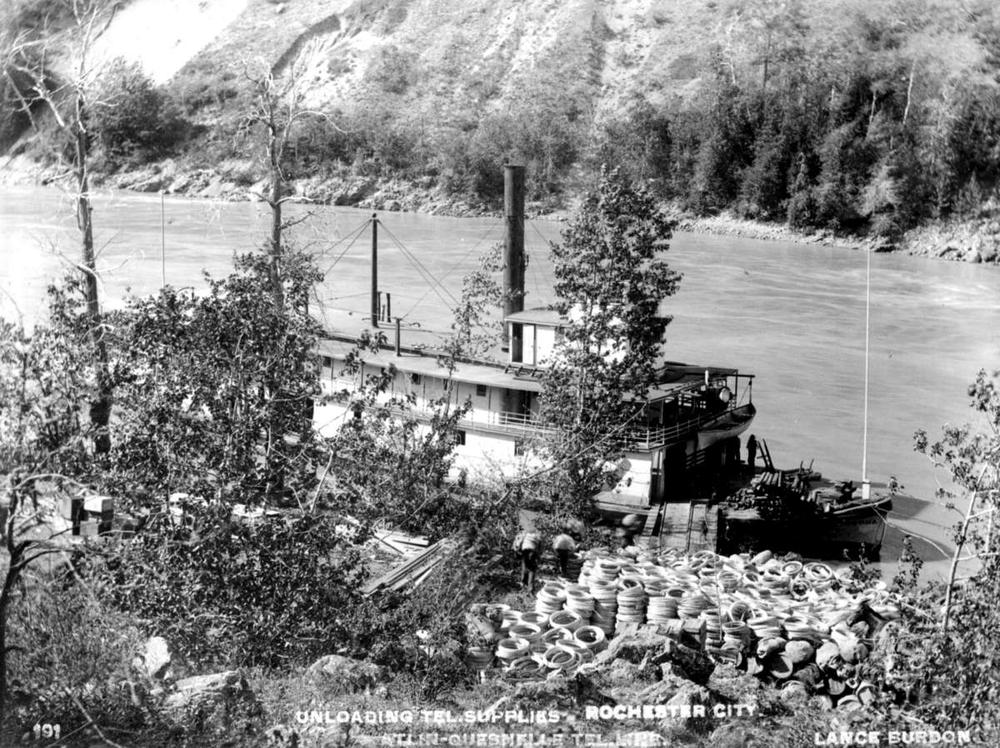
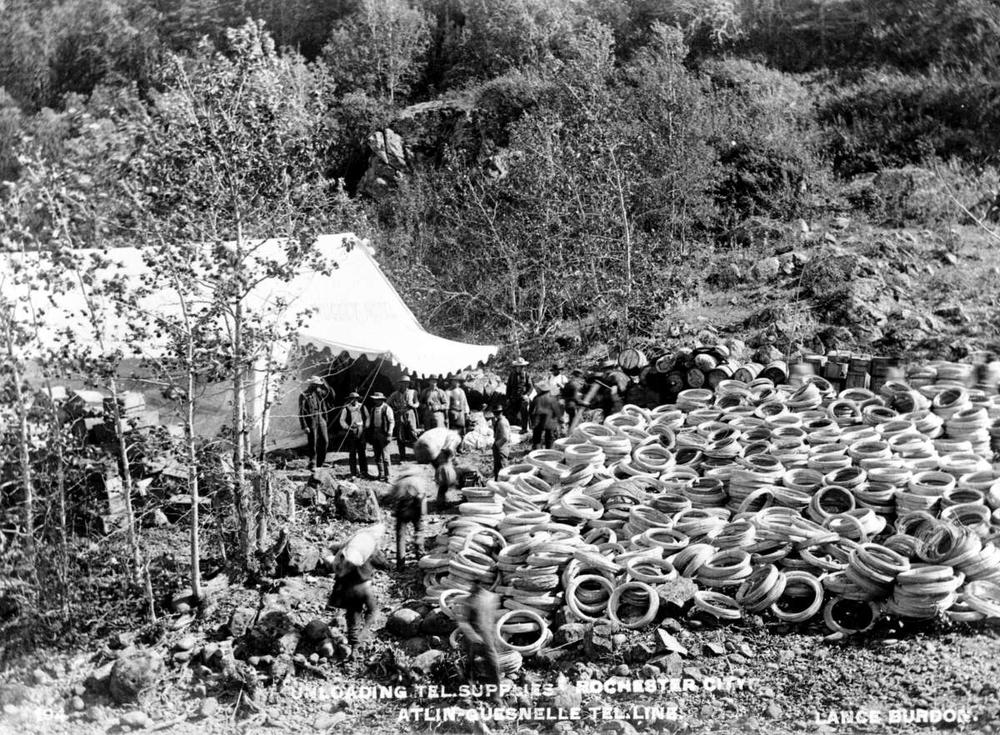


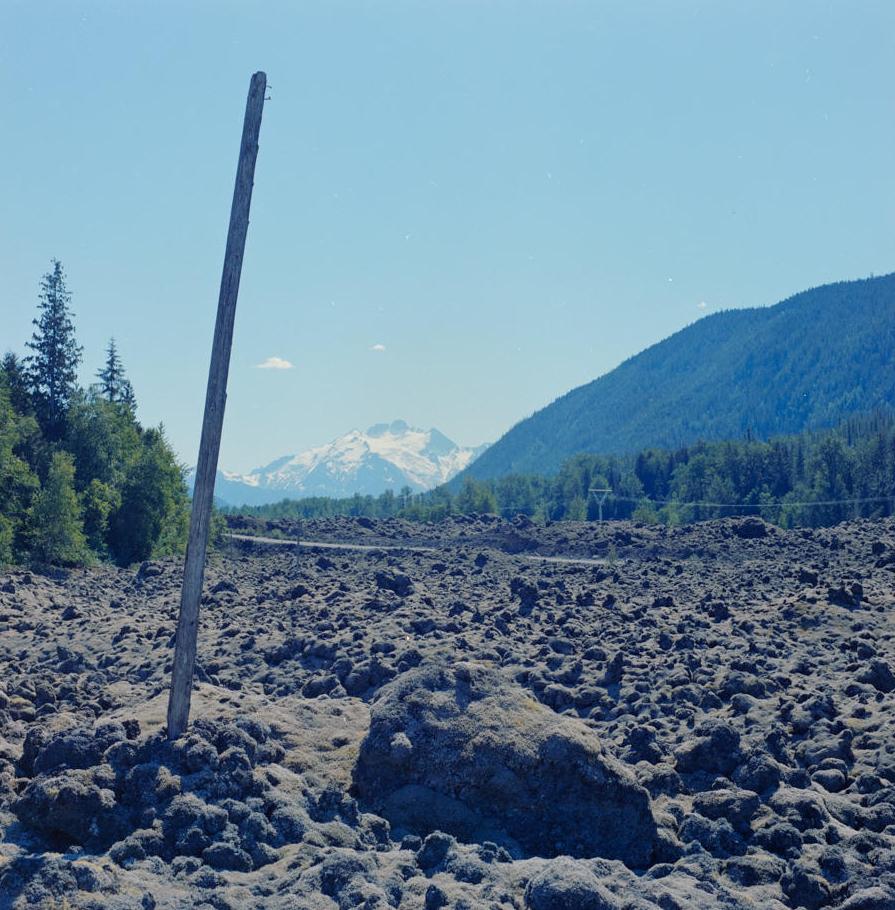

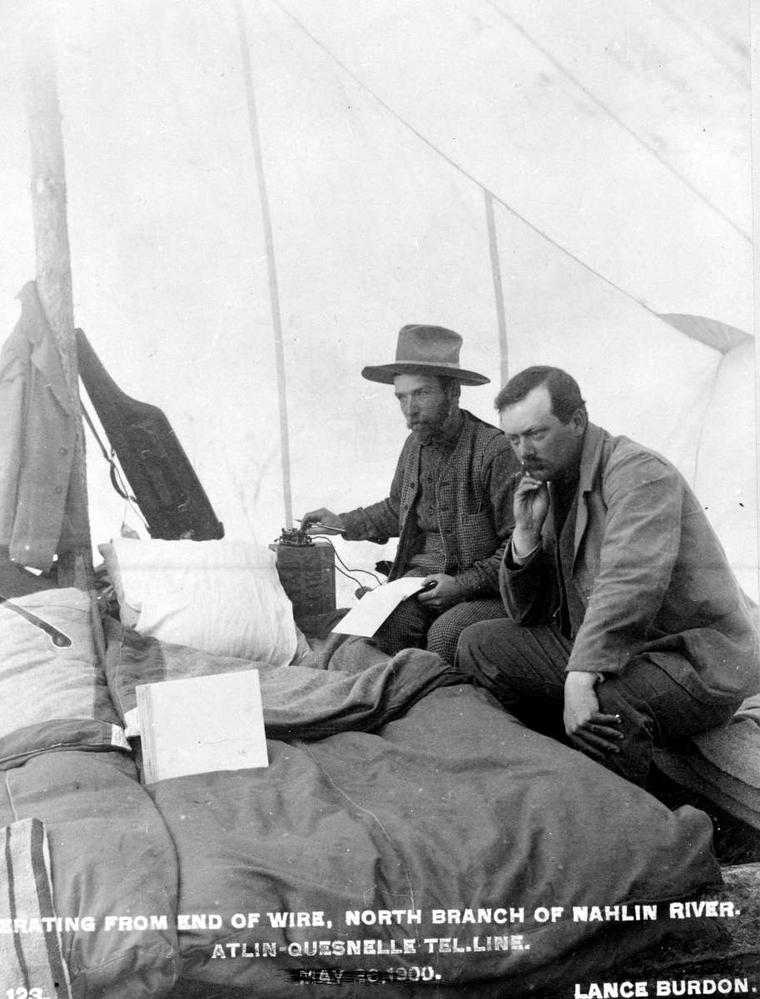




For a thorough description of the building, operation and decline of the Yukon Telegraph in BC and the Yukon, I highly recommend Bill Miller’s book Wires in the Wilderness: The Story of the Yukon Telegraph, published in 2004.
Sources:
Bennett, Norma V. Pioneer Legacy: Chronicles of the Lower Skeena River Volume I and II, 2000
Bulkley Valley Museum
Government Telegraph Service, 1905
Large, R. G. the Skeena, River of Destiny, 1957
Miller, B., Wires in the Wilderness: The Story of the Yukon Telegraph, 2004
Neering, R., Continental Dash, 1989
Ward, H. G. The Glamour of British Columbia, 1926
◀
