
The Collins Overland Telegraph Company Construction Executive
by Charles F. Morison
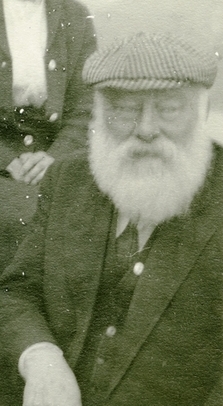
In his narrative of his time in northwest BC, about the building of the Collins Overland Telegraph line, Charles Morison shared his description of the men who made up the senior leadership:
“A few words regarding our executive men, etc., on this stupendous job: –
Steve Decker, our general foreman, undoubtedly the best man the company could have procured for the job. He was well known in the northern interior country of British Columbia. Decker Lake in the vicinity of Burns Lake I believe was named after him. He was born at LaGrange, Penobscot, Maine on 24 Aug 1827. “The men liked him and he got a full days work out of them; never gave them unnecessary, or what I would call nagging order, and consequently got full results from them. I am pleased to pay this tribute to his work and character. He died on 8 May 1911 at age 83 at the Vancouver General Hospital, having lived at Belcarra on the north shore of Burrard Inlet since 1867. He was buried a pauper in a known grave at Mountain View Cemetery in Vancouver. There is no headstone to mark his grave.”
Captain Edmond Conway, engineer in overall charge of the project, it is sufficient to say, he understood his work thoroughly. He was quite a young man, twenty six years of age and a Canadian by birth; a splendid telegraph operator and had seen much service with the Union Armies during the American Civil War. He often camped with me at Mission Point and on these occasions related many of his hair raising adventures to me. A most genial man, but expected any instructions he issued to be carried out implicitly.
Charles Burrage, Paymaster, was a man who did his duty. He was very kind to me; all fellow employees liked him. He carried a large amount of cash with him as all work done by the Indians was paid for in ready cash; no truck system or tokens employed by that Company. Burrage would have been well worth holding up had there been bandits in the country.
Thomas Elwyn was a well known official, and was the Stipendiary Magistrate, with a Constable, recognized for his tact and ability in dealing with affairs in a new country. Earlier, Governor Douglas had appointed him a Gold Commissioner, which gave him authority as a Justice of the Peace, and had authority to settle all Mining and Civil disputes, involving amounts of $200 or less. The Gold Commissioner collected the miners’ licenses, registered all mining claims and supervised the work of local mining boards. He was also assistant commissioner of lands, collector of revenue, Indian agent and coroner. His had the unique experience during his long term of service in British Columbia, of never having a judgment reversed on appeal. He was at one time a business partner of mine, and to know him was to respect and love him. At the time of his death he held the office of Deputy Provincial Secretary. He married a Miss McNeil, a daughter of the late Chief Factor McNeil of the Hudson’s Bay Company.
P. J. Leach, our astronomer, late Royal Engineers, an exceedingly clever man and great mathematician; a most genial Irishman, local to the backbone, full of his country’s native wit, and withal a player of that musical instrument the flute. He was a small spare man tough as iron with an enormous appetite, he could stow away five meals a day when he could get them, and “au contraive”[sic] could starve equally well. In later days he was City Engineer to the corporation of Victoria.
P. J. White, our draughtsman, also late of Royal Engineers. He sketched and painted beautifully, and dropped and put in his “H’s” with equal facility.
Mike Byrnes aka Burns, one of our two explorers, an old United States Army scout; a well informed man and wonderful in the bush.

Vital LeFort, Lafourie, Laforce, our other explorer, a French Canadian; he could neither read nor write, but could go into the bush for weeks and from memory could hand in a perfectly correct map of his explorations. Incidentally, he was the discoverer of gold in Vital Creek in the Omineca placer country, the creek, of course bearing his name; he also found gold on the Finlay River at a place known as Vital’s Bar. In 1906, during the latter years of his life, Lefort established a ferry across the Nechako River near Fort Fraser.” He was born on 19 Sept 1828 in La Prairie, Quebec near Montreal and died by suicide at Cadboro Bay, near Victoria, on 31 Dec 1911 at age 83, and is buried in a known grave at Ross Bay Cemetery in Victoria. There is no headstone to mark his grave.
Michael Byrnes and Vital Lefort played a major role in the Omineca Gold Rush of 1869. Years earlier they were two of the four discoverers of gold on Williams Creek near Barkerville in 1861, along with William Dietz and Edward Stout. Both Burns and Lefort were members of a six man group known as the Peace River Prospecting Party which set out from Quesnel in 1869 up the water route to Takla Lake. In June, Lefort discovered gold on a tributary of Silver Creek, which flows into the Omineca River.
Doctor-Surgeon George Chismore, he was a splendid character, the right man in the right place. Previous to joining the Collins Overland Telegraph he was in practice at Placerville, California, but long hours and close confinement brought on dyspepsia which became serious. He tried various treatments without avail; upon hearing a surgeon was required for our expedition he decided he would try bush life for a remedy. He applied for the position and was gladly accepted. He traveled up the Skeena River to join us and was a most satisfactory addition to our company. He was young but extremely clever in his profession and became a great surgeon operator; he died the leading surgeon in San Francisco and California. We became bosom friends, and corresponded regularly in after days. I shall never forget him. The Doctor entirely recovered his health in the bush; we concluded Bacon and Beans affected his cure. I imagine a bush life and coarse but wholesome food would restore to health many a blasé millionaire. We had very little sickness in the camps; of course the usual number of axe cuts and minor accidents, which our surgeon soon attended to. He later went back to work for the United States Army in Alaska, and Chismore Passage off Porcher Island was named after him by Captain Pender of the Beaver, circa 1868.
Provincial Constable we carried with us, – his chief occupation was to fire his double barrel in the morning to waken the cook.
Ah! a happy crew were we, plenty of work, plenty to eat, not a care and no liquor or city dissipations to mar our beauty. The writer often sighs for those old times, but alas, youth knows no return! I believe all the members of that old crowd have passed on to the better land.”
Sources:
BC Geographical Names, Heritage Branch, Ministry of Tourism, Arts, Culture and Sport, Province of BC.
Downs, Art, Pioneer Days of British Columbia, Volume Three, 1977, BC Outdoors and the authors.
Middleton, Lynn, Place Names of the Pacific Northwest Coast, 1969, Elldee Publishing Company, Victoria BC
Morison, Charles Frederic, A brief narrative history of early British Columbia, 1862 to 1876, written circa 1920.
Ormsby, Margaret, British Columbia, A History, 1958, MacMillan Company of Canada.
Sterritt, Neil J., Mapping My Way Home, 2016, Creekstone Press Ltd, Smithers BC.
◀
