
Steamboat Fight on the Skeena
By Charles LeRoss
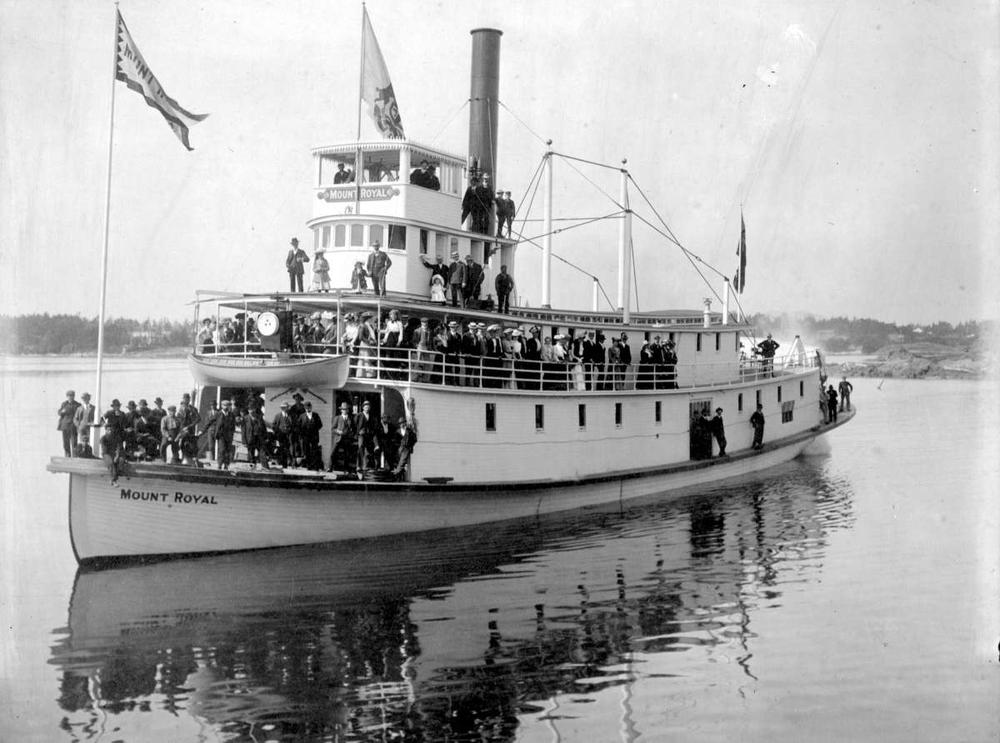
In the early 1900’s the Hudson Bay Company and Robert Cunningham & Son were the two companies operating sternwheelers on the Skeena River. Cunningham was operating a new ship the Hazelton, with Captain John H. Bonser in charge. The Hudson’s Bay Company (HBC) was operating the Mount Royal as well as the Caledonia and Strathcona. The Mount Royal had Captain Steward B. Johnson in charge. Competition between the Hazelton and Mount Royal heated up in 1902 when the water conditions on the Skeena were very favourable for the sternwheelers.
Courtesy BC Provincial Archives
Ordinarily, the water conditions on the Skeena were highly variable. It was not unusual for trips up and down the river to take many days and sometimes weeks. Often, the freight had to be left on shore (for transport by canoes or to be picked up later by sternwheelers) up the river because the sternwheelers could not navigate the difficult parts of the river such as Little Canyon or Kitselas Canyon. It was not unusual for sternwheelers to get stranded in a section of the river because of low water.
So on July 25, 1902 when the water conditions were just right on the river the Hazelton completed the trip from Port Essington to Hazelton and back in just 2 days, 7 hours and 55 minutes. On July 27, the Mount Royal completed the same trip in 2 days, 6 hours and 15 minutes. On August 1, 1902 the Hazelton beat this record with a time of 47 hours.
“Competition between Captains Bonser and Johnson was intense and all sorts of tricks were used to get the advantage over the rival ship. Cord wood was loaded for fuel at regular stops and sometimes extra wood would be taken by one or the other to deprive the ship following of an adequate supply. The climax of the competition between the two captains was reached on May 4, 1904 when the two ships were racing neck and neck up the river. Captain Johnson endeavoured to crowd the Hazelton into shallow water, so Bonser turned his ship, and striking the Mount Royal amidships pushed her right up on the beach. The story goes that Captain Johnson was so infuriated that he grabbed a rifle and started to shoot at Bonser. This disgraceful exhibition put an end to the racing.”
In 1905, Captain Johnson filed a complaint against Captain Bonser, through the Merchants’ Service Guild of Canada. The Department of Marine and Fisheries appointed Capt. James Gaudin to hold an inquiry into the collision on the Skeena River.
Capt. Bonser was the first witness at the inquiry and on being sworn said that he held a master’s certificate of a minor inland water grade. He was captain of the Hazelton during the season of 1904. On the 4th of May, in that year, he saw the Mount Royal leaving a wood pile the position of which he indicated on a chart submitted to the commissioner. The Mount Royal was coming 300 or 400 yards astern. She was in about the middle of the river, a little to the starboard. Capt. Bonser said that he had taken on seven cords of wood. He had to go to Hardscrabble bar to take on enough wood to take him over the rapids. There he took on a cord and a half to make sure that he had enough fuel to last him until the next wood pile was reached.
The witness then stated that he steered straight for Hardscrabble bar after leaving the wood pile. In the meanwhile the Mount Royal was overhauling the Hazelton and reached her after the latter had got to a standstill in strong water, running at the rate of about eight miles an hour. The Mount Royal was the faster boat and chased the Hazelton for half a mile. A collision took place at the bar.

Continuing, Captain Bonser said they came alongside attempting to pass him. The boats were neck and neck. They came within about three feet of one another and then they “sucked” together—any boat would do that, any flat bottomed boat in the water. The Mount Royal struck the after port of the Hazelton. “When he caught me, “ said the captain, “I put my wheel had aport to prevent him putting me on the bar. His boat is heavier than mine, and he threw me over and I struck the rocks three times, and made a hole in the bottom under the boiler.”
Asked what steps he had taken to avoid a collision, Capt. Bonser said: “I stood on my course as near as possible. He dropped back and fouled me. I couldn’t stop, it would have been dangerous swinging across the bow. I kept my course and speed. He dropped back and his pressure left me, and she hung on the rock until she sheered quite a bit. That left an opening for the Mount Royal and she came up full speed around my bow. I caught the Mount Royal within four feet of where she did me on her port quarter. Between the two collisions a minute elapsed.”
“Capt. Bonser, in answer to the commissioner, then described more minutely what he had done on the occasion. He had 15 or 18 passengers aboard. Captain Johnson had come out of the pilot house and had left the wheel with no one in charge, going some 15 or 20 feet from it. At the time the two boats were 30 or 40 apart. His boat was going full speed and the Hazelton was in the current. Had the Hazelton backed, the consequences would have been serious.
“Captain Johnson, master of the steamer Mount Royal, was then sworn. He also held a certificate of a minor inland water grade. He testified that the Hazelton was at Port Essington when the Mount Royal sailed. “As the Hazelton came in sight below the canyon,” he said, “we were just ready to leave. We had been there some time fixing the throttle valve. The Hazelton came in sight around the bend. She steamed by and went into the canyon without landing. I remained tied up for 35 minutes to give the Hazelton time to get through. That is the time it takes us to get through. We then left. As I got into the lower end of the canyon I could see the smoke of the Hazelton at the upper end of the canyon. I stopped my boat. The current was very slack, and I drifted around in there. I kept moving back and forth so that I could see what the other boat was doing until I saw it going on around the bar at the head of the canyon. I then proceeded to the bar and went on around. The Hazelton had gone ahead. We could see her smoke a mile ahead above the bend. I got around the bar and went up the river about a mile and a half to a wood pile. About 3 o’clock we left there, and about a half mile beyond we came in sight of the Hazelton again. She was lining up on the port side of the river. The Hazelton had gone around the bend out of sight. Next time we came in sight of the Hazelton she was lying at a wood pile just around the bend on the starboard side of the river. That was the commencement of the trouble.
“As we got within about 200 yards of the Hazelton she began to get under way, leaving some of her wood on the bank. She backed in order to make a start for up stream. We steamed up the river until the Mount Royal’s bow was about opposite to the Hazelton’s. The two boats were on the opposite sides of the river and about 175 or 200 yards apart. We were on the port and they on the starboard side. I kept on my course and the Hazelton steamed diagonally across the river towards the bank that I was going up. As I saw that the Hazelton was going to crowd in on my course I kept my boat a little closer to shore. The Hazelton was getting very close to us so I stopped my vessel and went full speed astern. As I backed down, Capt. Bonser opened his pilot house window and waved his hand at me as if he was having a good time and enjoying it. As I backed down he kept on full speed across my bow, and as he went on ahead the port crank of his engine in revolving struck me under my guard forward 10 or 15 feet back of the bow.
“After I had backed down clear from the Hazelton’s stern I started across the river to take the other side. As I went over and was going up along the side of the bank of Hardscrabble Island I saw that the Hazelton was coming across the river gain. She swung out and as she crossed the river she kind of drifted. As near as I could see she made a course like an S as she came over close to me. She steadied up about 20 or 30 feet from me on the outside and the two boats ran along parallel in that position. The Mount Royal was drawing ahead a little all the time, her bow would be about opposite to our engine room, and he threw his wheel hard down towards me. In a second the Hazelton crashed into us. I saw him actually put his helm to port and his wheel to starboard. After the two boats got started again the Mount Royal, being the faster boat, kept coming up on the Hazelton.
“Whichever side of the river I happened to be on,” continued the Mount Royal’s skipper, “Capt. Bonser would come across my bow, compelling me to slow down; in several instances to keep away from him. He would go ahead, wave his hand out of the pilot house, and in one instance he tooted his whistle at me.”
Patrick Hickey, engineer on the steamer Mount Royal, was also called but was unable to give any information as to the relative positions of the two boats. The inquiry then adjourned.
On November 1, 1905, after witnesses from Seattle and Port Essington failed to attend the inquiry, Captain James Gaudin, agent of marine, came to the conclusion he had enough evidence to issue a finding on the collision between the Mount Royal and Hazelton on the Skeena River. His finding was as follows:
“After hearing the evidence of Capt. J Bonser, and Mate Jonas Bergman of the steamer Hazelton, also that of Capt. S. B. Johnson, Engineer Hickey and Purser Lockerby of the steamer Mount Royal, regarding the collisions between those vessels in the Skeena River on May 4, 1904, I am of opinion:
“First, that the Mount Royal, being the overtaking vessel, was in default for the non-observance of Articles 19 and 24 of the regulations for preventing collisions at sea—the former, that the steamer which has the other on her starboard side shall keep out of the way of the other; the latter, notwithstanding anything contained in these rules, every vessel overtaking any other shall keep out of the way of the approaching vessel. This was the cause of the first impact.
“Second, the Hazelton, after getting under way, unnecessarily crowded the Mount Royal toward the northern bank of the river, for which there was no apparent reason. When the vessels were clear of each other after the first impact, the Hazelton was in default under Article 19 by not keeping clear of the other vessel when she had her on her own starboard side. This was the cause of the second collision.
“Third, taking into consideration the dangerous part of the river through which they were being navigated in the interval between the first and second compacts, both masters are blameable for closing in their steamers together within a distance of 40 feet thereby jeopardizing the safety of their vessels.
“Fourth, Capt. Johnson of the Mount Royal committed a grave dereliction of duty by leaving the helm of his vessel unattended whilst both vessels were in actual contact with each other.”
It is stated that Capt. Johnson of the Mount Royal will appeal from the finding of the commissioner, which has been forwarded to Ottawa. He was represented at the inquiry by H. Dallas Helmcken, K. C.
Sources:
Large, R. Geddes The Skeena River of Destiny, Vancouver Mitchell Press 1957
Victoria Daily Colonist, May, Nov 1905
Victoria Daily Times, October 1905
The Vancouver Daily Province, May 1904
◀
